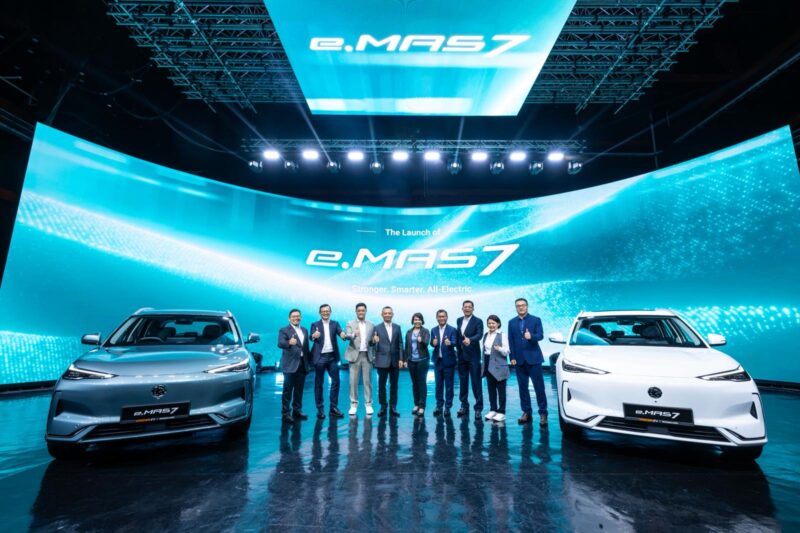
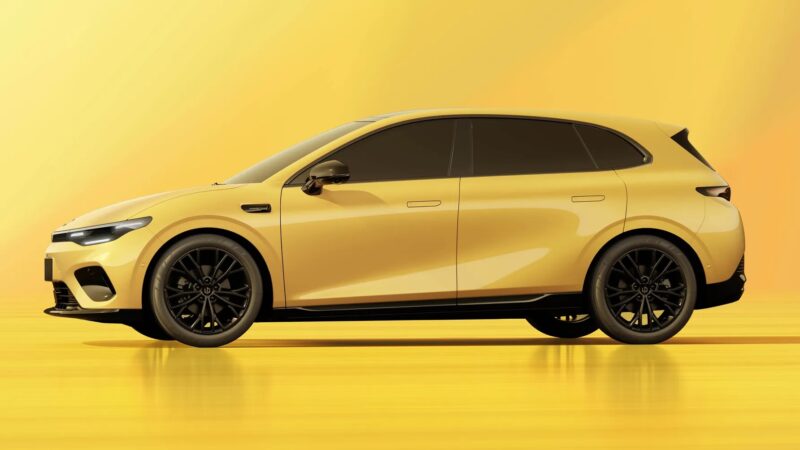
Proton New Energy Technology (Pro-Net) has announced the opening of bookings for the 2025 smart #5 electric SUV model, which will be launched soon.
Interested Malaysians can reserve the smart #5 through the Hello smart app or the official smart Malaysia website, with a reservation fee of RM2,000.
Two variants are available: Premium and Brabus.
The smart #5 Premium features a rear-wheel-drive electric motor delivering 358 hp and 373 Nm of torque, with acceleration from 0 to 100 km/h in just 6.5 seconds.
On the other hand, the smart #5 Brabus comes with a dual-motor setup providing 637 hp and 710 Nm of torque, allowing for acceleration from 0 to 100 km/h in as little as 3.8 seconds.
Equipped with a 100 kWh NMC battery pack, this SUV can travel up to 590 km (WLTP data) on a full charge, or up to 540 km for the Brabus variant.
With an 800V electric architecture, the smart #5 supports AC charging at 22 kW, as well as DC fast charging at 400 kW, enabling the battery to charge from 10% to 80% state of charge in just 15 minutes.
Other features include:
1,530 liters of cargo space and a 72-liter frunk
Dual 13-inch OLED display screens
25.6-inch augmented reality head-up display
Apple CarPlay and Android Auto support
Sennheiser audio system with 20 speakers and Dolby Atmos technology
Nappa leather upholstery
Oak wood trim
1.7 square meter panoramic glass roof
Built-in cooler in the center console storage compartment
The Brabus variant also includes additional features such as Launch Mode, Dinamica microfiber upholstery, red brake calipers, 21-inch Brabus Monoblock Z rims, and sport-tuned suspension.
The smart #5 offers safety features including a 360-degree camera and Smart Pilot Assist, which includes Highway Pilot Assist (HWA) with Stop & Go functionality for semi-automatic driving on highways.
To be frank, the Proton e.MAS 5 is currently one of the most interesting small electric vehicles to consider.
With an estimated selling price ranging from RM60,000 to RM80,000, the e.MAS 5 is highly suitable as a daily use vehicle.
A brief test drive conducted recently revealed some insights into what you can expect from the e.MAS 5.
Here is our concise review:
1. Compact Size, Yet Ample Space
It’s true that the e.MAS 5 appears compact when seen in person, even smaller than the BYD Dolphin.
However, as an electric vehicle, the e.MAS 5 offers adequate storage space, featuring a 70-liter frunk and a 375-liter cargo area (which can expand to 1,320 liters with the rear seats folded down).
Need more space? There are up to 32 storage compartments around the cabin, including a 28-liter drawer beneath the rear seats and a 20-liter space under the center console.
2. Comfortable Driving Position
Upon entering the cabin, I found the seats in the e.MAS 5 to be quite comfortable.
The dimensions of the driver’s seat cushion provide ample support for the thighs, making for a comfortable and less fatiguing drive.
It’s worth noting that the e.MAS 5 only features manual seat adjustments, which I personally don’t mind—fewer electronic systems to depend on.
The steering wheel is adjustable only up and down, with no telescopic adjustment.
For me, the driving position is quite comfortable, although it may not suit those with larger, taller physiques.
3. Acceleration and Braking
The variant I test drove was the e.MAS 5 Premium, equipped with a 114 hp/150 Nm electric motor.
While it isn’t the most powerful EV, it is sufficient for comfortable city driving and remains agile.
The e.MAS 5 can accelerate from 0 to 50 km/h in just 3.9 seconds. However, from my brief experience, it takes a bit longer to reach a top speed of 100 km/h.
What impressed me was the braking system, which can bring the vehicle to a stop from 100 to 0 km/h in just 36.9 meters without making the driver break a sweat.
4. Handling
Next, we were subjected to slalom and figure-eight handling tests.
With a turning radius as tight as 4.95 meters, a multi-link suspension setup, and rear-wheel drive, the e.MAS 5 displayed nimble characteristics and was easy to control.
The steering feel was adequate—not too light and quite precise.
Changing direction suddenly posed no issue; the e.MAS 5’s steering response was reassuring.
I also didn’t have to make frequent steering corrections when navigating through winding roads.
5. How Does It Handle on Highways?
In the next session, I experienced driving the e.MAS 5 on a high-speed track.
My conclusion? The e.MAS 5 is very stable at speeds reaching three digits.
I was pleasantly surprised to find that the suspension tuning of the e.MAS 5 felt superior compared to its larger sibling, the e.MAS 7, with significantly less body roll in corners.
Additionally, the steering was confidently tuned even at high speeds, needing minimal corrections to keep the EV on track.
The only downside I noticed was wind noise at 110 km/h, and you’ll have to be content with a maximum speed limit set at 140 km/h.
The Proton e.MAS 5 is set to launch soon, so what are your thoughts on this affordable Malaysian EV?
Volkswagen Passenger Cars Malaysia (VPCM) and Giti Tire Malaysia recently welcomed the famous world record holder Rainer Zietlow to Malaysia at the Volkswagen Glenmarie showroom (F.A. Wagen).
Driving a Volkswagen ID.Buzz, he is on a quest to set a world record for the “most countries visited with an electric vehicle.”
Since starting his journey, Zietlow has traversed 46 countries in 84 days, covering over 46,400 kilometers.
This is Zietlow’s second visit to Malaysia. Previously, he set a record by driving a Volkswagen Touareg in 2012.
For this journey, Zietlow is using an electric ID.Buzz van equipped with GitiSynergy H2 tires.
With advanced tire tread compounds and low rolling resistance, the GitiSynergy H2 tires are designed to support the heavy battery load, control torque instantly, and maximize travel distance.
They also perform excellently on wet surfaces to ensure stability and safety, especially when navigating through regions frequently affected by rain and slippery roads.
According to Renate Noessler, Managing Director of Volkswagen Passenger Cars Malaysia, Volkswagen embodies both innovation and exploration: “The Volkswagen brand is built on engineering excellence and emotional connection — vehicles that are made to move people, both physically and emotionally.
“The ID. Buzz is a modern revival of that legend, the VW Bus, the minibus a beloved icon. The ID. Buzz is carrying the same spirit, but reimagined for a new generation. Rainer’s mission really highlights its performance, reliability, and spirit of exploration that people all around the globe know and love.”
Shiroo Chia, Deputy GM, International Marketing, Giti Tire Group, emphasized how this journey showcases Giti’s technological strength: “Rainer’s ultra-long-distance journey is powerful real-world proof of GitiSynergy H2’s advanced technology and trusted performance. We’re proud that both the automaker and driver rely on Giti to conquer this 80,000-km, 70-country world tour.”
For Zietlow, the partnership between Volkswagen and Giti Tire has been central to his progress so far. “I am very happy to have Volkswagen and Giti Tire alongside me for this journey – the performance of the ID. Buzz and Giti tyres has met my expectations,” he said.
“The driving experience and overall capabilities are very good, and I am confident that I will be able to complete this zero-emissions world record attempt. I am thoroughly enjoying my second visit to Malaysia, and this will definitely not be my last.”
Pro-Net has recently announced the opening of bookings for the Proton e.MAS 5 electric SUV model.
During a live streaming session, Pro-Net also revealed the estimated selling price starting from RM60,000 to RM80,000.
This positions the e.MAS 5 as one of the most affordable electric vehicles in Malaysia.
With a reservation fee as low as RM99, the first 5,000 customers will also have the opportunity to receive a limited edition Touch ‘n Go NFC card preloaded with RM100 credit, along with an additional rebate of RM500.
The Proton e.MAS 5 is equipped with an 11-in-1 drive unit, complemented by MacPherson strut and multi-link suspension settings, offering a driving range of up to 325 km.
It also comes with features such as innovative storage space, a crystal gear knob, bilingual voice commands (in English and Malay), LED lights, ADAS safety systems, a 360-degree camera, and support for Apple CarPlay and Android Auto.
Bermaz Xpeng, the exclusive distributor of Xpeng vehicles in Malaysia, has announced the arrival of the upgraded G6 SUV for the local market.
Orders for the 2025 facelift model of the Xpeng G6 are now open, with sales prices starting from RM178,888.
Here’s a brief overview of the Xpeng G6 electric SUV:
Exterior
The exterior has undergone several minor changes, including Starlight Wing LED lights complete with turn signals, a repositioned Xpeng logo, and wheel arch trims that match the body color. The rear features a ducktail design that also contributes to road stability.
Interior
Inside, the G6 boasts a refreshed dashboard layout, featuring a 10.25-inch digital cluster screen and a center screen measuring 15.6 inches, supporting Apple CarPlay and Android Auto, as well as the voice command “Hey Xpeng.” Two theme color options are available: Dark Gray and Light Gray.
Additionally, it includes a panoramic glass roof, front seats with massage functions, lumbar support, heating, and ventilation, along with 12-way adjustable rear passenger seats.
Variants
For the Malaysian market, two variants of the Xpeng G6 are offered, detailed as follows:
RWD Long Range
Single electric motor, rear-wheel drive
292 hp, 440 Nm
0-100 km/h in 6.7 seconds
AWD Performance
Dual electric motors, all-wheel drive
480 hp, 660 Nm
0-100 km/h in 4.13 seconds
The maximum speed is capped at 202 km/h.
Six driving modes are available: Eco, Comfort, Sport, Individual, Launch, and Escape.
Battery
Both variants of the G6 come standard with an 80.8 kWh battery pack, allowing a range of up to 525 km according to WLTP data (510 km for the AWD version). The G6 also supports AC charging at 11 kW and fast DC charging up to 451 kW, thanks to the 800V platform that enables battery charging from 10% to 80% in just 12 minutes.
Vehicle-to-load (V2L) functionality is also available.
Safety
Standard safety features on the Xpeng G6 include XPilot Assist Driving, which encompasses adaptive cruise control (ACC), lane centering control (LCC), and automatic lane change (ALC).
Additionally, XPilot Assist Safety features include autonomous emergency braking (AEB), driver status monitoring (DSM), forward collision warning (FCW), rear cross traffic alert (RCTA), and XPilot Assist Parking.
Fully imported from China, the 2025 facelift version of the Xpeng G6 is available in five color options:
Arctic White
Graphite Gray
Midnight Black
Silver Frost
Stellar Purple
A special Black Edition model is also offered, featuring unique attributes such as a black Xpeng logo, 20-inch glossy black alloy wheels, and black brake calipers exclusive to the AWD Performance variant.
The sales prices are as follows:
Xpeng G6 RWD Long Range Pro – RM178,888
Xpeng G6 AWD Performance – RM189,888
Xpeng G6 AWD Black Edition – RM193,888
Xpeng Malaysia offers a five-year manufacturer warranty (or a mileage limit of 120,000 km, whichever comes first), a complimentary five-year service and maintenance package (or 100,000 km), and an eight-year high-voltage battery warranty with a mileage limit of 160,000 km.
Chinese electronics giant Xiaomi has showcased its high-performance electric sedan, the SU7 Ultra for the first time in Akihabara, Japan.
The exhibition event, held from September 26 to 28, also revealed Xiaomi’s future plans.
According to Kyodo News, Xiaomi plans to expand its retail network selling smart devices, home appliances, and mobile phones in several major cities in Japan to strengthen its presence.
Similar to the approach taken in China, Xiaomi will also sell electric vehicles (EVs) through Xiaomi stores, although no specific launch date for the model has been announced.
Currently, Xiaomi has opened two branches in Saitama Prefecture and plans to add three more outlets in Tokyo, including one in Chiba, by the end of this year.
The starting price for the Xiaomi SU7 Ultra is 529,900 yuan (approximately RM314,000).
Additionally, Xiaomi has launched a 1:18 scale die-cast model for the SU7 series, priced at 14,800 yen (approximately RM420) for the standard version and 16,800 yen (approximately RM477) for the SU7 Ultra version.
BYD Malaysia has just launched another electric sedan model for the local market, the BYD Seal 6 2025.
With this launch, Malaysia becomes the first international market to receive the Seal 6 after China.
Here are some key facts you need to know:
1. Platform
The BYD Seal 6 is built on the same e-Platform 3.0 used in the Sealion 7 model. It features a single rear-wheel-drive electric motor setup, with a weight distribution ratio of 48:52, contributing to sportier handling. Additionally, the Seal 6 is equipped with a MacPherson strut suspension setup complemented by a multi-link system at the rear.
2. Dimensions
The Seal 6 is categorized as a C-segment sedan, measuring 4,720 mm in length, 1,860 mm in width, and 1,495 mm in height, with a wheelbase of 2,820 mm. Its cargo capacity is 525 liters, consisting of 460 liters in the rear and a front trunk (frunk) of 65 liters. Moreover, there are up to 24 storage compartments available within the cabin of this sedan.
3. Exterior
In terms of design, the Seal 6 presents a more elegant appearance compared to the sportier Seal model. Its features include LED headlamps, semi-hidden door handles, LED taillights, and rims sized from 17 to 18 inches. The aerodynamic body design contributes to a drag coefficient as low as 0.28 Cd.
4. Interior
The cabin of the Seal 6 incorporates a simpler and more minimalist design compared to the existing Seal model. It includes an 8.8-inch digital cluster display, a 12.8-inch central screen, voice command support in four languages (English, Malay, Mandarin, Cantonese), an automatic climate control system, and CN95 and PM2.5 cabin air filters. The center console also features a 15W wireless device charging slot.
5. Variants
For the local market, there are two main variants: Seal 6 Dynamic and Seal 6 Premium.
Seal 6 Dynamic (RM100,000)
127 hp, 220 Nm
0-100 km/h in 10.9 seconds
Top speed of 160 km/h
56.64 kWh battery pack
Driving range of 485 km (NEDC data)
Six-way adjustable driver’s seat
Manual adjustment for the front passenger seat
Six-speaker audio system
Seal 6 Premium (RM115,800)
215 hp, 330 Nm
0-100 km/h in 7.5 seconds
Top speed of 180 km/h
Eight-way adjustable driver’s seat
Four-way adjustable front passenger seat
Front seat ventilation function
Panoramic roof
Eight-speaker audio system
6. Charging
The BYD Seal 6 comes with a 56.64 kWh battery pack, allowing for a driving range of up to 485 km on a full charge (NEDC data). It also supports 7 kW AC charging and DC fast charging up to 100 kW. Both variants also support vehicle-to-load (V2L) functionality of up to 6 kW.
7. Safety
As standard, the Seal 6 is equipped with six airbags, a seatbelt warning system, tire pressure monitoring system (TPMS), Auto Hold function, a 360-degree surround monitoring system, and hill-start assist.
Active safety features include automatic emergency braking (AEB), forward collision warning (FCW), lane departure warning (LDW), and high beam assist (AHB).
8. Launch Promotions
In conjunction with the Seal 6 launch, BYD Malaysia is offering warranty packages as follows:
Six-year or 150,000 km manufacturer’s warranty
Eight-year or 160,000 km drivetrain warranty
Eight-year or 160,000 km high-voltage battery warranty
Additionally, a V2L adapter and Type-2 charging cable will be offered for free.
Customers purchasing the Dynamic variant will receive a free wall charger valued at RM3,288, while those buying the Premium variant will be given the following options:
A free wall charger worth RM3,288 and an exclusive RM3,000 rebate, or
A Sime Platinum 4+ charging package for 12 months valued at RM5,000 and an exclusive RM1,000 rebate.
The iCaur 03 has just been launched in the Malaysian market, bringing off-road driving capability within a full-time electric SUV package.
The model displayed here is a sibling to the iCaur 03T, but with a different name: the Chery Fulwin X3L.
The ‘L’ at the end of the name signifies that this SUV offers the advantage of a longer dimension.
Compared to the iCaur 03, the Fulwin X3L measures 4,545 mm in length (+139 mm), 1,950 mm in width (+40 mm), 1,815 mm in height (+10 mm), and a wheelbase of 2,783 mm (+68 mm).
More notably, it now comes equipped with the Kunpeng Golden range-extender powertrain, combining a 1.5-liter turbo engine (154 hp) with either a single electric motor or dual electric motors with an AWD system.
The total power output for the single motor variant reaches 248 hp, while the AWD version boasts up to 422 hp and 505 Nm of torque.
Acceleration from 0 to 100 km/h takes just 4.7 seconds.
The X3L offers a zero-emission driving range between 135 km and 215 km, or up to 1,200 km with a full fuel tank.
The layout of the X3L’s cabin is nearly identical to that of the iCaur 03, but it includes several enhancements such as a tank turn function, off-road cruise control, and a low-speed crawling function.
The retail price in the Chinese market starts from 119,900 yuan to 159,900 yuan (RM71,043 to RM94,744).
Proton has recently announced the reintroduction of its brand in the neighboring country with the launch of the electric vehicle model e.MAS 7.
The specifications of the e.MAS 7 for the Singapore market are similar to what is offered in Malaysia.
The e.MAS 7 is powered by a single electric motor producing 215 hp and 320 Nm of torque.
Acceleration from 0 to 100 km/h is achieved in just 6.9 seconds, reaching a top speed of 175 km/h.
The Proton e.MAS 7 is available in two variants: Prime and Premium.
The Prime variant is equipped with a 49.52 kWh LFP battery pack, providing a range of 345 km on a full charge (WLTP data), while the Premium variant is fitted with a 60.22 kWh battery pack that allows for a driving range of 410 km.
This Aegis short-blade battery supports AC charging at 11 kW, as well as DC fast charging at 100 kW (80 kW for the smaller battery capacity), where the battery can be charged from 30% to 80% in just 20 minutes.
There are six color options available: Platinum Silver, Lithium White, Turquoise Green, Slate Grey, Quartz Rose, and Obsidian Black, along with two interior color choices: Indigo Blue and Alabaster White.
The e.MAS 7 is priced starting at S$175,988 (RM576k) for the Prime variant and S$179,988 (RM590k) for the Premium variant, exclusively for the first 99 owners.
Each purchase will include the following packages:
A 10-year battery warranty with no mileage limit
Five years of free roaming data in Malaysia and Singapore
Cross-border roadside assistance between Peninsular Malaysia and Singapore
The collaboration between Mitsubishi and Renault continues with the introduction of the all-new 2026 Eclipse Cross crossover for the European market.
The second generation of this Mitsubishi compact SUV is built on the Renault Scenic E-Tech platform and will only be offered as an electric vehicle (EV).
Here are some key facts about the Eclipse Cross EV:
1. Exterior Design
There are several differences to demonstrate that the Mitsubishi Eclipse Cross is not merely a badge-engineered model.
For instance, the front now features a refreshed Dynamic Shield design, along with updated headlights, LED daytime running lights, and a redesigned bumper grille.
At the rear, the taillight graphics have been revitalized.
2. Dimensions
This C-segment SUV measures 4,470 mm in length with a wheelbase of 2,785 mm.
It offers a cargo capacity ranging from 478 liters to as much as 1,670 liters when the second-row seats are folded down.
Buyers can choose futuristic 19- or 20-inch wheels.
3. Interior Space
The cabin of the Eclipse Cross EV appears to maintain Renault influences, similar to what is found in the Scenic E-Tech.
It features a 12.3-inch digital display complemented by a vertical 12.3-inch infotainment screen, complete with built-in Google support, as well as wireless Apple CarPlay and Android Auto connectivity.
Other features include a 48-color ambient lighting system, Harman Kardon audio system, and a panoramic glass roof with an electrochromic function.
This means owners can adjust the light transparency to reduce glare from sunlight with the press of a single button.
4. Powertrain
The Eclipse Cross EV is based on the same Ampr Medium platform used in the Scenic E-Tech, as well as the Nissan Leaf and Ariya.
This SUV is powered by a front-wheel-drive electric motor capable of generating 215 hp.
It offers four driving modes: Personal, Eco, Comfort, and Sport.
The 87 kWh battery pack provides a range of up to 600 km and supports 22 kW AC charging and fast-charging DC of up to 150 kW.
5. Safety Features
The Eclipse Cross EV includes up to 20 advanced driver-assistance system (ADAS) features supported by ultrasonic sensors and radar.
Among the integrated features are Adaptive Cruise Control (ACC), Around View Monitor (AVM), Blind Spot Monitoring (BSM), Driver Attention Monitoring (DAM), Forward Collision Mitigation System (FCM), Lane Keeping Assistance and Lane Centering Assistance (LKA & LCA), Lane Departure Warning (LDW), Rear Automatic Emergency Braking (Rear AEB), Rear Cross Traffic Alert (RCTA), and the MI-PILOT system.
Production of the 2026 Eclipse Cross EV will take place at the Douai factory in France starting in the fourth quarter of 2025, the same facility used for assembling Renault models (Megane E-Tech, Scenic E-Tech, R5 E-Tech), the Alpine A290, and the Nissan Micra EV.
Leapmotor captured public attention at the 2025 Munich Motor Show by showcasing an all-new electric hatchback model, the B05 which is also known as the Lafa 5.
At first glance, the front end of the B05 resembles that of the eighth-generation Golf.
In terms of dimensions, the B05 measures 4,430 mm in length, 1,880 mm in width, and 1,520 mm in height, with a wheelbase of 2,735 mm—larger compared to the aforementioned ID.3 and Golf models.
According to reports, the B05 is built on the modular LEAP 3.5 platform, shared with the B10 crossover, and offers a rear-wheel drive (RWD) system with a 50:50 weight distribution.
The technical specifications of the B05 are also expected to be similar to those of the B10 crossover.
In the Chinese market, the B10 is offered with a single electric motor producing 177 hp, paired with a 56.2 kWh LFP battery pack, while the more premium variant features a 215 hp electric motor and a 67.1 kWh battery pack.
The range can reach up to 510 km, or even 600 km according to CLTC data.
Notable exterior features include 19-inch alloy wheels, 225/45R19 tires, frameless windows, and door handles integrated into the body.
Interior specifications are expected to be similar to those of the B10, featuring an 8.8-inch digital display and a 14.6-inch infotainment screen in the center.
As of this writing, the presence of the Denza D9 electric minivan is increasingly noticeable on the roads.
If you visit any major shopping center, you’ll see this electric vehicle confidently parked alongside Malaysia’s popular boxy MPV choices, the Alphard and Vellfire.
With similar dimensions, height, and importantly, an impressively luxurious appearance on the road, the writer is convinced it can serve as the best alternative to the Alphard/Vellfire twins—provided you don’t mind spending time at charging stations.
Here are our thoughts after several days of testing the Denza D9.
Appearance
As previously mentioned, the Denza D9 has become a favored choice among Malaysians looking for a spacious and comfortable commuter vehicle.
Its significant advantages include larger dimensions compared to its competitors and a longer wheelbase, complemented by a premium overall look.
There’s no need for aggressive body lines or a fierce front end.
With its understated elegance, the Denza D9 stands out on the road, featuring a chrome grille, stylish 18-inch multi-spoke wheels, and slim LED daytime running lights that extend downward.
The rear design is simpler, although the graphics on the main light unit can be somewhat busy.
Driver’s Cockpit
For drivers, the Denza D9 is equipped with features that facilitate a seamless driving experience.
The front seats come with eight-way adjustments, lumbar support, ventilation, adjustable headrests, and crucially, a cushion that supports the thighs—especially important for long-distance driving.
Physical controls remain available despite the Denza D9 being an EV.
The central console hosts several important function switches, such as those for opening side sliding doors, selecting driving modes, and accessing the rear passenger fridge.
The gear knob is large and premium-feeling, though the placement of the P and Start/Stop buttons could be improved, leading to occasional confusion while trying to shift gears.
Climate control relies on a 15.6-inch central screen.
Overall, I have no complaints about this setup—all essential functions are easily accessible, ensuring maximum comfort for rear passengers.
Space for the Boss
Speaking of rear passengers, or rather the boss, they will undoubtedly appreciate the features offered in the second-row seating. Upon opening the door, you are greeted with captain’s chairs that boast rare amenities, including:
Heating and ventilation functions
A 10-point massage feature
Head and footrests
Zero-gravity settings for ultimate relaxation
All these functions can be activated via control screens for both seats.
Additionally, the left-side rear passenger can maximize space by activating a “boss switch.”
Working from the cabin is also made easy with folding tables and storage for cool beverages, with temperatures adjustable from -6 to 50 degrees Celsius.
Thanks to premium Nappa upholstery, the travel experience is made even more comfortable, complemented by excellent noise and vibration isolation.
For the first time, I spent more time in the second row of the Denza D9 than in other test models, simply to enjoy its luxurious features.
Driving Experience
Despite its larger dimensions, I had no trouble handling this premium MPV.
It offers excellent visibility, responsive steering, and is aided by a surround camera system that provides clear, sharp images, thus ensuring the Denza D9 remains free of scratches.
As discussed in previous brief test drive articles, the Denza D9 offers settings for the drive system, steering, brake system, and MacPherson/Multi-link suspension configurations.
Notable features include adaptive Disus-C suspension settings for driving control and comfort tailored to your needs.
Most of the time, I preferred using Sport mode to ensure the comfort that rear passengers require, as body roll is more pronounced in Comfort mode, which could lead to discomfort.
It might be better to use Comfort mode on high-quality paved roads.
Despite being equipped with dual electric motors (outputting 369 hp and 470 Nm with acceleration times as quick as 6.9 seconds), I didn’t feel the need to drive the Denza D9 aggressively; a gentle throttle response sufficed for reaching desired speeds—all in the name of VIP passenger comfort.
Suitable for Long Journeys
The Denza D9 comes in two variants.
The version I tested is the AWD model, which has a moderate range of about 480 km (WLTP data).
If power isn’t a priority, you can opt for the FWD variant, producing 309 hp and 360 Nm, with a range of 520 km.
Fast charging is also a non-issue, as the Denza D9 supports DC charging up to 166 kW.
With fast charging stations available along major routes, long-distance driving in the Denza D9 is no longer a significant concern, especially when tasked with transporting VIPs to their destinations.
Price
Another advantage of the Denza D9 is its more affordable price.
Compared to competing models, the Denza D9 is available from as low as RM259,000, or slightly more for the Premium AWD variant, priced at RM309,000.
So, are you still considering purchasing a premium MPV from Japanese brands?
Denza D9 Specifications
Powertrain: Dual electric motors
Power: 369 hp, 470 Nm
Drivetrain: All-wheel drive (AWD)
Acceleration: 6.9 seconds (0-100 km/h)
Battery: LFP Blade, 103.36 kWh capacity
AC Charging: 11 kW
DC Charging: 166 kW
Range: 580 km (NEDC data)
Suspension: MacPherson/Multi-link, adaptive DiSus-C system
Following its debut at the Malaysia Autoshow 2025, the electric off-road SUV iCaur 03 has officially launched for the local market.
For your information, the iCaur brand is a collaboration between Chery and Zhimi Technology, a subsidiary of Xiaomi.
As previously reported, buyers can obtain the iCaur 03 in either the 2WD variant or the all-wheel-drive iWD variant.
The SUV measures 4,406mm in length, 1,910mm in width, and 1,715mm in height, with a wheelbase of 2,715mm. It boasts an approach angle of 28° and a departure angle of 32°.
The cargo space is 450 liters and can expand to 1,238 liters when the second-row seats are folded. There is also external storage with a capacity of 40 liters.
Initially, the iCaur 03 will be available in the 2WD variant, featuring a single electric motor producing 181 hp and 220 Nm of torque, paired with a 65.7 kWh battery that offers a range of 426 km.
Additionally, there is an all-wheel-drive iWD variant that delivers 275 hp and 385 Nm of torque, achieving a range of 418 km, thanks to a 69.8 kWh battery.
The chassis of the iCaur 03 is made from an aluminum framework, which provides a weight reduction of up to 30%, a rigidity increase of 30%, and corrosion resistance for up to 30 years.
The suspension system consists of MacPherson struts at the front, followed by an H-Arm Multi-link setup at the rear.
Other features available on the iCaur 03 include:
AC charging capacity of 3.3 kW via a 3-pin plug, 6.6 kW AC charging (10 hours), and 80 kW DC fast charging (30 minutes)
V2L capability at 3.3 kW
A 9.2-inch cluster display and a 15.6-inch central display
Heating, ventilation, and massage functions for the front seats
Ventilation function for the rear seats
50 W wireless charging slot for smart devices
Panoramic glass roof
Electric door switches
iROAD system with 12 driving modes (for the iWD variant)
8 speakers (12 Infinity speakers for the iWD variant)
ADAS Level 2 safety features include following functions:
Autonomous Emergency Braking (AEB)
Driver Attention Alert (DAI)
Forward Collision Warning (FCW)
Emergency Lane Keeping (ELK)
Lane Departure Warning (LDW)
Rear Collision Warning (RCW)
Lane Departure Prevention (LDP)
Rear Cross Traffic Alert (RCTA)
Adaptive Cruise Control (ACC)
Traffic Jam Assist (TJA)
Blind Spot Detection (BSD)
Door Opening Warning (DOW)
For the Malaysian market, the iCaur 03 is available in five color options: silver, gray, white, black, and aurora green.
The starting retail price is RM119,800 for the 2WD version and RM129,800 for the iWD version.
There is also a Black Phantom edition that features an exclusive body kit, matte black finishes, a roof rack, and side steps, available at an additional cost of RM20,000.
iCaur Malaysia also offers the iCARE Insurance Program, developed in collaboration with Allianz General Insurance, Berjaya Sompo, AIG, Etiqa Takaful, Zurich, and Zurich Takaful, which covers protection for wall chargers and portable charging cables, along with unlimited towing services.
Please note that the iCaur 03 will be offered as a completely built-up (CBU) model, while the CKD assembly program is expected to begin in January 2026.
As BMW begins to reduce the size of its front grilles, its competitor Mercedes-Benz takes an opposite approach with the new GLC with EQ Technology.
This completely new GLC is set to go on sale in the first half of 2026, replacing the EQC model.
Here are some key facts about the GLC with EQ Technology:
1. Dimensions
The electric GLC measures 4,845 mm in length, 1,913 mm in width, and 1,644 mm in height, with a wheelbase of 2,972 mm.
This means it is longer, wider, and offers a more spacious cabin compared to the petrol-powered GLC.
It features a cargo space of 570 liters to 1,739 liters, along with a frunk (front trunk) of 128 liters.
2. Chassis
The electric GLC can tow loads weighing up to 2,400 kg when equipped with a trailer hitch.
Among the new features is the option to pair it with the Airmatic air suspension borrowed from the S-Class, complete with a rear-axle steering system.
This intelligent suspension system will communicate with traffic infrastructure and Google Maps data to determine optimal settings, including the SUV’s height based on current road conditions.
3. Performance & Charging
Initially, Mercedes will offer the GLC 400 4MATIC with a dual electric motor setup producing 483 hp and paired with a 94 kWh lithium-ion battery pack.
With a full charge, it can achieve a range of 713 km according to the WLTP cycle.
Supporting fast DC charging of up to 330 kW, this GLC can add 300 km of range in just 10 minutes of charging.
4. Exterior
The GLC with EQ Technology retains a shape similar to the existing GLC, but can be distinguished by its unique front and rear designs.
A standout feature of this electric GLC is its larger front grille, adorned with 942 illuminated points, including the central logo.
The three-pointed star theme is also present in the design of both the front and rear headlights.
5. Interior
Inside the cabin, the Mercedes GLC features upholstery certified by The Vegan Society, alongside premium options like Soft Torino leather and Nappa leather.
The MBUX Hyperscreen has been updated with a 39.1-inch screen that integrates a digital cluster display, a central infotainment screen, and a screen for the front passenger.
The center console includes a wireless charging slot for smart devices and two cup holders.
Rest assured, Mercedes has maintained the presence of physical function buttons, especially on the center console, door panels, and steering wheel.
Introducing the first model built on BMW’s latest Neue Klasse platform, the 2026 BMW iX3
The exterior design of this iX3 closely resembles the Vision Neue Klasse X concept model that was showcased last year.
This new design approach will also be applied to all future BMW models, including ICE models.
Here are some key facts about the iX3 2026:
1. Dimensions
The BMW iX3 measures 4,783 mm in length, 1,895 mm in width, and 1,636 mm in height, with a wheelbase of 2,898 mm.
Compared to the previous iX3, the new model is larger and has a longer wheelbase.
2. Electric Platform
As mentioned, the iX3 2026 is built on the Neue Klasse platform, which is distinct from the existing BMW X3.
The Neue Klasse platform is a fully electric architecture that supports an 800-volt system, providing faster charging benefits.
It also features the sixth-generation eDrive system, which integrates newly developed electric motors with high-density cylindrical battery cells.
3. Performance
Initially, the BMW iX3 will be available in the 50 xDrive variant, equipped with two electric motors and an all-wheel-drive system delivering 463 hp and 645 Nm of torque.
The 0-100 km/h acceleration is achieved in just 4.7 seconds, reaching a top speed of 209 km/h.
4. Battery
There are two battery size options available, with the larger capacity (108.7 kWh) capable of offering a range of up to 805 km (WLTP data).
With DC fast charging at 400 kW, the battery can be charged from 10% to 80% in just 21 minutes, adding 370 km of range in 10 minutes.
The 2026 BMW iX3 supports bidirectional charging and is equipped with an NACS port.
5. Exterior Design
The appearance of the iX3 is inspired by classic BMW models like the 2002, infused with more modern elements.
In addition to the smaller, upright grille, the iX3 retains the Hofmeister kink design on the sides.
The rear lights have a more traditional shape compared to the previous iX3 model.
Overall, the BMW iX3 boasts a drag coefficient as low as 0.24, compared to 0.29 on the earlier iX3 model.
6. Cabin Space
A significant change in the iX3 is the Panoramic iDrive system, which gives the dashboard a more traditional and tidy layout.
No longer featuring a curved screen, it now has a central display of 17.9 inches and a wide screen located at the dashboard’s end.
There is also a four-spoke steering wheel with touch-based function buttons, complemented by several physical control buttons on the center console.
Other features include a Harman Kardon audio system, a panoramic glass roof, three-zone climate control, and BMW HypersonX sound effects.
The cargo space is 520 liters and can expand to 1,750 liters, along with an additional frunk space of 57 liters.
7. Four “superbrains” to control everything
The BMW iX3 is equipped with four high-performance computer units designed to manage various functions within the iX3.
One of the units, named Heart of Joy, is responsible for controlling driving dynamics, including the drive system, brakes, energy recovery, and steering, ensuring an exhilarating driving experience.
Another unit is designed for autonomous driving and parking functions, while the remaining units are dedicated to the infotainment system and essential vehicle functions.
Pro-Net recently held a preview session for another electric SUV model set to be launched soon, the 2025 smart #5.
This model is built on the PMA2+ platform, which is also used in Geely’s models such as the Zeekr 7X.
Here are five things you need to know about the smart #5.
Dimensions
Positioned as a D-segment SUV, the smart #5 features significantly larger dimensions compared to its siblings, the smart #1 and #3.
The SUV measures 4,705 mm in length, 1,920 mm in width, 1,705 mm in height, with a wheelbase of 2,900 mm and a ground clearance of 197 mm.
True to its nature as a rugged SUV, the smart #5 can traverse water up to 500 mm deep.
Exterior
There are two units of the smart #5 were showcased.
The Brabus version displays a sportier look with body kit, rear spoiler, two-tone color scheme, and 21-inch monoblock alloy wheels wrapped in Continental EcoContact 7 tires.
Also displayed was the #5 Premium without the Brabus body kit, featuring 20-inch aerodynamic wheels.
Overall, the smart #5 presents a boxy body design, which is a stark contrast to the #1 and #3.
Interior
Inside the cabin, the smart #5 is equipped with a 10.3-inch cluster display, dual 13-inch OLED screens, Apple CarPlay & Android Auto connectivity, a 25.6-inch head-up display with augmented reality (AR), ambient lighting with 256 color options, and wireless charging slots.
The second-row passengers enjoy features like the ‘Boss’ function, ‘Comfort Mode’ buttons, power-adjustable seating, and heating functionality.
In terms of practicality, this model offers a cargo space of 1,530 liters, with an additional 72 liters in the front trunk.
The base variant comes with a 9-speaker audio system, while the two higher variants feature a Sennheiser audio system with 20 speakers.
The Brabus variant is equipped with exclusive features such as an Alcantara steering wheel, Dinamica trim on the seats and doors, and simulated engine sound.
Variants
There are three variants of the smart #5:
Pro
Single electric motor with rear-wheel drive (RWD)
Power: 335 hp/373 Nm
Acceleration 0-100 km/h in 6.9 seconds
Top speed: 200 km/j
Battery pack: 76 kWh LFP
Range: 465 km (WLTP)
11 kW AC
Premium
Power: 358 hp/373 Nm
Acceleration 0-100 km/h in 6.5 seconds
Top speed: 200 km/j
Battery pack: 100 kWh NMC
Range: 590 km (WLTP)
22 kW AC
Brabus
Dual motor electric configuration with all-wheel drive (AWD)
Power: 637 hp/710 Nm
Acceleration 0-100 km/h in 3.8 seconds
Top speed: 210 km/h
Range: 540 km (WLTP)
Sport suspension
Standard across all variants, the smart #5 comes with three drive modes: Eco, Comfort, and Sport.
The smart #5 Brabus also includes additional driving modes such as Snow, Sand, Mud, Rock, Adaptive, and Brabus.
With a 800V electrical architecture, the smart #5 supports rapid charging to go from 10-80% State of Charge in just 15 minutes.
Safety
Safety features include six airbags, as well as ADAS technology assisted by 12 ultrasonic radars, 5 mm-wave radars, 4 surround cameras, 2 HD cameras, and one cockpit camera.
This allows the #5 to offer functions such as Autonomous Emergency Braking (AEB), Lane Keeping Assistance (LKA, ELKA, LDW), Traffic Jam Assistance (TJA), Highway Assistance (HWA, ALCA), Forward Collision Warning (FCMS), Traffic Crossing Warning (FCTA, RCTA), Blind Spot Detection, and Full Autonomous Parking (FAP).
After making its debut at the 2025 Malaysia Autoshow, Zeekr Malaysia has officially launched its latest model, the 2025 Zeekr 7X.
Three main variants are available:
RWD Standard (RM179,800)
Single electric motor, rear-wheel drive
Power: 421 PS / 440 Nm
Acceleration: 0-100 km/h in 6 seconds
Battery pack: LFP 75 kWh
Driving range: 480 km (WLTP data)
RWD Long Range (RM190,800)
Same drivetrain specifications as RWD Standard
Battery pack: 100 kWh
Driving range: 615 km
AWD Performance (RM226,800)
Dual electric motor setup, all-wheel drive
Power: 646 PS / 710 Nm
Battery pack: LFP 100 kWh
Driving range: 543 km
In terms of dimensions, the Zeekr 7X measures 4,787 mm in length, 1,930 mm in width, 1,650 mm in height, and has a wheelbase of 2,900 mm.
This means that in Malaysia, the Zeekr 7X competes with models such as the BYD Sealion 7, Tesla Model Y, and Xpeng G6.
The Zeekr SUV features a double wishbone setup at the front, followed by a multi-link setup at the rear.
Regarding charging, the Zeekr 7X supports AC charging at 22 kW, as well as DC fast charging up to 450 kW (with the exception of the two higher variants, which support 420 kW), allowing for a 10-80% charge in as little as 10.5 minutes (16 minutes for the two higher variants).
Standard equipment includes 19-inch wheels, LED lights with daytime running lights, while the cabin is equipped with a 13.02-inch cluster screen, a 16-inch central screen, Apple CarPlay/Android Auto support, 10 speakers, and tri-zone climate control.
The mid-range variant adds features such as electric steering adjustment, massage and ventilation functions for the front seats, a 36.21-inch heads-up display, Zeekr Sound Pro audio system, and wireless phone charging.
The Zeekr 7X AWD Performance model comes with 20-inch wheels, Michelin Pilot Sport EV tires, four-piston brake calipers, an air suspension system, a glowing Zeekr logo at the front with Zeekr Stargate, powered door openings, Nappa leather upholstery, and electrically operated rear curtains.
Standard safety features include seven airbags, Autonomous Emergency Braking (AEB), front and rear Traffic Crossing Alerts (FCTA & RCTA), Automated Parking Assistance (APA), Forward Collision Warning (FCW), Automatic Lane Change Assistance (ALC), Adaptive Cruise Control (ACC), a 360-degree surround camera, and Sentinel mode.
Five colors are available: Crystal White, Onyx Black, Tech Grey, Forest Green, and a two-tone Blue/Silver. The AWD Performance variant also offers an option to upgrade to 21-inch wheels.
Vehicles with a longer wheelbase, especially sedans, have become a popular choice in mainland China.
It’s not surprising that even a compact car like the Mercedes-Benz A-Class has a long-wheelbase variant there.
Tesla has adopted a similar approach, introducing a new model, the Model Y L, which features a three-row seating configuration.
True to the addition of the letter “L”, the Model Y L is 179 mm longer and 44 mm taller than the standard model.
These changes result in the new Tesla Model Y L measuring 4,976 mm in length, 2,129 mm in width, and 1,668 mm in height.
The wheelbase also increased by 149 mm, from 2,891 mm to 3,040 mm.
These dimensional enhancements affect several aspects, including longer rear passenger doors and a redesigned mirror housing.
Additionally, the Model Y L comes with unique 19-inch rims and a more pronounced rear spoiler.
Inside the cabin, the original center screen has been replaced with a 16-inch display, and features include temperature controls for the second-row captain’s chairs, heated seats for the third row, a panoramic glass roof, an 18-speaker audio system, and an 8-inch rear screen.
When the second and third-row seats are folded down, it provides a cargo space of 2,539 liters, which is 401 liters larger than the standard Model Y.
Equipped with dual electric motors, the Tesla Model Y L can accelerate from 0 to 100 km/h in just 4.5 seconds, 0.2 seconds slower than the existing offerings.
This is attributed to the longer dimensions, which add 96 kg to the weight, bringing the total to 2,088 kg.
To accommodate the increased weight, the suspension has been upgraded for more precise and smooth driving control.
The NMC 82 kWh battery pack allows for a driving range of 751 km on a full charge.
In the Chinese market, the Tesla Model Y L is priced starting at RMB 339,000 (approximately RM 235,000).
In a separate development, Tesla China has reintroduced the physical turn signal stalk for all variants of the Model 3 Highland.
Owners of existing Model 3 Highland vehicles can obtain the stalk package through the online store for RMB 2,499 (approximately RM 1,470).
Installation of this accessory can only be done at Tesla Service Centers, where technicians will use special tools to install the component.
Such accessories have already been offered by third parties, such as Enhance Auto through their S3XY Stalks product, which provides a solution for owners seeking traditional driving controls in their electric vehicles.
Yadea Malaysia has announced the arrival of another electric scooter for the local market, the 2025 Yadea RS20 coinciding with the launch of Mforce SmartShop in Banting recently.
The RS20 electric scooter is priced from RM4,998 (excluding road tax and insurance) and qualifies for the MARiiCas rebate.
The Yadea RS20 comes in three color options: Khaki Grey, Roman Grey, and Grey.
This scooter is powered by single electric motor generates 3.29 hp with a maximum torque of 107 Nm, allowing for a climbing capability on steep inclines of up to 13 degrees and a top speed of 51 km/h.
Its Graphene 72V 22Ah battery supports a riding range of up to 105 km on a full charge and can be fully recharged from 0 to 100 percent in eight hours.
The scooter features a suspension system with a telescopic fork and dual shock absorbers at the rear, while the braking system combines disc and drum brakes, enhanced by a CBS system for more stable stopping.
Other features include an LED lighting system, 12-inch rims, a digital meter display, a USB Type-A charging port, a reverse gear function, two riding modes (Sport/Eco), front and under-seat storage compartments, a rear cargo rack, and three locking methods (mechanical, remote control, and the Yadea app).
The total weight of the electric scooter is just 114 kg (with the battery), and the seat height is approximately 765 mm.
Lotus Cars Malaysia has announced an update to the hyper-GT offering, the Lotus Emeya, which now features a new naming structure aligned with Lotus’s global strategy.
For the 2025 model year, the Lotus Emeya is available in five main variants: Emeya 600, Emeya 600 GT SE, Emeya 600 Sport SE, Emeya 900 Sport, and Emeya 900 Sport Carbon.
Standard across the range, the Lotus Emeya comes equipped with a dual electric motor setup and an all-wheel-drive (AWD) system.
The Emeya 600 variant generates 603 hp and 710 Nm of torque, while the Emeya 900 variant boasts an impressive output of 905 hp and 985 Nm.
The 102 kWh NMC battery pack offers a driving range of up to 610 km, or 580 km for the 900 variant.
In terms of features, the Emeya 600 is fitted with 20-inch wheels, whereas the Emeya 600 GT SE comes with 21-inch alloy wheels, six-piston brake calipers, a panoramic glass roof, and a hands-free tailgate.
The Emeya 600 Sport SE includes the Lotus handling package, an active rear spoiler, an active rear diffuser, and an active front air dam.
Moving on to the Emeya 900 Sport variant, it is equipped with an active rear spoiler, while the Emeya 900 Sport Carbon variant features additional enhancements such as an active front air dam, an active rear diffuser, and an exterior carbon package.
The Emeya’s cabin is equipped with a KEF Premium audio system with 15 speakers, a 29-inch HUD display, four-zone climate control, and LotusWear Performance fabric upholstery.
Higher variants additionally offer ambient lighting, ventilated seating with massage functions, and soft-close doors.
The sale prices are as follows:
Lotus Emeya 600 – RM459,000
Lotus Emeya 600 GT SE – RM519,000
Lotus Emeya 600 Sport SE – RM599,000
Lotus Emeya 900 Sport – RM699,000
Lotus Emeya 900 Sport Carbon – RM729,000
Orders for the 2025 Emeya model are now open at showrooms in Glenmarie, Pavilion Damansara Heights, and Penang.
The first batch of deliveries is expected to begin in September 2025.
Malaysia’s Leading Automotive News | ENGEAR ENGLISH