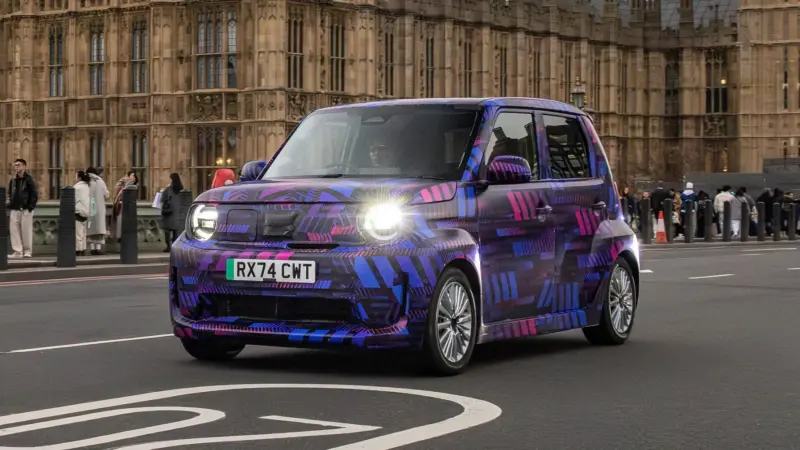
Introducing the second electric SUV that Proton will be launching in the coming months, the Proton e.MAS 5.
This model was first showcased at the Malaysia Autoshow 2025 in May.
Upon its launch, the Proton e.MAS 5 is expected to challenge competitors in the B-segment SUV market, such as the BYD Atto 2, and another electric SUV from Perodua.
Here are five things you need to know:
1. Dimensions
As a B-segment SUV, the e.MAS 5 measures 4,135 mm in length, 1,805 mm in width, 1,580 mm in height, and has a wheelbase of 2,650 mm.
Its ground clearance is 160 mm.
The cargo space offers 375 liters and can expand up to 1,320 liters with the second-row seats folded down.
There is also a front cargo space of 70 liters available.
2. Variants
Two main variants will be offered to consumers.
The e.MAS 5 Premium variant is equipped with a 40.16 kWh LFP CATL battery pack, providing a range of 325 km on a full charge (WLTP data).
The battery supports AC charging at 6.6 kW, and fast DC charging at 71 kW, enabling a charge from 30% to 80% in just 21 minutes.
There is also a Prime variant with a 30.12 kWh battery and a range of 250 km (WLTP data) or 310 km according to CLTC data.
3. Performance
The Proton e.MAS 5 is equipped with an 11-in-1 drive unit powering the rear wheels (RWD).
It produces a maximum power output of 114 hp and a torque of 150 Nm.
Acceleration from 0 to 50 km/h takes just 3.9 seconds.
The driving experience is enhanced by a MacPherson strut front suspension setup, followed by a multi-link setup at the rear, as well as an electric steering system.
4. Features
On the exterior, the Proton e.MAS 5 comes with LED lighting units, aerodynamic 16-inch rims, a dual-tone color scheme with a black roof, and neatly integrated door handles.
Interior features of the e.MAS 5 include a two-spoke steering wheel (with a two-tone finish), a central gear selector, an 8.8-inch digital display, and seats upholstered in faux leather.
The main screen measures 14.6 inches and includes the ATLAS Auto operating system, Apple CarPlay/Android Auto support, a mapping system with built-in charging station locations, and voice command support in both Malay and English.
5. Safety
The Proton e.MAS 5 is equipped with six airbags, ABS, Electronic Stability Control (ESC), a 360-degree camera, rear parking sensors, and the following Advanced Driver Assistance Systems (ADAS):
Adaptive Cruise Control (ACC)
Autonomous Emergency Braking (AEB)
Forward Collision Warning (FCW)
Lane Departure Warning (LDW)
Traffic Sign Recognition (TSR)
Front Vehicle Departure Warning (FVD)
Blind Spot Detection (BSD)
Lane Change Assist (LCA)
Rear Cross Traffic Alert (RCTA)
Rear Collision Warning (RCW)
Door Open Warning (DOW)
At this time, Proton has not yet disclosed the actual selling price of the e.MAS 5.
A BYD transport ship, the Zhengzhou, arrived at Port Klang on August 5.
The roll-on/roll-off (RORO) vessel has the capacity to carry up to 7,000 vehicles and has set sail on its inaugural journey to destinations in Southeast Asia, including the Philippines, Indonesia, and Singapore.
After Port Klang, the ship will continue to its final stop in Thailand before returning to China.
The BYD Zhengzhou is the seventh ship in BYD’s fleet of specialized transport vessels, demonstrating the company’s strong supply chain and logistics capabilities as it seeks to meet the growing demand for electric vehicles (EVs).
Completed vehicles will be driven on and off the ship, offering time and cost benefits compared to traditional container shipments.
By operating its own fleet, BYD has greater control over critical aspects of the EV supply chain.
Eagle Zhao, Managing Director of BYD Malaysia, stated, “This transport ship plays a crucial role in realizing BYD’s global aspirations and strengthening our relationship with Malaysia, which we see as a key market for our growth in the Asia-Pacific region.”
“The BYD Zhengzhou enables faster and more reliable deliveries directly to our customers here,” he added.
Jeffrey Gan, Managing Director of Sime Motors for Southeast Asia, said, “With the strengthening of the regional supply chain through the BYD transport ship, we can ensure shorter delivery times, thereby enhancing our ability to provide better customer satisfaction.”
BYD Malaysia and Sime Motors continue to strengthen their cooperation to deliver EVs to Malaysians more quickly and reliably.
This initiative is supported by over 35 BYD sales centers across the country, with a target of reaching 60 sales centers by the end of 2026.
Proton New Energy Technology (Pro-NET) has announced the Jelajah MISI 5 tour across the country, which will take place from August to October 2025.
The MISI 5 tour aims to introduce the second EV model from Proton, the e.MAS 5, which is set to be launched soon.
Below is the schedule of locations starting from August 9 to August 17 in the Klang Valley:
August 9: SG Car (Shah Alam), Wheelcorp (Setia Alam), EON (Glenmarie), and AJG (Puchong)
August 10: AJG (Sri Kembangan), Jawira (Balakong), ProAuto (Kajang), and Jewel Sonic (Putrajaya)
August 16: Able Mobility (Cheras), MBF EV (Jalan Tun Razak), Cahaya (Segambut), and Igreen (Setapak)
August 17: Pantai Bharu (Rawang), EON (Damansara), Regal Motor (Petaling Jaya), and Peringgit (Jalan Klang Lama)
Following this, the MISI 5 tour will head north from August 21 to 25, followed by the East Coast (Pahang, Terengganu, Kelantan) from September 4 to 8, Johor from September 13 to 15, Negeri Sembilan and Melaka from September 20 to 21, Sarawak from September 25 to 28, and finally Sabah from October 3 to 5.
Through this tour, the public will have the opportunity to get a closer look at the e.MAS 5, as well as learn how this second Proton EV can be adapted to the lifestyle of the Malaysian people.
Introducing the smallest electric car produced by Honda: the Honda N-One e:.
With dimensions that place it within the kei car class, it replaces the Honda e, which ceased production in January of last year.
Here are some key facts you should know:
1. Honda’s second electric kei car
This is not the first ultra-compact electric car, as Honda previously launched the commercial EV N-Van e: last year.
The specifications of the N-One e: are expected to mimic those of the N-Van e:, featuring a single electric motor that drives the front wheels (64 hp).
2. Driving Range
Equipped with a 29.6 kWh battery pack, the N-Van e: can travel up to 245 km; however, when paired with the N-One e:, it has an estimated range of over 270 km based on WLTC data.
The N-Van e: also supports DC fast charging at 50 kW, allowing the battery to charge in 30 minutes or 4.5 hours using AC charging at 6.0 kW.
3. Nostalgic features from the 1960s
Honda employs the e:Daily Partner approach for the N-One e, offering an attractive exterior design along with a spacious cabin.
The N-One e: also provides the benefit of easy handling—evoking features from Honda’s classic kei car, the N360, of the 1960s and 70s.
4. Cabin space
The cabin of the N-One e: follows the Man Maximum Machine Minimum philosophy, showcasing a minimalist design.
It comes with an LCD cluster screen, a nine-inch central display, USB charging ports, a PRND selection button, and central climate controls, along with a two-spoke steering wheel similar to that of the N-Van e:.
Practicality is enhanced by a small tray on the dashboard, cup holders in the driver’s area and center console, as well as foldable rear seats to suit various needs.
5. Variations
Two variants are offered for the Japanese market: the e: L, which is more fully equipped, and the base e: G.
Both variants come standard with front and rear LED lights and an ADAS system (complete with cameras).
The base e: G features 14-inch steel rims with hub covers.
Its cabin appears more minimalist, as it includes only a simple audio system with Bluetooth support.
The e: L variant, on the other hand, is equipped with sporty 14-inch six-spoke aluminum rims and a cabin that includes the infotainment screen mentioned in point four.
6. Honda Access Accessories
As always, no Honda car offering would be complete without a wide array of accessories.
Honda Access provides a V2L adapter kit that offers up to 1,500W of power for emergency use.
A charging indication light module is also available, allowing owners to see the battery charge level from outside, even when the car is locked.
The Premium Style package adds decorative racing stripes to the hood, tailgate, sides of the car, and front grille.
7. Sales
Honda Japan will begin sales of the N-One e: starting this September.
Interestingly, this kei car will also make its official debut in the European market at the IAA event in Munich during the same month.
Welcome the newest addition to the BYD electric vehicle family, the BYD Atto 2 2025, which has just been launched for the Malaysian market.
Here are some key facts you need to know:
1. Dimensions
The Atto 2 measures 4,310 mm in length, 1,830 mm in width, and 1,675 mm in height, with a wheelbase of 2,620 mm.
Compared to the Dolphin, the Atto 2 is significantly larger in dimensions but has a wheelbase that is 80 mm shorter.
When compared to the Atto 3, the Atto 2 is 145 mm shorter and has a wheelbase that is 100 mm less, but it is slightly taller (+60 mm).
2. Powertrain
The Atto 2 is powered by a single front-wheel-drive electric motor producing 174 hp and 290 Nm of torque.
It accelerates from 0 to 100 km/h in just 7.9 seconds.
3. Range
With a battery pack capacity of 51.13 kWh, the Atto 2 can travel up to 410 km on a full charge (NEDC data).
It supports AC charging at 7 kW and DC fast charging at 82 kW, allowing for a charge from 30-80% in just 30 minutes.
4. Features
On the exterior, the Atto 2 features LED headlights and taillights, 17-inch alloy wheels, a sporty front bumper, a rear roof spoiler, and a two-tone color option.
Inside the cabin, it includes an 8.8-inch digital cluster screen, a 12.8-inch rotating central screen, wireless smartphone charging, and adjustable ventilated front seats.
The cargo space can reach up to 1,320 liters when the second-row seats are folded down.
Safety features include six airbags, a 360-degree surround monitoring system, and advanced driver assistance systems (ADAS).
5. Price
For the Malaysian market, the BYD Atto 2 will be available in three colors: Ski White, Breeze Green, and Harbour Grey.
The price starts at RM100,000. Each purchase comes with a six-year manufacturer’s warranty or a mileage limit of 160,000 km, as well as an 8-year or 160,000 km warranty on the high-voltage battery, and an 8-year or 150,000 km warranty on the drive unit.
For the first 800 customers, BYD Malaysia is offering a hassle-free ownership package worth RM13,500 with no monthly installments for the first six months through the Sime Motors panel bank financing package.
Additionally, there are various charging package options available:
A free wall charger for landed homeowners.
The Sime Platinum 4+ by Power Up for high-rise residents, which includes a 12-month subscription, 4 mobile charges per month, 2 car washes per month, and 2 free roadside assistance services per year.
Are you still pondering which electric vehicle (EV) is suitable for everyday use?
Within the price range of RM150,000, we are presented with various models such as the BYD Atto 3, Proton e.MAS7, and the latest MG S5 EV.
Officially launched in May 2025, the MG S5 EV is offered in three main variants, with the base model starting at RM115,900 and the premium version priced at RM135,900.
Engear TV was personally invited by MG Malaysia for a test drive session to experience the driving experience of this EV from Damansara to Kuantan, Pahang.
Can it prove to be a worthwhile option in its segment? Read our brief review below:
Design
Starting with the exterior design, the MG S5 adopts a safer approach, avoiding overly aggressive body lines.
The trend of split headlights at the front remains, complemented by slim LED lights stretching across the rear.
There are two rim size options available: 17 inches and 18 inches, with the latter available on the Lux Long Range variant that we tested.
As you can see, the MG S5 is a compact electric SUV, measuring 4,476 mm long, 1,849 mm wide, 1,621 mm tall, with a wheelbase of 2,730 mm.
Compared to rivals, the MG S5 is slightly smaller than the Proton e.MAS7 but boasts a wheelbase that is 10 mm longer than that of the BYD Atto 3.
The cargo space is rated at 453 liters, expandable to 1,441 liters when the second-row seats are folded flat.
Advanced and Driver-Friendly Cabin
Inside the cabin, the MG S5 features a 10.25-inch instrument cluster display with a relatively simple interface, paired with a central 12.8-inch screen that supports Apple CarPlay and Android Auto.
Undoubtedly, a myriad of vehicle functions has been integrated into the central screen, yet the menu displays are easy to navigate.
Most importantly, physical control buttons are conveniently located below the screen for essential functions such as temperature control, airflow speed, audio volume, and emergency lights.
Their placement is easily visible and reachable by the driver.
The center console provides a rotary PRND knob, cup holders, a slot for smart devices, and a wireless charging pad. Simple yet practical.
Overall, this makes the MG S5 EV a modern electric car that is very driver-friendly.
Comfort
One of the commendable aspects of the MG S5 is its comfort for family use.
The seats, upholstered in a combination of leather and fabric, provide a distinct level of comfort.
The long cushion dimensions support the thighs, making for a less-fatigue journey.
Head and legroom are also ample, thanks to the panoramic glass roof and flat floor structure.
The rear seatback angle is not overly upright, and I have no complaints about the rear space—it is indeed comfortable!
The noise, vibration, and harshness (NVH) levels are satisfactory, allowing us as passengers to relax peacefully while traversing the undulating East Coast Highway.
The efficiency of the single-zone air conditioning system was tested throughout the journey, functioning well even in sweltering weather.
However, we had one complaint: the air conditioning vents are relatively small, and at times, they are difficult to adjust for optimal airflow direction.
Driving Experience
By standard, the MG S5 is equipped with a rear-wheel-drive electric motor that delivers 170 PS and 250 Nm of torque—a unique feature in its segment.
We didn’t have the opportunity to test its 0-100 km/h acceleration, but the power generated by this compact electric SUV is sufficient enough for daily use.
The power delivery is smooth and not overly abrupt, and the steering response can be adjusted to feel slightly heavier as desired.
In addition to its rear-wheel drive, it features a sports car characteristic with a weight distribution ratio of 47:53, providing a sporty driving feel, though not at the level of performance sports cars.
For those seeking a family SUV that is enjoyable to drive, the MG S5 is a strong contender.
The tuning of the MacPherson strut suspension in the front and multi-link setup in the rear strikes a balance between comfort and driving dynamics that can bring a smile to your face.
This SUV handles corners well on the Karak International Circuit and can navigate uneven road surfaces, such as entering a durian orchard (it’s that season, right?).
The MG S5 also features a regenerative braking system and a single-pedal driving mode with adjustable settings according to preference.
Suitable for Long Journeys?
With a 62 kWh battery pack, the MG S5 can achieve a range of up to 430 km (WLTP data).
It supports DC fast charging of up to 150 kW, although unfortunately, AC charging is limited to just 7 kW.
In our experience, you can comfortably drive the MG S5 across state borders to visit family.
With several fast charging facilities along the main routes, you can now plan your journeys more effectively.
For the return trip, we drove the MG S5 from Kuantan with a battery capacity of 96 percent, maintaining a steady driving pattern throughout and arriving in Kuala Lumpur with 16 percent battery remaining.
With the DC fast charging station at Bamboo Hills, we seized the opportunity to take a short break and add range in under 15 minutes to ensure we arrived on time for the launch of yet another new model in Shah Alam.
Safety
By standard, the MG S5 EV comes equipped with an extensive array of safety features, including seven airbags, adaptive cruise control (ACC), lane-keeping assistance (LKA), traffic jam assistance (TJA), and autonomous emergency braking (AEB).
It also features a 360-degree surround camera system, which is particularly helpful at low speeds and in heavy traffic.
If you need to change lanes, simply activate your turn signal, and the camera system will display a clear image of the area outside the blind spot.
The MG S5 EV also encourages safe driving.
The speed limit warning system will alert you if the vehicle exceeds the allowed speed, which can be a bit distracting during your journey.
The good news is that the volume of this warning can be lowered. So, you can relax and enjoy the music from the six speakers without interruptions.
Conclusion
Based on a short test drive, the MG S5 EV can be considered an option for those seeking a unique electric SUV.
The weight distribution ratio and rear-wheel drive that are usually characteristics of larger segment SUVs can now be found in this SUV.
While it certainly doesn’t boast any overly advanced or ‘fancy’ features, the MG S5 offers a more affordable price point, providing a package of practicality, comfort, and driving experience that will surely bring a smile to your face.
Don’t be fooled by its ordinary appearance; we recommend you take the MG S5 for a test drive before making your decision.
Zeekr Malaysia has announced the opening of the RM10 million Zeekr Space showroom located in Sunway City, managed by its dealer partner Sunway Marketing.
Situated on Lagoon Lane, Zeekr Space Sunway City spans 11,100 square feet and occupies a site that previously housed an iconic helipad.
In addition to the vehicle display area, Zeekr Space Sunway features a premium customer lounge, four AC charging stations, and plans for DC charging facilities to be added in the future.
There is also a state-of-the-art Zeekr service center located on a separate facility at Jalan Lagoon Selatan.
The service center not only offers vehicle servicing and diagnostics, but it also provides ample parts storage to meet the after-sales needs of Zeekr vehicles in Malaysia.
Considering the growing Zeekr community, the 10,000 square foot center is designed for expansion to 20,000 square feet in the future.
The Zeekr Space showroom in Sunway City is open daily from 9:00 AM to 7:00 PM from Monday to Saturday, and from 10:00 AM to 5:00 PM on Sundays.
The Zeekr Service Center in Sunway operates from 9:00 AM to 6:00 PM on weekdays and from 9:00 AM to 1:00 PM every Saturday.
In conjunction with the opening of Zeekr Space Sunway City, Sunway Marketing has announced a “Win-a-Zeekr” campaign that offers a brand-new Zeekr X Premium as a prize.
This lucky draw campaign is open to any customer who has made a purchase and received delivery of a Zeekr vehicle from Zeekr Space Sunway City or Petaling Jaya before September 30, 2025.
BMW Group Malaysia has launched the facelifted 2025 electric SUV iX for the local market, now available in two main variants: the iX xDrive45 Sport and the iX xDrive60 M Sport Pro.
Here are some key facts you need to know:
1. Exterior Design
Compared to the previous model, the facelifted iX features several cosmetic changes.
These include a front grille with now-straight diagonal lines, larger openings on the side of the front bumper, and a slightly more aggressive rear bumper.
2. Variants
There are two main variants available: the iX xDrive45 Sport and the iX xDrive60 M Sport Pro.
The xDrive45 Sport variant comes equipped with 21-inch aerodynamic wheels finished in 1012 Bicolour 3D.
Meanwhile, the xDrive60 M Sport Pro features M 22-inch aerodynamic wheels with a 1025 M Multicolour 3D finish, red brake calipers, M Lights Shadowline, and an M Aerodynamics package.
Both variants come in a wide range of colors, including Black Sapphire, Mineral White, Arctic Race Blue, Aventurine Red, and Dune Grey.
Exclusive colors include Alpine White and Sophisto Grey, with interior color options of Atelier Oyster, Atelier Mocha, or Atelier Black for the xDrive45 variant.
The xDrive60 variant, on the other hand, is available in the exclusive M Carbon Black, with interior design color options of the Amido, Castanea, or M Sport Black/Atlas Grey suites.
3. Cabin Space
Both variants showcase features such as ambient lighting, a panoramic glass roof, a Harman Kardon 655-watt audio system with 18 speakers, and the BMW IconicSounds Electric sound system.
Additionally, there is a 4-zone automatic climate control system, wireless smart device charging storage, and emergency call support.
Exclusive to the M Sport Pro variant are the M emblem, M seats covered in Sensatec M/Alcantara, an M leather steering wheel, anthracite headliner, and Sensatec/Alcantara upholstery for the armrests and dashboard panel.
The cargo space is 500 liters and can expand to 1,750 liters.
4. Power
Both variants are equipped with a dual-motor setup and xDrive all-wheel-drive system.
The xDrive45 Sport variant can generate 408 hp and 700 Nm of torque, achieving acceleration from 0-100 km/h in 5.1 seconds and a top speed of 200 km/h.
Its 100.6 kWh battery allows the iX xDrive45 Sport to cover a range of 602 km and supports DC fast charging up to 175 kW.
With more powerful charging, the BMW iX xDrive45 Sport can add 166 km in just 10 minutes, or charge from 10% to 80% in 34 minutes.
The BMW iX xDrive60 M Sport, on the other hand, offers up to 544 hp and 765 Nm of torque, enabling acceleration from 0-100 km/h in 4.6 seconds, with a top speed of 200 km/h.
With a 111.5 kWh battery, the xDrive60 can achieve a range of 701 km and supports DC fast charging up to 195 kW.
DC fast charging from 10% to 80% takes just 35 minutes, while adding 217 km takes only 10 minutes.
5. Pricing
The retail prices are as follows:
BMW iX xDrive45 Sport – RM425,800
BMW iX xDrive60 M Sport Pro – RM487,800
One of the unique features of electric vehicles (EVs) is the one-pedal driving mode. This mode simplifies the driving process by allowing the driver to control both acceleration and deceleration with just a single pedal.
However, studies have shown that excessive reliance on this feature can lead to slower driver reactions, especially in emergency situations.
For safety reasons, China will introduce new legislation that prohibits manufacturers from setting the one-pedal mode as the default driving system.
According to a report by The Paper, the new regulations will come into effect on January 1, 2027.
Additionally, there are two changes to standards that will take effect earlier, on January 1, 2026.
One of these changes mandates that every new EV must ensure that the brake lights illuminate when the deceleration process, triggered by energy recovery systems, exceeds 1.3 m/s².
This measure is deemed necessary to reduce the risk of rear-end collisions and to warn other road users.
Another change, which has been implemented at a slower pace compared to other continents, is the requirement for every new vehicle to be equipped with an anti-lock braking system (ABS).
The ABS has been mandatory in Europe since 2004, prior to being adopted by other markets.
In conjunction with the Goodwood Festival of Speed, Hyundai took the opportunity to launch the high-performance electric sedan, the Ioniq 6 N.
The Hyundai Ioniq 6 N is the second high-performance EV produced by the South Korean manufacturer, following the introduction of the Ioniq 5 N in 2023.
Here are the details:
Power
The Ioniq 6 N is powered by two electric motors, delivering a total output of 601 hp and 740 Nm of torque.
With the N Grin Boost function, this power can surge to 641 hp and 770 Nm, but only for a duration of 10 seconds.
Acceleration from 0 to 100 km/h can be achieved in just 3.2 seconds, before reaching a top speed of nearly 260 km/h.
Chassis
According to Hyundai, the chassis of the Ioniq 6 N has been refined with a focus on improving handling, including suspension geometry with this sole purpose.
It is also equipped with electronically controlled dampers, complete with sensors that allow the vehicle to adjust damping based on current driving conditions.
Drivers can also take advantage of the N Drift Optimizer and N Torque Distribution functions for an exhilarating power control experience.
Braking System and Wheels
To bring the powerful N electric machine to a stop, Hyundai has fitted it with four-piston calipers and 15.7-inch rotors at the front, along with single-piston calipers and 14.1-inch rotors at the rear.
All four corners feature 20-inch wheels.
The Hyundai Ioniq 6 N utilizes specially developed 275/35R20 Pirelli P-Zero 5 tires designed specifically for this model.
Aerodynamics
Compared to the standard Ioniq 6 model, the Ioniq 6 N is equipped with a more sporty body kit, featuring a more aggressive bumper and front splitter.
For improved aerodynamic performance, the Ioniq 6 N comes with a ducktail rear wing and wider fenders.
For Drivers
In addition to the mentioned features, the Ioniq 6 N boasts an upgraded N e-shift system designed to minimize performance loss and enhance sound quality.
There is also an N Ambient Shift Light system that synchronizes with the ambient lighting when ‘gear shifts’ occur.
Finally, the N Active Sound+ feature offers three unique sound options: “Ignition,” inspired by motorsports; the nostalgic EV sound “Evolution”; and the futuristic theme “Lightspeed.”
How far can it go?
The Hyundai Ioniq 6 N is equipped with an 84 kWh battery pack, offering a range of up to 468 km on a full charge according to WLTP data.
For comparison, the Ioniq 5 N can travel up to 356 km using a similar battery setup.
Color Options
This high-performance EV is available in Performance Blue Pearl, Abyss Black Pearl, Serenity White Pearl, Nocturne Gray Metallic, Nocturne Gray Matte, and Gravity Gold Matte.
MG Motor Malaysia has announced the introduction of a new rear-wheel drive (RWD) variant of the electric roadster, the MG Cyberster.
With the arrival of the RWD variant, the MG Cyberster is now available starting at a price of RM299,900, while the Cyberster 4WD is priced at RM319,900.
In terms of specifications, the Cyberster RWD is powered by a rear-wheel drive electric motor that produces 340 PS and 475 Nm of torque.
It accelerates from 0 to 100 km/h in just five seconds, while the 77 kWh battery pack offers a driving range of up to 508 km.
The Cyberster RWD also supports DC fast charging, allowing the battery pack to be charged from 10% to 80% in just 38 minutes.
Other features include 19-inch alloy wheels and a Brembo braking system that provides control corresponding to its performance.
In terms of design, both the Cyberster RWD and 4WD variants showcase similar styling elements, including LED headlamps and a low silhouette that highlights a Kammback-style rear design.
The cabin of the Cyberster is inspired by motorsports, featuring leather and Alcantara finishes, sport seats with lumbar support, a 10.25-inch digital display, a seven-inch touchscreen, and two additional seven-inch screens.
Four attractive color options are available: Dynamic Red, Camden Grey, Inca Yellow, and English White.
MG Malaysia also offers a red soft top as a RM2,000 option in addition to the standard black roof.
Malaysians can take a closer look at the all-new MG Cyberster RWD during the “Dare to Love” roadshow series, taking place at 1 Utama (Old Wing) from July 9 to July 13.
Customers who place an order for the MG Cyberster during this period will receive a one-year unlimited JomCharge charging package, a complimentary 7kW AC wall charger, and a limited edition diecast MG Cyberster model.
The writer had the opportunity to test drive several small Volvo models before, including the Volvo V40 and the Volvo XC40 and C40 crossovers.
This time, it’s the turn of the smallest production model ever created by the Scandinavian manufacturer, the Volvo EX30.
It comes exclusively as an electric crossover, with no internal combustion engine options available.
Despite being available only in an EV version, the EX30 is not a model to underestimate.
It has a package that can meet the needs of every user—offering style, practical space, and performance capable of outperforming larger SUVs, especially when you choose the Ultra Twin Performance variant, which we drove for this test.
Here’s a summary of our experience after enjoying the EX30, priced at RM228,888, for several days.
Exterior Appearance
Yes, in terms of design, it’s hard to deny that this is a Volvo SUV.
Just look at the headlights with Thor hammer-shaped LED graphics, the front end without a grille displaying the minimalist Volvo logo, and the rear lights—all reminiscent of the Volvo EX90.
Its size is indeed quite compact, measuring 4,223 mm in length, 1,837 mm in width, 1,555 mm in height, and a wheelbase of 2,650 mm, making it smaller than its siblings, the XC40 and C40.
However, small does not mean the EX30 is less practical; the details can be found in the next section.
Practicality
Volvo seems clever in providing a comfortable and practical cabin space in the EX30.
Due to the absence of a speaker system (it has only a Harman Kardon soundbar on the dashboard), there is ample space on the door panels.
The center console appears simple, but when the weather is warm, you can place a cool drink in a pull-out cup holder that can be hidden away when not in use.
Is that not enough? The floor console is also provided, along with additional hidden compartments for smaller items and space in the console tunnel.
The glove box is positioned in the center for easy access by both the driver and front passenger.
Although it looks small from the outside, the Volvo EX30 offers a cargo space of 318 liters, which can expand up to 718 liters when the second-row seats are folded flat in a 60:40 ratio.
This is large enough to accommodate items up to 1.64 meters long and 0.86 meters high.
If you need to head to Ikea for furniture shopping, you can refer to the storage guide graphic provided on the rear tailgate.
Still not enough? There’s a frunk that offers a capacity of seven liters.
Extremely Minimalist to the Point of Confusion
Want to know why Volvo can provide such extensive space?
It’s because Volvo has taken minimalist design to an extreme level, requiring me to ‘reset’ my mindset each time before starting my journey.
The window buttons have been relocated to the center—like cars from the old days—and there are only two buttons available.
You need to press an extra button to open the rear passenger window.
To control the temperature of the air conditioning system? Use the central display screen.
To adjust the steering settings and side screens? Again, it’s done through the central display.
Want to open the glove box? Yes, you also need to press the menu on the central screen.
Fortunately, to start my journey, I didn’t have to scroll through the central screen to switch to Drive mode. The gear shift lever is provided in the steering column, complete with cruise control mode (you only need to pull the lever down once after entering Drive mode).
Finishing Touches
One commendable aspect of the Volvo EX30 is its extensive use of sustainable materials within the cabin.
For example, the upholstery for the seats, dashboard, and doors is made from recycled materials such as denim, hemp, and a wool blend.
The use of these materials does not compromise the comfort factor throughout the driving experience.
What I particularly like is the seating that fully supports the lower legs, along with the comfortable armrest panel on the door.
However, if you look closely, the plastic finishes in certain areas seem inconsistent with the luxurious image Volvo is trying to portray in the EX30. After all, it is made from recycled plastic.
Agile Driving on the Road
The Ultra Twin Performance variant of the EX30 comes equipped with two electric motors that produce 422 hp and 543 Nm of torque, allowing it to accelerate from 0 to 100 km/h in just 3.6 seconds.
With its small, agile body package, the EX30 has no trouble outperforming any sports car out there.
Its suspension tuning is excellent, effectively absorbing all the imperfections found on the road and providing a delightful driving experience, especially when encountering curves.
To be frank, I believe the suspension tuning in the EX30 is significantly better compared to its bigger siblings, the XC40 and C40.
Most of the time, the power delivered by the rear motor is sufficient, and I hardly relied on the Performance mode for the AWD system (which has to be accessed through the central screen).
The NMC 69 kWh battery pack allows you to achieve an impressive driving range of 450 km, making it well-suited for urban driving.
The steering response is also quite good, ensuring that the EX30 stays precisely on its intended path.
Unexpected Off-Road Capability
Clearly, the Volvo EX30 has its unique strengths, making it suitable as an everyday vehicle.
However, one unexpected advantage I discovered is the comfort it offers when the Volvo EX30 is taken off-road (more appropriately, soft-road).
I admit that this EV is already quite comfortable on paved roads, but when the tires hit gravel paths, the EX30’s suspension system effectively filters out all the roughness of unpaved roads.
It’s perfect for driving across rough terrain, allowing you to enjoy outdoor weekend activities like picnicking by the river or camping on the beach.
Given this impressive potential, it’s no surprise that Volvo showcased the EX30 Cross Country version earlier this year for those who seek a more rugged driving experience in this compact EV.
Will the EX30 Cross Country be realized in the future? We can only wait and see what plans Volvo has for this electric SUV.
Charging
The 69 kWh NMC battery supplied in the Volvo EX30 supports AC charging at 11 kW, taking eight hours for a full charge.
If you’re short on time, simply charge the EX30 at any fast-charging station, as this EV supports DC charging up to 153 kW.
In just half an hour, the 69 kWh battery can be charged from 10% to 80% state of charge.
Alternatively, you can visit any shopping center with fast-charging facilities, allowing you to shop for your desired items while the vehicle charges.
One feature I particularly like about this EV is the Google-based mapping system that displays the estimated battery state of charge upon arrival at your destination or after a round trip.
Safety
As a Volvo, the EX30 is equipped with nearly comprehensive safety features in this compact package.
These include adaptive cruise control, traffic jam assistance, collision avoidance assistance, autonomous emergency braking, lane keeping assistance, lane departure warning, blind spot monitoring, and rear cross-traffic alert.
Ironically, it also features a driver attention monitoring system that alerts the driver if it detects a lack of attention on the road.
What can you expect from a car that crams all sorts of settings and functions into a single 12.3-inch screen?
Essential information such as speed, battery state of charge, traffic light notifications, and gear position (RND) is displayed at the top of the screen.
During driving, I find myself looking to the left to ensure that this EV is being driven at the speed allowed by law.
Or every time my left finger pushes the lever to activate the turn signal.
Or each time I feel the cabin temperature is too cold and want to adjust the air conditioning.
It would be more pleasant if the EX30 had a separate screen behind the steering wheel, so that eye movement would be minimized compared to having to rely entirely on the central screen.
Directly installing a head-up display screen would probably be more practical.
Conclusion
For an urban-use EV, I find the Volvo EX30 has a solid foundation and an attractive design, making it suitable for young people with active lifestyles.
That is, if you don’t mind the overly minimalist dashboard layout presented in this Volvo.
Try taking the time to get used to it, and it won’t be a major issue.
However, it can be somewhat problematic for old-school drivers like me, who are still adjusting because we’re used to physical buttons and controls.
In terms of driving, the EX30 is certainly suitable as an everyday car, enjoyable to drive, and, most importantly, it does not compromise practicality and safety elements, which are the primary foundations of the Volvo brand.
However, if you aren’t concerned about all-wheel-drive performance or the panoramic glass roof, you can opt for a lower variant (priced from RM189k) to enjoy a longer driving range.
Specifications of the Volvo EX30 Ultra Twin Performance (RM228,888)
Hap Seng Trucks Distribution (HSTD), the authorized distributor of Mercedes-Benz Vans in Malaysia, recently launched the new electric minivan model, the 2025 Mercedes-Benz EQV 300.
Offered in a single Avantgarde variant, the EQV 300 is powered by a 204 PS electric motor with a torque of 365 Nm, paired with a 90 kWh battery pack.
With a full charge, the EQV 300 can travel up to 418 km.
The EQV 300 also supports AC charging at 11 kW, allowing for a 10-hour charging time, as well as fast DC charging at 110 kW, in which the battery pack can be charged from 10% to 80% in just 45 minutes.
This seven-seater minivan is equipped with LED lighting units, 17-inch alloy wheels, a panoramic glass roof, as well as an electric tailgate and sliding doors.
The cabin features dual 12.3-inch MBUX display screens, Apple CarPlay and Android Auto support, a Burmester audio system, automatic climate control, ambient lighting with 64 color options, Lugano leather upholstery, and wireless smartphone charging facilities.
In terms of safety, the EQV 300 is equipped with features such as a 360-degree camera, Hill Start Assist (HSA), a blind spot monitoring system, a tire pressure monitoring system, Active Distance Assist Distronic, Active Brake Assist, and airbags covering the front, side, and all A-D pillars.
The Mercedes-Benz EQV 300 Avantgarde is priced starting from RM450,000.
Every purchase includes a free Wallbox charging package, a complimentary three-year maintenance package, and a special RM10,000 booking rebate.
As standard, the EQV 300 comes with a two-year warranty (or a mileage limit of 200,000 km, whichever comes first), and a battery warranty of up to eight years or 160,000 km, whichever comes first.
Hap Seng Trucks Distribution will also hold a roadshow at Bangsar Shopping Centre from July 21 to July 27, where Malaysians can get a closer look at the EQV 300 model.
Mercedes-Benz Malaysia has just launched the electric-powered off-road SUV model, the Mercedes-Benz G 580 with EQ Technology, for the local market.
Built on the existing G-Class platform, the G 580 EQ features a setup of four electric motors, delivering up to 587 hp and a torque of 1,164 Nm.
It accelerates from 0 to 100 km/h in just 4.7 seconds, with a top speed limited to 180 km/h.
There are several driving modes available through the Electric Dynamic Select system, including Comfort, Sport, Individual, and off-road modes such as Trail and Rock.
The G 580 EQ is equipped with a 116 kWh battery pack, offering a range of up to 473 km on a full charge.
It also supports AC charging of up to 22 kW, allowing for a 0-100% state of charge (SoC) in 12 hours, as well as fast DC charging at 200 kW that enables the battery to charge from 10-80% in just 32 minutes.
Despite being electrically powered, the G 580 EQ maintains the unique features characteristic of the G-Class, including its boxy shape. However, it is refined with a more modern approach, featuring a black front grille and a storage box at the rear.
The suspension system of the G 580 consists of a double-wishbone setup in the front, followed by a De Dion suspension setup at the rear, offering a ground clearance of 250 mm, the ability to wade through water up to 850 mm deep, and the capability to climb slopes of up to 35 degrees.
Key off-road angles for the G 580 EQ include:
Approach angle: 32 degrees
Departure angle: 30.7 degrees
Breakover angle: 20.3 degrees
It also offers special functions for off-road use, such as:
Creep function
G-Turn for tight turns
G-Steering to reduce the turning radius in confined spaces
AMG G-Roar artificial sound system
Bonnet viewing system
Inside the cabin, the G 580 EQ retains the same dashboard layout as the standard G-Class, featuring dual 12.3-inch screens, a Burmester 3D sound system, separate rear entertainment systems, and support for Apple CarPlay and Android Auto.
Safety features include Active Distance Assist DISTRONIC, Active Steering Assist, Active Lane Keeping Assist, a Parking Package with a 360-degree camera, and a Pre-Safe system.
In addition to standard specifications, buyers can also opt for the exclusive Edition One, which offers the following features:
Three special color options
Blue stripes on the side body
Blue brake calipers
Mercedes-Benz branding on the front
There are also extensive customization options available through the Manufaktur program, which offers a variety of paint colors, seating graphics, decorative stitching, and bespoke instrument panel materials for this model.
The starting price for the Mercedes-Benz G 580 with EQ Technology is RM958,888, while the G 580 with EQ Technology Edition One is priced at RM998,888. The prices mentioned include the cost of installing a wall charger.
Sisma Auto has officially launched a brand-new Denza showroom located in Glenmarie, Shah Alam.
This two-story facility, valued at RM25 million, spans 20,000 square feet and showcases the latest luxurious and sophisticated identity of the Denza brand.
Visitors have the opportunity to explore the Denza D9 electric vehicle (EV) model up close and take it for a test drive.
In addition to the spacious showroom, there is also a state-of-the-art service center equipped with the latest facilities to provide comprehensive after-sales service.
Moreover, visitors to the Sisma Auto Glenmarie Denza showroom can avail of door-to-door vehicle pick-up and drop-off services for servicing, either directly from their homes or offices.
Syed Khalil bin Syed Ibrahim, Managing Director of the SISMA Auto Group, expressed his excitement about expanding their offerings in the luxury vehicle market.
“Global confidence in the BYD brand is on the rise, and Denza, as a sub-brand of BYD, is well-positioned to attract the attention of premium and luxury vehicle owners.
“With the launch of Denza Sisma Auto, we aim to make the Denza experience accessible to more Malaysians.”
Eagle Zhao, Managing Director of BYD Malaysia Sdn Bhd, stated, “With the official opening of five new Denza dealers, this is a testament to our commitment to providing an extraordinary customer experience. We are currently expanding access to premium electric mobility that is more personal, reliable, and easily accessible.
“BYD Malaysia will continue to expand our network of dealers and service centers to ensure that high-quality electric vehicles—catering to both general and premium markets—are readily available to meet the growing needs of Malaysian consumers.”
The Denza Sisma Auto showroom and service center is located at No. 21, Jalan Perintis U1/52, Seksyen U1, Glenmarie, Shah Alam, and is open daily from 10:00 AM to 10:00 PM.
This is no longer the electric Leaf you’ve known for years; it is in fact the third generation of the Nissan Leaf, which has transformed into an electric SUV.
This subcompact crossover (segment B) shares the same AmpR Medium platform used by the Nissan Ariya EV.
Here’s some brief information you need to know:
1. Power
The base version of the Nissan Leaf is powered by a front-wheel-drive electric motor producing 174 hp and 344 Nm of torque, equipped with a 52 kWh battery pack.
Meanwhile, the top variant is powered by an electric motor generating 214 hp and 354 Nm, along with a liquid-cooled 75 kWh lithium-ion battery pack.
2. Range
The Nissan Leaf can travel up to 487 km, which is farther compared to the 2024 Leaf model.
Versions equipped with larger wheels can achieve a range between 416 km and 463 km.
The range for the lowest variant will be announced later.
3. Charging
The Nissan Leaf supports fast charging, allowing the battery to be charged from 10% to 80% in just 35 minutes.
Interestingly, this new Leaf is equipped with two charging ports: the NACS port (compatible with Tesla chargers) and the J1772 port.
While the Leaf for the European market retains the CCS port, the Japanese version is equipped with a CHAdeMO port.
4. Aerodynamic Body
The design of the Nissan Leaf body clearly draws inspiration from popular American-made EV models.
The front features sharp LED headlights connected by a horizontal LED light bar, while the rear showcases an integrated spoiler and deliberately darkened light housings.
According to Nissan, the Leaf 2026 offers a drag coefficient as low as 0.25.
5. Dimensions
The Nissan Leaf 2026 measures 4,350 mm in length, 1,810 mm in width, and 1,550 mm in height, with a wheelbase of 2,690 mm.
In comparison, the second-generation Nissan Leaf measures 4,490 mm in length, 1,788 mm in width, and 1,530 mm in height, with a wheelbase of 2,700 mm.
It is shorter than its predecessor but has a taller profile.
6. Cabin
This new platform provides advantages for the Leaf 2026 in terms of a flatter floor structure.
It also features a pair of 12.3-inch display screens or a 14.3-inch screen for the highest variant, complete with integrated Google software, alongside Apple CarPlay and Android Auto.
The top variant is also equipped with a Bose audio system with 10 speakers and a head-up display screen.
There’s also an option for a panoramic roof with electrochromic technology that doesn’t require physical shades to block sunlight.
The cargo space in the Nissan Leaf is 437 liters.
7. Safety
As standard, all versions of the Leaf 2026 come equipped with ProPilot Assist, which includes features such as forward collision warning, automatic emergency braking, high beam assist, and lane departure warning.
Additional features include a 3D surround monitoring system, a transparent hood view system, and a wide-angle front view feature.
Introducing the Honda Super EV Concept. With a design that bears a striking resemblance, could this be the true successor to the Honda e electric hatchback?
The Honda Super EV Concept will be officially unveiled by Honda at the Goodwood Festival of Speed this July, featuring impressively compact dimensions.
As is typical for a concept model, it is still covered with camouflage stickers.
However, we can see several details, such as round-shaped headlights, a charging slot located at the front grille, wide front and rear fenders, and a flat roofline.
According to Honda, this concept is designed to showcase how a model in the A-segment can still deliver an enjoyable electric driving performance while maintaining the usability associated with the Honda brand.
They also mentioned that this sporty small model has already undergone feasibility testing in the UK as part of a broader global prototype program.
So, does this mean that Honda is ready to launch this model in the Southeast Asian market, especially in Malaysia?
Leapmotor Malaysia has updated the specifications of the Leapmotor C10 electric SUV for the 2025 model year.
For this latest offering, the Leapmotor C10 has been enhanced with an 11 kW AC charging capability, replacing the previous 6.6 kW unit.
This improvement allows the battery charging time (from 30% to 80% State of Charge) to be shortened from six hours to just four hours.
Other features include a real-time tire pressure monitoring system (TPMS), a motorized tire pump kit, and black upholstery replacing the Midnight Aurora color trim in the cabin.
For the Glazed Green model, the Criollo Brown cabin finish has been replaced with Camel Brown.
The cabin of the Leapmotor C10 still utilizes OEKO-Tex Standard 100® certified baby-friendly silicone textile upholstery.
In terms of specifications, the Leapmotor C10 continues to be powered by a 214 hp electric motor and a 69.9 kWh battery pack, offering a range of 424 km (according to WLTP data).
The selling price has also been updated, with the 2025 Leapmotor C10 available for as low as RM125,000, making it cheaper than the previous offering (from RM159,000).
Each model comes with a comprehensive six-year warranty (four-year + an additional two-year warranty extension) or a mileage limit of 150,000 km, as well as an eight-year battery warranty or a mileage limit of 160,000 km, whichever comes first.
Proton has officially launched its first electric vehicle, the e.MAS 7, in the export market of Port of Spain, the capital of Trinidad and Tobago, distributed by ANSA Motors.
This country marks the second international market for the Proton e.MAS 7, just three months after its inaugural launch in Nepal.
ANSA Motors has been the official dealer for Proton vehicles in Trinidad and Tobago since 2013.
Coinciding with this launch, ANSA Motors has also opened a new electric vehicle showroom located in The City of Grand Bazaar.
The state-of-the-art facility is expected to provide a comprehensive experience for customers to explore, understand, and receive specialized support for Proton’s electric vehicle models.
The Proton e.MAS 7 is available in a Premium specification, featuring an electric motor with a power output of 214 hp and 320 Nm of torque, along with a 60.22 kWh Aegis Short Blade battery pack, allowing for a driving range of up to 410 km (WLTP data).
Since entering this market last year, Proton has successfully sold a total of 481 units of cars, including 271 units of the Proton X50, 141 units of the Proton X90, and 44 units of the Proton Saga.
According to Edmund Lim Meng Thong, Director of International Sales Division at Proton, “The journey of Proton with the e.MAS 7 into the Trinidad market is a significant milestone for Proton and reflects our commitment to lead the acceptance of electric vehicles in the country.”
Among the new export markets Proton is expected to enter by the end of this year are Mauritius and Singapore.
Amid challenges with financial issues, Nissan has officially unveiled the sixth generation of its urban hatchback, the Nissan Micra 2026.
Unlike its five predecessors, the Nissan Micra now functions as a fully electric vehicle (EV).
Here are some quick facts you need to know:
1. Renault Platform
This B-segment hatchback is not developed entirely by Nissan; instead, it uses the CMF-B (or AmpR Small) platform.
Along with sharing the same body as the Renault 5, the Nissan Micra also features similar electric drive unit specifications.
2. Power
The base variant of the Nissan Micra is powered by a 121 hp/225 Nm electric motor, with a 40 kWh battery pack that provides a range of 310 km.
The most powerful version is equipped with a 148 hp/245 Nm electric motor and a 52 kWh battery pack, allowing for a driving range of 408 km.
3. Dimensions
Unlike the fifth-generation Micra, the new Micra has shorter dimensions (3,920 mm), but it is wider (1,800 mm) and has a longer wheelbase (2,540 mm). In fact, the Micra is also wider compared to the original Renault 5.
4. Design
Due to sharing its body with the Renault 5, several elements from the donor model still exist, such as the side windows, the side mirror housing structure, the wide C-pillar, and the hidden rear passenger door handle.
Unique to the Nissan Micra is the oval-shaped round headlight and taillight design inspired by the Concept 20-23 model.
As standard, this EV comes equipped with 18-inch wheels featuring three design options.
Additionally, the Nissan Micra features multi-link suspension settings at the rear—a characteristic typically found in more expensive car segments.
5. Interior
The driver-oriented dashboard layout found in the Renault 5 has been fully integrated into the Nissan Micra EV.
There is a 10.1-inch digital cluster screen supported by a matching center screen deliberately positioned facing the driver.
Besides the NissanConnect infotainment system, which includes built-in Google services, it also supports connections to Apple CarPlay and Android Auto.
The start button is located between the two screens, while the transmission lever is positioned on the steering column, close to the start button.
6. Production
The Nissan Micra EV will be assembled at the Renault ElectriCity factory located in Douai, France—which has been producing the Renault 5 since 2024. This EV is expected to enter the European market by the end of 2025 as a 2026 model.
Malaysia’s Leading Automotive News | ENGEAR ENGLISH