Further details regarding the Mazda EZ-60 electric SUV have been revealed through the website of the Chinese Ministry of Industry and Information Technology.
According to preliminary reports, the Mazda EZ-60 is equipped with a single electric motor producing 255 hp, capable of reaching a top speed of 185 km/h.
In terms of dimensions, the SUV measures 4,850 mm in length, 1,935 mm in width, 1,620 mm in height, and has a wheelbase of 2,902 mm, placing it in the mid-size SUV category.
The EZ-60 features a futuristic and minimalist cabin layout, with a floating 26.45-inch 5K display, a two-spoke steering wheel, and side display screens.
Additionally, the front seats come equipped with a zero-gravity function, premium upholstery, ventilation, heating, massage features, built-in speakers in the headrest, and wireless charging slots.
Mazda has also disclosed that this SUV weighs approximately 2,180 kg and has a weight distribution ratio of 47:53, compared to 50:50 for the extended-range version (EREV) of the EZ-60.
For your information, the Mazda EZ-60 EREV combines a 255 hp electric motor with a 1.5-liter engine that serves only as a power generator, along with a 31.73 kWh LFP battery pack.
This configuration allows the EZ-60 EREV to travel up to 160 km on a zero-emission drive.
Interestingly, since its debut last month, Mazda has received interest for 20,000 pre-orders for the EZ-60.
While the sale price has not been disclosed, local automotive websites suggest that the price for the EZ-60 starts from RMB 150,000 to RMB 300,000 (approximately RM 88,000 to RM 175,000).
For most VIPs, VVIPs, and VVVIPs in Malaysia, the default vehicle frequently seen on the roads is none other than the most popular boxy MPVs: the Toyota Alphard/Vellfire.
This has been a common sight for the past 23 years, proving how essential such vehicles are for this demographic.
However, this situation may change with the introduction of several premium minivan models in the current market, which are available with electric (EV) and plug-in hybrid (PHEV) powertrain options.
One model that is already challenging the status quo is the Denza D9, a premium minivan from the luxury brand BYD.
Officially launched earlier last year, the Denza D9 is a three-row premium MPV that comes with a more affordable price tag compared to the Alphard/Vellfire duo—starting from RM259,000 to RM309,000 for the highest variant.
For this brief two-day, one-night test drive session, we were ‘challenged’ to experience the premium features that the Denza D9 aims to offer, starting from the Denza showroom on Jalan Klang Lama to Desaru, Johor.
Day One: Experience as a Boss
As soon as you open the sliding door, the Denza D9 provides a second-row layout featuring captain seats with a comprehensive package: headrest and footrest, heating and ventilation functions, 10-point massage, and zero gravity settings that can be adjusted via a separate touch screen on the armrest.
There are also wireless smart device charging slots and USB Type-C ports for both middle-row seats.
Feeling thirsty after a day of meetings? The Denza D9 includes a 6.8-liter refrigerator that can be set to temperatures between negative 6 and 50 degrees Celsius, enough to hold a few small bottles of water.
Additionally, there is a picnic table that can be unfolded from behind the front row seats. However, in our opinion, it might be more practical if the table were positioned closer to the second-row seats, to truly give that authentic business class flight feeling.
Want to maximize the second row? The Denza D9 does not offer a ‘boss switch’ function for the front passenger seat. Instead, you can access the ‘boss key’ menu through that small screen.
The use of premium Nappa upholstery makes for a more comfortable and less tiring travel experience.
Moreover, the noise, vibration, and harshness (NVH) levels in the Denza D9’s cabin are commendably low.
Tire noise is barely noticeable, and the use of double-glazed glass ensures that the sound of heavy rain doesn’t disturb the passengers’ sleep.
Importantly, with the standard smart adaptive suspension system DiSus-C, the Denza D9 is capable of providing a unique level of comfort throughout the journey.
Day Two: Working as a Driver for VIPs
After thoroughly enjoying the experience of being a VIP, on the second day, the writer ‘switched careers’ to take on the role of a driver responsible for bringing two VIPs back to Kuala Lumpur.
Upon entering the cockpit, the first thing the writer wants to commend is the driver’s seat adjustment, which is both comprehensive and perfectly suited for the task at hand.
It offers the essential support a driver needs, featuring eight adjustment levels, along with lumbar support, ventilation functions, and an adjustable headrest.
The center console still houses the gear knob and several physical buttons for key functions, such as drive mode selection, opening the side sliding door, and the rear door, plus a special button for accessing the refrigerator in the center.
The 10.25-inch cluster screen provides easily readable graphics; however, it would be better if it included a simpler analog theme option. Not all drivers prefer a screen filled with various information.
Fortunately, there is a head-up display (HUD) provided, allowing all crucial information to be read without requiring significant eye movement while driving.
The centrally located 15.6-inch screen is indeed large enough and supports Apple CarPlay and Android Auto, along with an easily navigable menu display and several shortcut buttons.
As a driver, this layout is genuinely appreciated, as it prevents the writer from fumbling to find and adjust vehicle settings, ensuring the two VIPs in the back remain comfortable without disturbance.
Driving Experience
In terms of dimensions, the Denza D9 is considerably larger compared to the Alphard/Vellfire duo, which is prevalent on the roads today.
However, it was not difficult for the writer to handle this premium MPV due to the large outward visibility, aided by a surround camera that ensures no body panels are scratched when entering narrow areas.
You can choose a softer and more relaxed steering tuning (Comfort mode) or a slightly heavier (Sport mode), depending on the conditions. However, most of the time, the writer preferred using Sport mode for a more natural response.
The driving modes available in the Denza D9 do not offer comprehensive settings.
This is because when Sport mode is selected, it only adjusts the ECU settings; you still need to enter the main screen menu to change the suspension, steering, and brake response settings as needed.
Speaking of suspension settings, based on our two-day driving experience, we found that the Denza D9 is more comfortable when using Sport settings.
In this condition, the body roll of this premium MPV is at an acceptable level, unlike in Comfort mode, where the body roll is more pronounced. Perhaps this mode is better suited for smoother and well-maintained road conditions.
Ideal for Long Journeys
The Denza D9 has advantages in terms of its powerful electric powertrain.
The unit we drove over the course of two days is the Premium AWD variant, equipped with a dual motor setup, with one motor for each axle.
The front axle is powered by an electric motor producing 308 hp and 360 Nm, while the rear axle is supported by a 60 hp and 110 Nm electric motor. Total power output? 369 hp and 470 Nm, with an acceleration performance of just 6.9 seconds from 0 to 100 km/h.
Based on the driving experience the other day, the acceleration of the Denza D9 feels sufficiently powerful, smooth, and linear. Achieving speeds above the national speed limit does not require overly aggressive throttle action.
Simply pressing the throttle gently, this premium MPV can easily reach triple-digit speeds, and most importantly, the passengers in the back are hardly affected by the driver’s actions.
Is the Denza D9 suitable for long journeys? Yes!
Range anxiety is not a concern you need to think about, as this MPV can travel up to 580 km (NEDC data) on a full charge, thanks to the standard 103.36 kWh battery pack.
Moreover, with numerous fast charging facilities available along the main routes in Peninsular Malaysia, it makes it easier for you to transport VIPs to their destination without unnecessary worry.
Just stop at any fast charging facility, such as Johor Premium Outlet or major Rest & Relaxation (R&R) stops, and you can charge the Denza D9’s battery from 30% to 80% state of charge in just 30 minutes.
This is because the Denza D9 MPV is standardly equipped to support DC fast charging up to 166 kW.
Conclusion
Based on our brief driving experience the other day, we believe the Denza D9 can be a premium MPV option worth considering, especially for those looking to move away from the typical VIP vehicles available on the market.
It offers a powerful zero-emission driving package, a spacious and quiet cabin filled with various premium features, and importantly, at a price that is not overly expensive.
Starting at just RM259,000, you can get the front-wheel-drive version of the Denza D9, or opt for the Premium AWD variant to enjoy all the features we’ve mentioned.
Most interestingly, the Denza D9 is offered with cross-border warranty coverage across three countries (Singapore, Malaysia, and Thailand), meaning that if you venture into these neighboring countries, you can still enjoy roadside assistance and after-sales service similar to what is provided in Malaysia.
Denza D9 Specifications
Drivetrain: Dual electric motors
Power: 369 hp, 470 Nm
Drive: All-wheel drive (AWD)
Acceleration: 6.9 seconds (0-100 km/h)
Battery: LFP Blade, capacity 103.36 kWh
AC charging: 11 kW
DC charging: 166 kW
Range: 580 km (NEDC data)
Suspension: MacPherson strut/Multi-link, adaptive DiSus-C system
Currently, Malaysia is still maintaining its target to establish up to 10,000 electric vehicle (EV) charging stations by the end of this year.
This announcement was made by Deputy Prime Minister Datuk Seri Fadillah Yusof, who is also the Minister of Energy Transition and Water Transformation, recently.
He stated that Malaysia aims to become a regional hub for EV manufacturing and innovation, while strengthening the overall EV value chain.
“The government is focused on efforts to improve and upgrade charging infrastructure across the country to stimulate EV sales and attract potential investors into this rapidly growing segment.
“Our target is to have approximately 10,000 charging stations throughout Malaysia, including in Sabah and Sarawak, by the end of this year,” he said during a dinner event with the Malaysian diaspora in Thailand on Thursday.
He also believes that Malaysia has great potential in the EV segment and is capable of attracting interest from various parties to continue investing in this sector.
At the same time, Fadillah acknowledged the challenges posed by the high demand for direct current (DC) chargers compared to alternating current (AC) chargers.
“We are working closely with Petronas and other industry stakeholders to address this issue. Our ministry is ensuring that charging connectivity is sufficient, including along highways, rural areas, and throughout Malaysia,” he said.
In the first four months of 2025, Pro-Net successfully delivered 2,716 units of the Proton e.MAS 7 to customers in Malaysia and export markets.
This means that, on average, one Proton e.MAS 7 is sold every hour!
In April 2025 alone, Proton recorded sales of 863 units of the e.MAS 7 for both the local and export markets, further solidifying its position as the leader in the EV segment.
The market share stands at 26 percent for four consecutive months.
To facilitate ownership, Pro-Net continues to expand its charging network, with the Integrated Direct Charging Map now featuring over 2,500 charging points.
e.MAS 7 owners living in condominiums and apartments need not worry, as more than 1,000 charging points are available at 397 residential locations.
Additionally, e.MAS 7 owners can send their vehicles for regular maintenance services at 24 3S centers, supported by 10 Body and Paint centers.
According to Zhang Qiang, CEO of Pro-Net, “In line with the rapid growth of EVs, we are also actively improving our services so that every e.MAS 7 owner can enjoy a smoother, more enjoyable, and environmentally friendly vehicle ownership experience.”
As standard, the Proton e.MAS 7 is powered by a front-wheel-drive electric motor generating 218 PS and 320 Nm of torque, allowing for acceleration from 0 to 100 km/h in just 6.9 seconds.
There are two battery pack options available: a 49.52 kWh pack providing a range of 345 km, or a 60.22 kWh pack with a range of up to 410 km.
For the Malaysian market, the Proton e.MAS 7 is priced starting at RM105,800 for the Prime variant, and RM119,800 for the Premium variant.
MG Malaysia has officially launched their latest EV model, the MG S5 EV 2025.
This electric SUV falls into the C-segment and will directly compete with the Proton e.MAS 7 and the BYD Atto 3.
In terms of dimensions, the MG S5 EV measures 4,476 mm in length, 1,849 mm in width, and 1,621 mm in height, with a wheelbase of 2,730 mm.
The cargo space is 453 liters and can reach a maximum capacity of 1,441 liters when the second-row seats are folded down.
For the local market, this electric SUV is available in three variants: Com, Com Long Range, and Lux Long Range.
The Com variant is offered with a 49 kWh lithium iron phosphate (LFP) battery pack, providing a range of 340 km, while the Com Long Range variant features a 62 kWh battery with a range of up to 430 km.
The Lux Long Range variant is exclusively equipped with the 62 kWh battery.
All variants come standard with a rear-wheel-drive electric motor producing 170 PS and 250 Nm of torque.
Additionally, the MG S5 EV supports AC charging at 7 kW and DC fast charging up to 120 kW, while the Lux variant offers faster DC charging of up to 150 kW.
This allows the MG S5 EV Lux to be charged from 10% to 80% State of Charge (SoC) in just 26 minutes.
Standard features on the MG S5 EV include LED headlights with LED daytime running lights (DRL), a new horizontal LED rear light, wireless Apple CarPlay and Android Auto support, a 10.25-inch digital cluster display, and a 12.8-inch central screen.
The Lux variant boasts additional features including 18-inch alloy wheels, a panoramic sunroof, a combination of leather and fabric seat upholstery, adjustable driver’s seat, heated steering wheel, wireless smartphone charging, a powered tailgate, a six-speaker audio system, and a surround-view camera.
Five color options are available: Arctic White, Monument Silver, Camden Grey, Dynamic Red, and Elegant Latte.
The retail prices start at RM115,900 for the Com variant, RM125,900 for the Com Long Range variant, and RM135,900 for the Lux variant.
The first 500 customers will receive benefits of savings of up to RM6,000, along with a complimentary 7 kW wall charging package. This means the starting price for the MG S5 EV is now as low as RM109,900.
To strengthen its presence in the European market, Mitsubishi will rely on models produced by Renault for badge engineering.
Most recently, Mitsubishi is set to launch an all-electric SUV, the Eclipse Cross EV, based on the Renault Scenic E-Tech platform.
Previously, Mitsubishi has introduced several models based on Renault, including the Colt (Clio), ASX (Captur), and Grandis (Symbioz).
Based on a teaser video that was uploaded, several features can be identified, such as aerodynamic wheel design, front grille pattern, hidden door handles, and the Eclipse Cross and EV badges.
To differentiate it from the donor model from Renault, Mitsubishi will also apply its Dynamic Shield design language to the new model.
This C-segment SUV is expected to retain the specifications found in the Scenic E-Tech, with either a single electric motor delivering 168 hp or a dual-motor version producing 215 hp, along with battery pack options of 60 kWh and 87 kWh.
Additionally, the Eclipse Cross EV will feature a five-seat configuration, with a cargo space of 545 liters, a Google-based infotainment system, and various ADAS safety features.
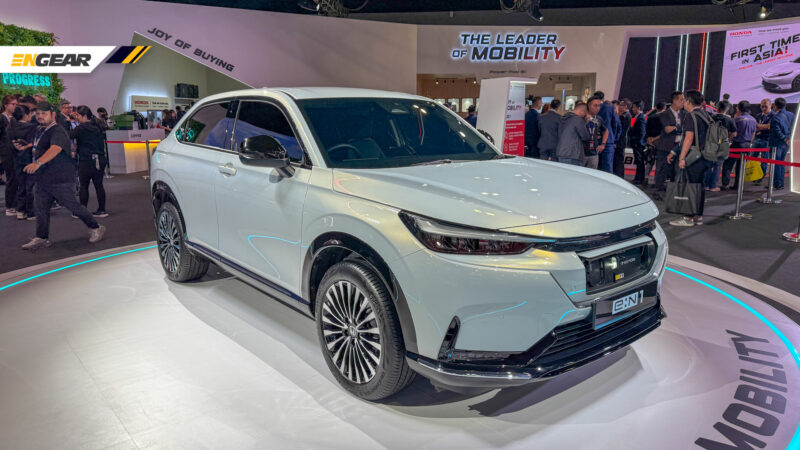
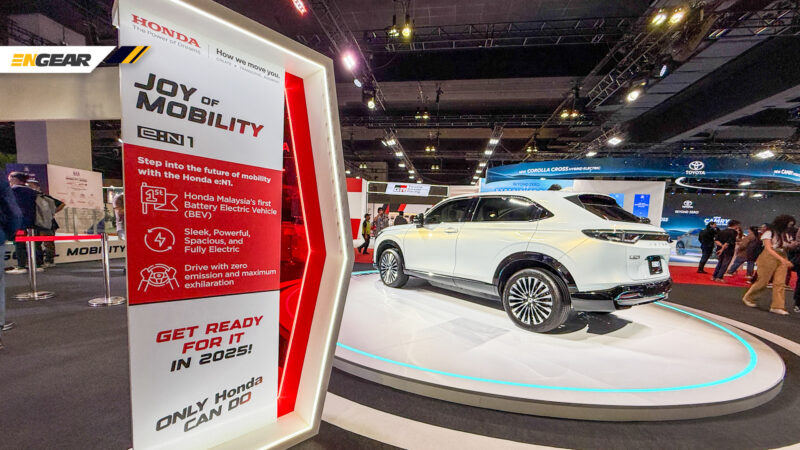
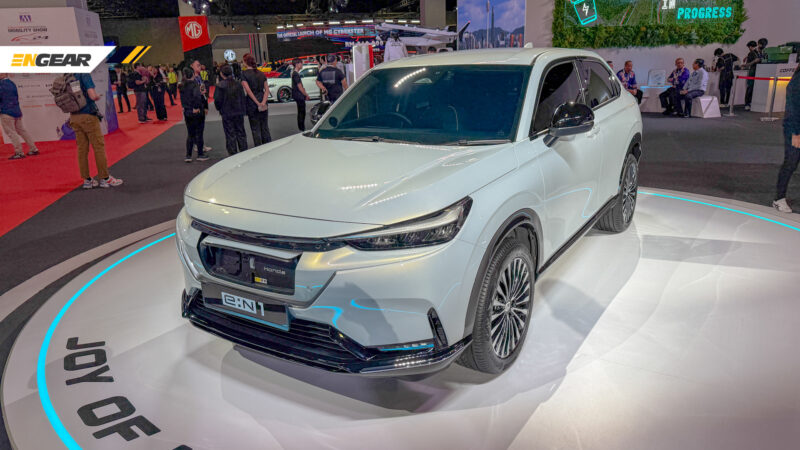
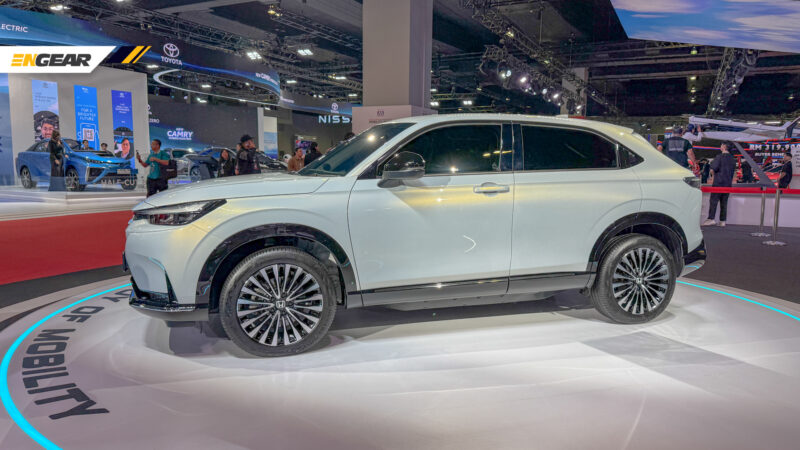
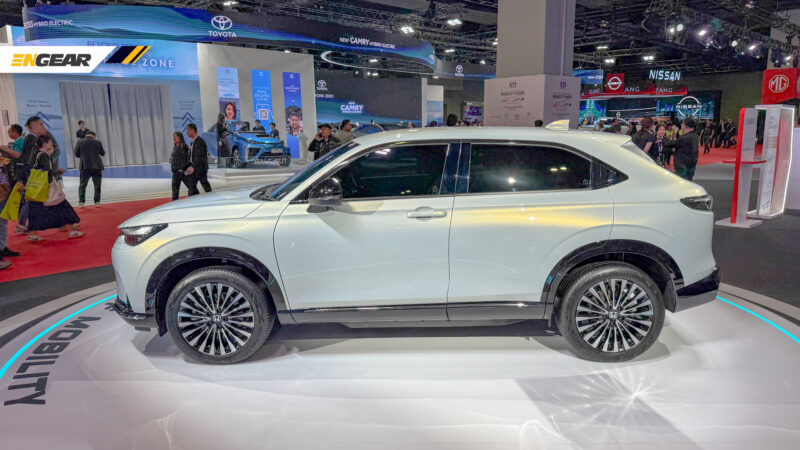
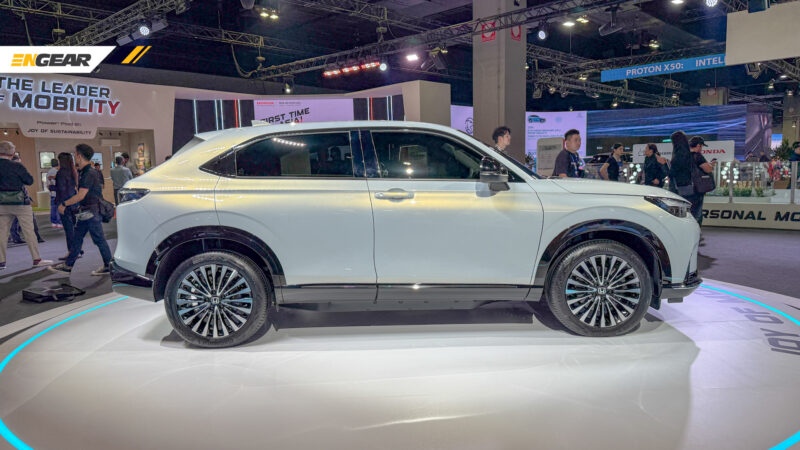
Honda Malaysia’s first electric vehicle (EV), the Honda e:N1, has officially been launched.
Although it shares a similar appearance to the Honda HR-V, the e:N1 does not share the same platform.
Instead, the e:N1 is built on the e:N Architecture F platform and features a front-wheel drive electric motor that produces 201 hp and 310 Nm of torque.
It can accelerate from 0 to 100 km/h in just 7.7 seconds, reaching a top speed of 160 km/h.
Equipped with a 68.8 kWh lithium-ion battery pack, this electric SUV can travel up to 500 km on a single full charge (NEDC data).
This EV supports AC charging at 10 kW (full charging time of six hours) and DC charging up to 78 kW, allowing the battery to be charged from 10% to 80% in just 45 minutes.
In terms of dimensions, the Honda e:N1 measures 4,380 mm in length, 1,790 mm in width, 1,592 mm in height, with a wheelbase of 2,610 mm and a ground clearance of 142 mm.
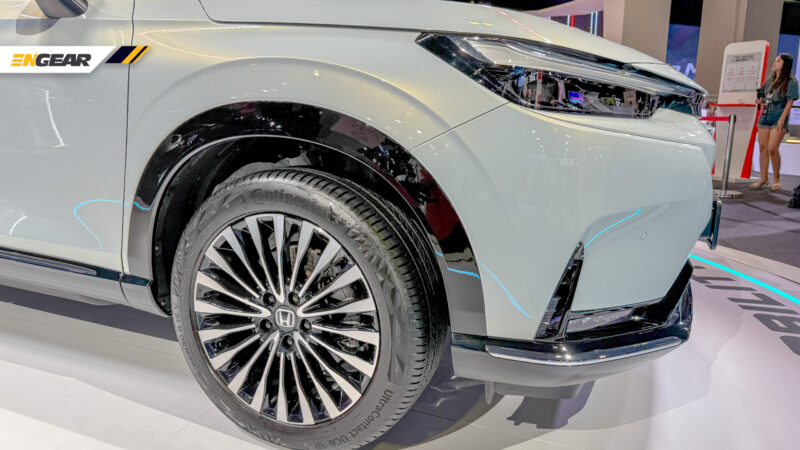
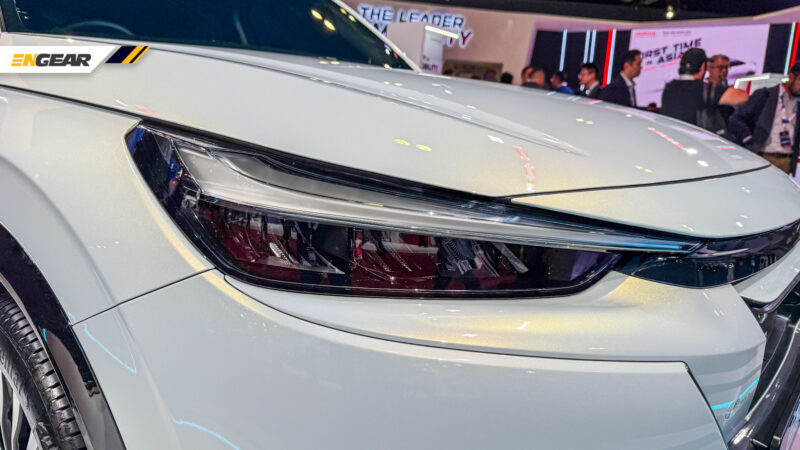
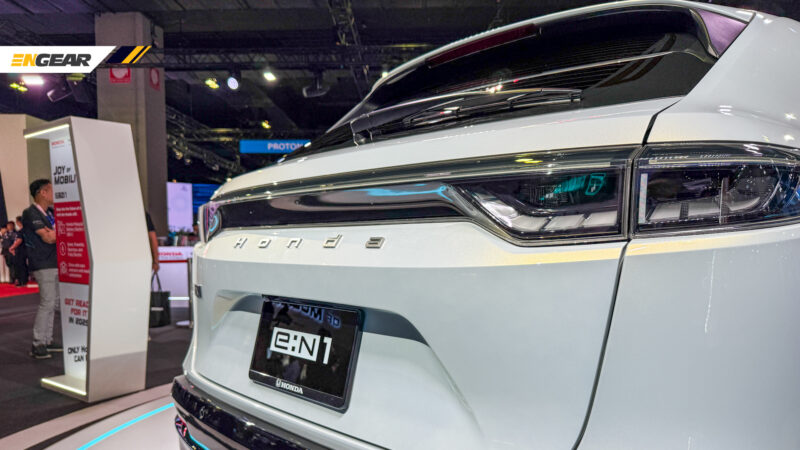
Standard features include 18-inch alloy wheels, LED headlights, sequential LED turn signals, clear rear light housings with a smoky effect, a rear spoiler, and a shark fin antenna.
Inside the cabin, the e:N1 is equipped with leather-wrapped seats, a 10.25-inch digital cluster screen, a 15.1-inch vertical central screen, and wireless support for Apple CarPlay and Android Auto.
The center console features PRND buttons, cup holders, a driving mode selection button, and an electronic parking brake.
The Honda Sensing safety suite includes features such as Forward Collision Warning (FCW), Collision Mitigation Braking System (CMBS), Adaptive Cruise Control (ACC), Lane Departure Warning (LDW), Road Departure Mitigation System (RDM), Lane Keeping Assist System (LKAS), Lead Car Departure Notification (LCDN), and Automatic High Beam (AHB).
Additionally, there is also a Blind Spot Information (BSI) system and a Cross-Traffic Monitoring (CTM) system.
There are three color options available: Aqua Topaz Metallic with a gray interior theme, and Urban Gray Pearl and Platinum White Pearl with a black interior theme.
For the local market, the Honda e:N1 is priced at RM149,900 on-the-road, excluding insurance.
CarNewsChina reports that BYD is currently developing a prototype of a mini-sized electric vehicle with one goal: to capture Japan’s kei car market.
Although still covered in camouflage stickers, the car showcases features such as sliding rear doors, twin A-pillars, and a relatively high window glass housing structure.
This demonstrates BYD’s seriousness in creating a product that complies with the dimensional regulations set for the kei car segment in Japan.
For your information, the kei car segment is a category of ultra-compact cars in Japan, with a maximum length of 3.4 meters, a width of 1.48 meters, and a height of 2 meters.
Furthermore, engine power is limited to a maximum of 64 hp according to the agreement of the Japan Automobile Manufacturers Association (JAMA).
Although BYD currently offers the Seagull as its smallest EV, its size is still too large to be categorized as a kei car.
According to reports from China, BYD’s electric ‘kei car’ will be equipped with a 20 kWh battery that offers a range of about 180 km (WLTC data), along with support for fast charging at 100 kW.
BYD plans to produce this electric kei car in China for export to the Japanese market starting in late 2026, with the ambition to capture 40 percent of the electric kei car market within a few years.
Currently, the kei car market in Japan offers two EV models: the Nissan Sakura and its twin, the Mitsubishi eK X EV.
Both models were launched in 2022, equipped with a 64 hp electric motor producing 195 Nm of torque, and a 20 kWh battery pack with a driving range of up to 180 km.
The full-size electric SUV, the Volvo EX90, has been crowned the winner of the World Luxury Car of the Year 2024 award.
This prestigious recognition was announced at the New York International Auto Show by a panel of judges comprising 96 prominent automotive journalists from 30 countries.
The Volvo EX90 has been praised for its sophisticated Scandinavian luxury, dynamic electric performance, and world-class safety innovations.
Officially launched in April, the Volvo EX90 is available in a single Ultra Twin variant, featuring twin electric motors that produce 517 horsepower and 910 Nm of torque.
Its 111 kWh NMC battery pack offers a driving range of up to 623 km on a full charge.
As the most advanced SUV, the Volvo EX90 is described as a mobile computer, equipped with an NVIDIA DRIVE AI processing unit that manages every aspect of the vehicle, from infotainment and advanced driver assistance to safety features.
In addition to passenger detection functions, the Volvo EX90 includes a driver understanding feature, which monitors real-time data and provides alerts or safely stops the vehicle in the event of an emergency.
The Volvo EX90 is also equipped with a comprehensive array of sensors, including radar, cameras, ultrasonic sensors, and a LIDAR unit designed to support higher levels of autonomy in driving in the future.
In the Malaysian market, the Volvo EX90 is priced at RM442,888, complete with an unlimited mileage vehicle warranty, 24-hour roadside assistance, and five years of free digital services.
The first 50 customers will receive a wall charger voucher and a foldable panoramic sunshade worth RM5,000 for free.
After more than a decade, Proton has made its long-awaited return to the neighboring market of Singapore with the launch of the Proton e.MAS 7 electric vehicle (EV), managed by the new distributor VINCAR Group.
This best-selling EV in Malaysia was officially launched at The Car Expo 2025, which recently took place.
According to Proton’s Chief Executive Officer, Dr. Li Chunrong, “The launch of the Proton e.MAS 7 in Singapore marks an important step in expanding our international market, as well as our commitment to introducing high-quality and advanced EVs to this region.”
“We are confident that the e.MAS 7, with its attractive features and suitability for urban environments, will receive a positive response from Singaporean drivers who are increasingly prioritizing electric mobility,” he explained.
Proton’s return to Singapore aligns with the country’s rapid transition towards green mobility.
The Singapore EV market is reported to have seen a consistent increase from 12 percent in 2022 to 18 percent in 2023, with a target of reaching 55 percent by 2027.
The Singaporean government also aims to provide up to 12,000 EV charging points in 2,000 Housing and Development Board (HDB) parking areas by the end of this year, and 60,000 by 2030.
In Singapore, the Proton e.MAS 7 is offered in six attractive color options, including the new color Moyu Black.
Based on the supplied images, the Proton e.MAS 7 for this market resembles the Prime variant sold in Malaysia, featuring 18-inch wheels (compared to the 19-inch wheels for the Premium variant).
Other features include a 15.4-inch touchscreen, Flyme Auto audio system, and full LED lighting.
The Proton e.MAS 7 is priced starting from S$173,988 (approximately RM565,429).
At the Shanghai Hongqiao Hotel, another electric SUV known as the X20e made an appearance next to a segment B electric SUV.
The design of the X20e certainly reminds us of the smart brand’s EV, the #1, particularly in the front and rear light designs; most notably, the finishing on both C-pillars stands out.
Interestingly, the showcased X20e is a right-hand drive (RHD) version.
Does this mean that Jetour is ready to market this model for right-hand drive countries?
Since the X20e is a very new model, there are no specifications available to report at this time, and it is not listed on any official Jetour websites.
However, based on the exhibited model, the X20e is equipped with 15-inch alloy wheels, a pastel green color, hidden door handles, and a floating roof design inspired by the smart #1.
Inside, the cabin features two separate display screens for the driver and the center console, physical control buttons for the air conditioning system, a three-tone dashboard finish, and relatively comfortable fabric-wrapped seats.
With very few small EVs currently available in the Malaysian market, could the X20e be a suitable candidate for urban driving?
Proton New Energy Technology Sdn Bhd (Pro-Net) recently delivered three Proton e.MAS 7 electric SUVs to the management of Northport (Malaysia) Sdn Bhd for use by its auxiliary police force.
This achievement marks Northport as the first port operator in the country to utilize the e.MAS 7 in its fleet management, reinforcing its commitment to corporate ESG initiatives and sustainable transportation solutions.
The use of the Proton e.MAS 7 electric SUV will not only reduce fuel consumption, carbon emissions, and noise pollution, but its quiet and smooth ride will also make patrol operations more comfortable and reduce officer fatigue.
According to Zhang Qiang, CEO of Pro-Net, “We are delighted to be working with Northport, an organization that exemplifies sustainability.”
“Its use in Northport’s operations proves that electric vehicles are not just a vision of the future, but a solution that can be adopted today.”
Fakhrul Azhar Tajudin, CEO of Northport, said, “At Northport, we are committed to practicing a sustainable approach and supporting clean energy solutions.”
“As a port that is proud of its Malaysian identity, the selection of the Proton brand also reflects our support for local innovation and national industry development. With its balance of performance, safety and technology, the Proton e.MAS 7 is a suitable choice to meet the demanding operational needs of the port.”
While other manufacturers have begun to pull the handbrake, Zeekr is ready to reignite the sporty wagon segment with the introduction of the 007 GT model.
The Zeekr 007 GT (also known as the Zeekr 7 GT in global markets) is built on the Zeekr 007 electric sedan and is the second shooting brake model after the Zeekr 001.
It features dimensions of 4,864 mm in length, 1,900 mm in width, a height of up to 1,445 mm, and a wheelbase approaching 3 meters (2,925 mm).
In comparison, the Zeekr 001 measures 4,977 mm in length, 1,999 mm in width, and has a wheelbase of 3,005 mm.
The Zeekr 007 GT is available in a single motor variant that produces 416 hp and 440 Nm of torque, accelerating from 0 to 100 km/h in just 5.2 seconds.
Meanwhile, the dual motor variant generates power up to 637 hp and 710 Nm, with a 0 to 100 km/h acceleration time of 3.8 seconds.
The Zeekr 007 GT utilizes a 75 kWh lithium iron phosphate (LFP) battery, offering a range of 650 km (CLTC data), while the 100 kWh nickel cobalt manganese (NCM) battery provides a driving range of 825 km.
The LFP battery supports the fastest charging in the world, where charging from 10% to 80% can be completed in just 10.5 minutes!
Inside the cabin, there is a 15.4-inch touchscreen, a digital cluster screen, and an augmented reality (AR) head-up display for driver use.
The center console features a cluster of function buttons located at the bottom of the screen, storage space, cup holders, and two wireless device charging slots.
The front seats have 14-way adjustability with heating, cooling, massage functions, and Nappa leather upholstery.
In terms of practicality, the Zeekr 007 GT cabin offers up to 36 storage spaces, an optional hidden refrigerator, and a cargo space of 1,737 liters when the second-row seats are folded.
Not stopping there, the Zeekr 007 GT also features an intelligent driving system, thanks to 31 sensors including LiDAR, 11 cameras, and 3 radar units that enable it to avoid obstacles at high speeds and stop automatically under certain conditions.
In China, the Zeekr 007 GT is priced starting from RMB 202,900 (approximately RM 121,876).
Batik Air, in collaboration with Leapmotor Malaysia, has announced a private terminal transfer service for business class passengers at Kuala Lumpur International Airport (KLIA), Sepang.
Five units of the electric SUV Leapmotor C10 will be used to transport business class passengers from Gate G1 in the Main Terminal Building to Gate C1 in the Satellite Building and vice versa.
The Leapmotor C10 is a D-segment electric SUV capable of offering a driving range of up to 424 km (WLTP data).
To ensure guaranteed travel comfort, this SUV features ergonomic seating and OEKO-Tex Standard 100 textile material that is more durable and environmentally friendly.
In addition, the vehicle offers a spacious and comfortable cabin, along with a cargo space of 415 liters, which can be expanded to 1,410 liters to accommodate larger items.
This exclusive service provided by Batik Air is expected to reduce waiting times while complementing the bus services offered by Malaysia Airports during the temporary suspension of the aerotrain service.
Honda Malaysia has officially opened booking for their first electric SUV model, the Honda e:N1, which is set to launch in the second quarter (Q2) of 2025.
Built on the e:N Architecture F platform, the Honda e:N1 is powered by a front-wheel-drive electric motor producing 201 hp and 310 Nm of torque.
Its 68.8 kWh lithium-ion battery pack allows for a driving range of up to 500 km on a full charge (NEDC data).
With dimensions measuring 4,380 mm in length and 1,592 mm in height, and a wheelbase of 2,610 mm, it matches the size of the petrol version of the HR-V.
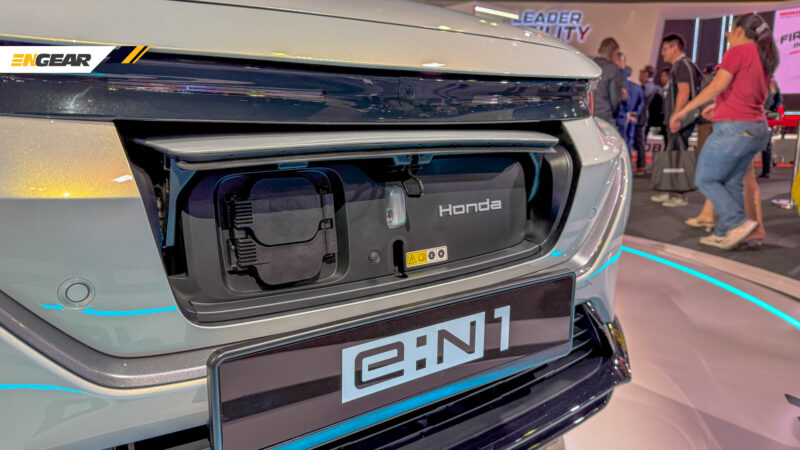
Features included in the e:N1 comprise two-tone 18-inch alloy wheels, LED headlights and taillights, a charging slot in the front grille, a white Honda badge, and the word ‘Honda’ emblem on the rear.
Safety features also include blind spot information (BSI), a cross-traffic monitoring system (CTM), in addition to nine advanced Honda SENSING safety functions.
Honda customers can place orders for the e:N1 on the website https://prebook.honda.com.my/ or via the HondaTouch app.
Honda Malaysia has also appointed eight authorized dealerships to handle any matters related to the e:N1 as follows:
Following the launch of the electric sedan EZ-6, the collaboration between Mazda and automotive manufacturer Changan continues with the introduction of another new crossover model – the Mazda EZ-60.
Like the previously showcased EZ-6 sedan, the Mazda EZ-60 is fundamentally built on the modular platform EPA1 developed by Changan. This means it shares very similar specifications with the Deepal S07 crossover.
The exterior design of the Mazda EZ-60 aligns with Mazda’s modern Kodo design philosophy.
Notable features include a grid structure and illuminated front logo, separated headlight design, hidden door handles, and the presence of side cameras.
A striking feature is the air vent located on the C-pillar, designed to reduce drag coefficient, thereby aiding in achieving a longer driving range.
The minimalist approach is also reflected at the rear, where the Mazda EZ-60 features elongated LED tail lights that extend towards the center, along with the word “MAZDA” replacing the traditional logo.
Based on its dimensions, it is highly likely that the Mazda EZ-60 shares nearly identical measurements with the Deepal S07 SUV, as previously presented by Bermaz earlier this year.
In terms of dimensions, the Deepal S07 measures 4,750 mm in length, 1,930 mm in width, 1,625 mm in height, and has a wheelbase of 2,900 mm.
In the Chinese market, the Deepal S07 is available with a single electric motor option producing either 218 hp or 258 hp.
There are two battery pack options available: a 66.8 kWh pack offering a range of 520 km, or a 79.97 kWh pack providing a range of up to 620 km (CLTC data).
More information about this electric SUV will be revealed ahead of the Shanghai Auto Show 2025, which is set to take place later this month.
MG Motor Malaysia has recently unveiled an upcoming electric SUV model, the 2025 MGS5 EV.
In terms of dimensions, the MGS5 EV measures 4,476 mm in length, 1,849 mm in width, and has a wheelbase of 2,730 mm.
The cargo space is 452 liters, which expands to 1,441 liters when the second-row seats are folded down.
The MGS5 EV is powered by a rear-wheel drive electric motor that produces 170 PS and 250 Nm of torque.
There are two battery options available: a 49 kWh battery that offers a driving range of 340 km, and a 62 kWh battery that provides a driving range of 430 km.
The MGS5 EV supports 11 kW AC charging as well as fast DC charging up to 88 kW, and it includes a Vehicle-to-Load (V2L) function of up to 6.6 kW.
In the cabin, the MGS5 EV features a 10.25-inch display cluster, a 12.8-inch infotainment screen, and connectivity for wireless Apple CarPlay and Android Auto.
The premium variant comes with additional features such as 18-inch alloy wheels, a panoramic glass roof, powered tailgate, leather and perforated fabric seats, a heated steering wheel, power-adjustable driver’s seat, a premium audio system with six speakers, and a 360-degree surround camera.
Safety features include seven airbags and Advanced Driver Assistance Systems (ADAS).
There are five attractive color options available: Arctic White, Monument Silver, Camden Grey, Dynamic Red, and Elegant Latte.
Slated for launch soon, the MGS5 EV is expected to be priced around RM115,000.
The Nissan LEAF battery electric vehicle has been on the global market since 2010 and has endured through two generations in a hatchback body style.
However, for the third generation, the Nissan LEAF has been redesigned as a crossover to align with the market demand, which leans more towards larger-bodied models.
Built on the CMF-EV platform owned by the Renault-Nissan-Mitsubishi alliance, the new LEAF features increased overall dimensions, though it is slightly shorter compared to the existing LEAF.
From the showcased design, it is evident that the LEAF borrows many styling elements from the Ariya EV and boasts a drag coefficient of 0.25.
Nissan has not disclosed further specifications for the LEAF.
However, according to Nissan Europe’s product chief, Francois Bailly, the new LEAF is capable of offering a real-world driving range exceeding 598 km.
He added that the LEAF will also receive the latest Google-based infotainment system, complemented by advanced driver assistance systems.
CelcomDigi is proud to announce a strategic partnership with JomCharge and chargEV, leaders in electric vehicle charging in Malaysia, as the leading operators of electric vehicle (EV) charging stations in the country. They will install more than 100 charging stations in residential and commercial areas by the end of 2025.
This is part of CelcomDigi’s commitment to support the EV ecosystem in Malaysia while facilitating the transition of Malaysians to sustainable mobility.
Additionally, CelcomDigi customers can enjoy a rebate of RM10 when charging at JomCharge and chargEV stations. Check the MyDigi and Celcom Life apps today for more information on participating station locations. Rewards will be available for redemption on April 1, 2025.
The celebration of Hari Raya Aidilfitri becomes more meaningful with close ties and harmony between generations. In conjunction with this festive season, CelcomDigi presents the #EratkanIkatan campaign with the theme “Raya Bersama, Lebih Bermakna” inviting us to gather and create memories with family, friends, and the community.
In celebration of Hari Raya Aidilfitri 2025, CelcomDigi presents:
Syukur: A Tale of Dreams & Determination
‘Syukur’ tells the story of Melor, a busker from a small town with big ambitions. Set against the backdrop of the Ramadan month, this short film portrays the challenges faced by Melor that test his patience and resilience.
The climax of the film features a cameo appearance by Yuna, who inspires the main character while also depicting CelcomDigi’s role in empowering the next generation.
Special promotions for Raya
Enjoy exclusive offers such as subscriptions to Disney+ Hotstar, Viu, and iQiyi starting from RM11.90/month, as well as smart devices with the Easy360 5G package for as low as RM1/month.
Good news for Proton eMAS 7 and smart EV owners returning home for Aidilfitri. Pro-Net, a subsidiary of Proton, is offering a special discount of 30% on EV charging fees from March 29 to April 7, 2025.
According to the company, this initiative ensures a smoother and more affordable balik kampung experience.
Established in 2022 as the official distributor of smart and Proton eMAS electric vehicles, Pro-Net provides access to over 2,000 public charging points across the country, which is the largest integrated charging network in Malaysia.
Pro-Net’s Chief Executive Officer, Mr. Zhang Qiang, expressed his excitement for this initiative: “At Pro-Net, we are focused on making electric driving practical and enjoyable for all. As we celebrate Raya, we want to thank our customers by making it easy and affordable for them to get home.”
Proton eMAS and smart EV owners can enjoy this special offer at over 85% of public charging stations. Just use the Proton eMAS or Hello smart apps to start your charging session, and the discount will be applied automatically.
Malaysia’s Leading Automotive News | ENGEAR ENGLISH