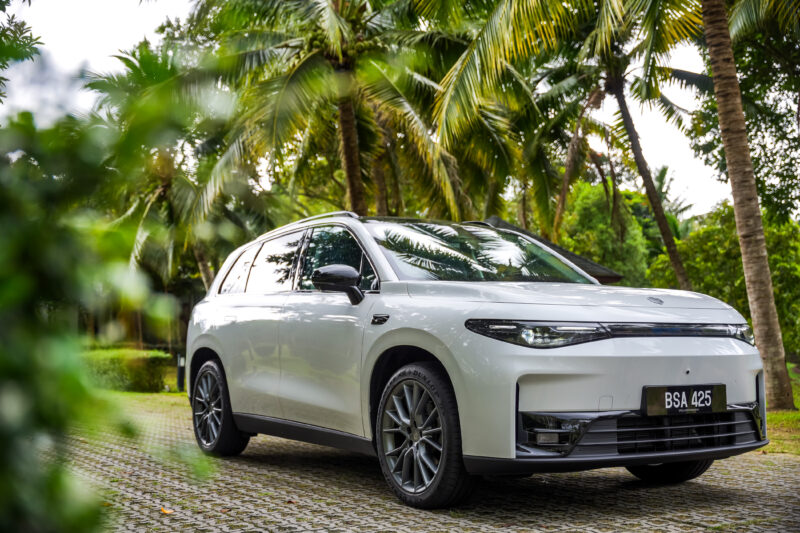
Leapmotor Malaysia has announced an over-the-air (OTA) update available for all 2024 and 2025 C10 models.
The latest version, LeapOS 3.40.32, offers several enhancements:
1. Driving Recorder
Drivers can use the built-in 360° camera as a dashcam to capture the surroundings while driving.
There are modes for continuous recording as well as emergency recording.
2. Navigation System in Malay
The Leapmotor C10 navigation system now supports Bahasa Melayu, available for both display screens and audio.
It is also integrated with voice command functions, allowing drivers to search for songs and artists using the command “Hi Leapmotor.”
3. ADAS Functions
Drivers can now access and customize ADAS functions and driving modes through a function button on the steering wheel.
The ADAS system has also been enhanced with the following features:
Improved driver monitoring system
Adaptive Cruise Control (ACC) and Lane Centering Control (LCC) up to 160 km/h
Smoother speed control and deceleration in turns while ACC and LCC are active.
4. QDLink
This latest OS update also includes the QDLink function, allowing drivers to mirror their smartphone screens onto the infotainment display for navigation, streaming, and music functions.
This feature is available via either a wired data connection or a wireless connection.
Additionally, the LeapOS 3.40.32 update improves the slope detection function, activating the front camera for clearer views.
The hill hold feature has also been enhanced to prevent the vehicle from rolling back unexpectedly when stopping on a slope.
Proton has officially launched its electric vehicle (EV) production facility located in the Automotive High Technology Valley (AHTV) of Tanjung Malim.
The launch ceremony was officiated by Malaysia’s Prime Minister, YAB Dato’ Seri Anwar Ibrahim, and was also attended by the Chief Minister of Perak, Dato’ Seri Saarani Mohamad; the Minister of Transport, Anthony Loke Siew Fook; and the Minister of Investment, Trade, and Industry, Tengku Zafrul Tengku Abdul Aziz.
With operations commencing this month, the EV factory will serve as an assembly site for various models from the Global Modular Architecture (GMA) platform.
The first model to be assembled at this factory will be the Proton e.MAS 7 electric SUV, followed by the Proton e.MAS 5 in due course.
Initially, the factory will have a production capacity of up to 20,000 units per year, with the ability to scale up to 45,000 units per year depending on domestic and international demand.
This factory is also expected to generate over 200 job opportunities for the local community.
Bermaz Motor has launched another model for the local market—the 2025 Mazda CX-80 PHEV.
Like the CX-60, the Mazda CX-80 shares the Large Group Product platform but features a longer dimension and a three-row seating configuration.
Here are some key details about the 2025 Mazda CX-80:
Engine
The Mazda CX-80 is powered by a Skyactiv-G 2.5-liter engine complemented by a plug-in hybrid system.
This engine produces 189 hp and 261 Nm of torque, paired with an electric motor generating 172 hp and 270 Nm of torque, resulting in a total power output of 323 hp at 6,000 rpm and torque of 500 Nm at 4,000 rpm.
The 17.8 kWh lithium-ion battery allows for an all-electric range of up to 65 km, along with supporting AC charging at 7.2 kW (full charging time: 2 hours and 30 minutes).
With a fuel tank capacity of 70 liters, the CX-80 offers a fuel consumption rate as low as 1.6L/100 km.
There are four driving modes: Normal, Sport, Off-road, and EV.
Dimensions
The CX-80 measures 4,995 mm in length, 1,890 mm in width, and 1,705 mm in height, with a wheelbase of 3,120 mm.
It has a ground clearance of 175 mm and a turning radius of 5.80 meters.
Suspension
Similar to the CX-60, the CX-80 features a double wishbone setup at the front and a multi-link system at the rear, along with Kinematic Posture Control (KPC).
Exterior
Exterior features of the CX-80 include LED headlights with daytime running lights, 20-inch rims, windshield wipers with a rain sensor, powered side mirrors, and a power-operated hands-free tailgate.
Interior
The CX-80 cabin is equipped with features such as a 12.3-inch digital cluster screen, a 12.3-inch infotainment screen, Apple CarPlay and Android Auto support, a Bose audio system with 12 speakers, as well as leather and gunmetal trim on the dashboard.
As mentioned, the CX-80 offers three rows of Nappa leather seating that can accommodate six passengers at once.
The driver and front passenger seats provide up to 10-way adjustment, including memory functions, ventilation, and heating.
Additional features include dual-zone automatic climate control, 12V power slots, USB ports, a frameless rearview mirror, and a wireless charging pad.
Safety
The safety equipment of the CX-80 matches what is offered in the CX-60, including airbags, ABS, EBD, Brake Assist, Stability Control, Traction Control, a 360-degree camera, and Hill Launch Assist (HLA).
The CX-80 also comes with several advanced safety technologies including:
Adaptive LED Headlights (ALH)
Blind Spot Monitoring System (BSM)
Front and Rear Traffic Cross Alert (FCTA & RCTA)
Lane Departure Warning System (LDWS)
Lane Keeping Assist (LAS)
Driver Attention Alert (DAA)
Traffic Jam and Cruising Support (CTS)
Smart Brake Support (SBS)
Mazda Radar Cruise Control (MRCC)
Price
Fully imported from Japan (CBU), the 2025 Mazda CX-80 is priced starting at RM331,610.
Bermaz Motor has officially launched the latest SUV model, the 2025 CX-60 for the local market.
This is Mazda’s first product built on the Large Product Group platform, offering a more luxurious and elegant image.
Below are the key details of the Mazda CX-60 for the Malaysian market:
Engine
The Mazda CX-60 is powered by a Skyactiv-G 2.5-liter engine, delivering 189 hp at 6,000 rpm and torque of 261 Nm at 3,000 rpm.
Power is transmitted to the wheels via an eight-speed automatic transmission.
With a fuel tank capacity of 58 liters, the CX-60 achieves a fuel consumption rate of 7.3 liters per 100 km.
Dimensions
The CX-60 measures 4,740 mm in length, 1,890 mm in width, and 1,680 mm in height, with a wheelbase of 2,870 mm.
The ground clearance is 175 mm, while the turning radius is approximately 5.40 meters.
Suspension System
The CX-60 features a double wishbone setup in the front, complemented by a multi-link system at the rear.
It also comes equipped with Kinematic Posture Control (KPC) that optimizes suspension performance for smoother and more stable body movement, especially at high speeds.
Exterior
Standard equipment on the CX-60 includes LED lighting systems, LED daytime running lights, 18-inch alloy wheels, rain-sensing wipers, a hands-free powered tailgate, and power-adjustable side mirrors.
Interior
Inside the cabin, the CX-60 offers features such as a 12.3-inch digital cluster display, a 12.3-inch central screen, support for Apple CarPlay and Android Auto, a Bose audio system with 12 speakers, and leather accents on the dashboard.
The driver’s seat provides up to 10 adjustments, complete with memory function, while the front passenger seat offers up to eight adjustment levels.
Other features include dual-zone climate control, 12V power outlets and USB ports, a frameless rearview mirror, and wireless charging capability.
Safety
Safety features in the CX-60 include airbags, ABS, EBD, Brake Assist, stability control, traction control, a 360-degree camera, and Hill Launch Assist (HLA).
The CX-60 also comes with several advanced safety technologies, including:
Adaptive LED Headlights (ALH)
Blind Spot Monitoring (BSM)
Front and Rear Traffic Cross-Detection Alerts (FCTA & RCTA)
Lane Departure Warning System (LDWS)
Lane Keeping Assistance (LAS)
Driver Attention Alert (DAA)
Traffic Jam and Cruise Support (CTS)
Mazda Radar Cruise Control (MRCC)
Pricing
The 2025 Mazda CX-60 is a completely built unit (CBU) imported from Japan and is priced starting from RM200,510 on-the-road excluding insurance.
Volvo has officially unveiled its latest SUV, the 2026 XC70, marking the start of the pre-sales for the Chinese market.
Built on the Scalable Modular Architecture (SMA) platform, the Volvo XC70 is no longer just a high wagon, as seen in its previous versions.
For the Chinese market, the XC70 is equipped with a plug-in hybrid (PHEV) powertrain, featuring a 1.5-liter turbo engine (161 hp/255 Nm) paired with an electric motor and a 3DHT transmission.
Specifications are as follows:
Two-Wheel Drive Variant
Power: 318 hp
Acceleration 0-100 km/h in 8 seconds
Battery pack: 21.2 kWh
Zero-emission range: 116 km
Fuel consumption: 1.27L/100 km
Four-Wheel Drive Variant
Power: 462 hp
Three electric motors
Acceleration 0-100 km/h in 5.3 seconds
Battery pack: 39.6 kWh
Zero-emission range: 212 km
Fuel consumption: 0.98L/100 km
Additional features include support for AC charging at 7 kW, fast DC charging at 87 kW (0-80% in as little as 23 minutes), a fuel tank capacity of 60 liters, and four driving modes (Hybrid, Sport, Electric, and Off-road).
As a mid-size crossover, the XC70 has dimensions of 4,815 mm in length, 1,890 mm in width, 1,650 mm in height, and a wheelbase of 2,895 mm.
Inside, the cabin features a 12.3-inch digital cluster screen, a 15.4-inch central display, a 9.2-inch HUD display with augmented reality (AR), a Harman Kardon audio system with 23 speakers, a panoramic glass roof, and 50W wireless device charging.
The starting price for the Volvo XC70 PHEV 2026 is 299,900 yuan (RM177,000) for the 2WD version, and goes up to 329,900 yuan (RM196,000) for the 4WD version.
The inaugural Omoda | Jaecoo Technical Skills Competition was a resounding success, attracting over 132 technicians from 48 dealerships across Malaysia.
The finals featured only 10 finalists showcasing their skills in a fierce battle for the National Champion title, held by Wong Sau Seng from Gagner Auto Sdn Bhd.
Wong will represent Malaysia at the global competition in China this October.
According to Wong, this achievement is a result of strong support from his company, as well as guidance from his managers and superiors, who motivated him to continually improve.
“It is a great honor, and I am proud to represent Malaysia on a global platform, showcasing my skills and commitment to excellence,” he stated.
Meanwhile, the title of Runner-Up was awarded to Ng Chen Ton from CarShen Sdn Bhd, with Syasya Mazdiana binti Nor Azman from Anggerik Auto Sdn Bhd taking third place.
As the only female technician in the competition, Syasya serves as a testament to diversity and gender equality within the Omoda | Jaecoo network.
“As the sole female participant in the finals, it is a great honor and proves that women can stand shoulder to shoulder with men in the technical field,” she remarked.
Each participant was individually assessed by a panel of judges from Chery Malaysia’s technical team, based on a theoretical evaluation (30 percent) and a practical test (70 percent), which included real-world problem-solving, repair quality, and efficiency.
Emily Lek, Vice President of Omoda | Jaecoo Malaysia, stated, “The passion displayed in this competition reflects our culture of excellence and our genuine concern for our customers throughout their ownership experience.
“We believe that our shared goal of upholding world-class technical standards and customer satisfaction drives the long-term success of our brand in Malaysia,” she added.
Edaran Tan Chong Motor (ETCM) has announced that bookings for the 2025 Nissan Navara X-Tremer pickup truck are now open.
This new trim package features exterior details such as:
Black front grille
X-Formation bumper cladding
Carbon fiber-like fender accents
New black over fenders
Shark fin antenna
Black rear bumper
Decorative trim on the tailgate door
Inside the cabin, the X-Tremer trim showcases features including:
Soft-touch dashboard with double-stitching
Stylish center console
Leather-wrapped steering wheel
8-inch infotainment screen with Apple CarPlay/Android Auto connectivity
Zero Gravity front seats
Quole Modure upholstery that is dirt-resistant and stays cool
The Nissan Navara X-Tremer retains a double-wishbone suspension setup at the front with a stabilizer bar, followed by a multi-link setup that minimizes body roll, ensuring comfort and stability.
Safety features include:
Front Collision Warning (IPFCW)
Emergency Braking (IFEB)
Blind Spot Warning (BSW)
Lane Departure Warning (LDW)
Rear Cross Traffic Alert (RCTA)
ABS, EBD, BA, TCS, VDC, HSA, HDC
Trailer Sway Assist (TSA)
Electronic Locking Rear Differential
The Nissan Navara X-Tremer is available in three variants with the following prices:
2.5L Turbo V – RM134,800
2.5L Turbo VL – RM146,900
2.5L Turbo Pro-4X – RM154,800
Customers who purchase and register the new Nissan Navara X-Tremer will also be eligible for a cash rebate of up to RM8,000 (subject to terms and conditions).
Malaysians are invited to view the Navara X-Tremer up close at the Nissan Roadshow taking place at East Coast Mall, Kuantan from September 10-14, or to visit any Nissan showroom nationwide.
Isuzu Malaysia recently announced the official opening of its new 3S center (Sales, Service, and Spare Parts) located in Kuantan, Pahang.
Operated by Dynamic Motors Sdn Bhd, this brand-new 3S center is built on a 3,500 square meter plot of land in the Semambu industrial area and showcases Isuzu’s latest corporate identity.
Facilities at the Isuzu 3S center include a showroom, a waiting area resembling a café complete with tables, a refrigerator, and a coffee machine, as well as a covered pathway for service customers.
In addition to the Isuzu D-Max and Elf models, this 3S center also sells and provides services for the entire lineup of medium and heavy-duty vehicles, including the Forward and Giga.
Tomoyuki Yamaguchi, CEO of Isuzu Malaysia, stated that the new home of Isuzu in Kuantan comes at a time when the acceptance of Isuzu vehicles is growing in the country.
Meanwhile, Donald Chan, Chairman of Dynamic Motors, remarked, “For the past 20 years, we have received support from many loyal customers who return to purchase new Isuzu vehicles.
“With the support of Isuzu Malaysia, we hope to continue delivering the best to our customers in Kuantan for years to come.”
The showroom of this 3S center is open every day, while the service center operates from Monday to Saturday.
Mercedes-Benz Malaysia has announced a collaboration with Power-Up (P.UP) by Nazamax Malaysia, introducing an exclusive mobile charging subscription plan for Mercedes-Benz EQ owners.
Under the MB Platinum 5 plan, owners can choose a subscription period of one, six, or twelve months to enjoy the following benefits:
Five charging sessions each month (DC 120 kW, up to 80% State of Charge)
Including a car wash, vacuuming, and tire polishing package
Free service and parking fees of up to RM5 per session
Subscription period options of one, six, or twelve months
Additionally, customers can book sessions through the P.UP mobile app, where the service will be delivered directly to the customer’s location, whether at home, office, or any destination.
The trial service was launched in Penang in September 2024 and is now available in the Klang Valley with three vans.
It will be expanded to Johor Bahru in the first quarter of 2026, and throughout Peninsular Malaysia in the second half of the same year.
Carro, the largest online used car platform in the Asia-Pacific region, has opened two brand new Zeekr showrooms located in Bangsa, Kuala Lumpur, and Juru Autocity, Penang.
It is reported that two more Zeekr showrooms are expected to open by the end of this year.
Spanning over 12,000 square feet, the Zeekr House located in Juru Autocity offers 3S services (sales, service, and spare parts) to customers in the surrounding area.
This follows the latest development in which Carro has been appointed as Zeekr’s new official distributor in Malaysia.
Under a Memorandum of Understanding signed in June, Carro will establish four Zeekr showrooms along with three Carro Care workshops to support retail and maintenance efforts for the EV brand.
Mforce Bike Holdings has introduced yet another electric scooter to the local market, this time under the QJMotor brand: the 2025 E-LTR.
In terms of power, the QJMotor E-LTR is driven by a 4.02 hp electric motor capable of reaching a maximum speed of 70 km/h, with three selectable speed modes.
With a 74V 27Ah lithium-ion battery, the E-LTR can achieve a riding range of up to 105 km on a full charge.
Charging from 30% to 80% state of charge (SoC) takes only 5 to 6 hours.
There are two battery slots available; one comes standard with the scooter, while an additional battery can be purchased as an option.
Among its features are hydraulic front and rear shock absorbers, a disc brake system with CBS technology, 12-inch rims, LED lights, an LCD meter display, and a USB charging slot.
The E-LTR also provides storage space under the seat, additional twin compartments at the front, and a cargo hook.
This scooter includes a fault code function to help users quickly diagnose any technical issues.
The total weight of this electric scooter is only 98.5 kg without the battery, while the seat height is approximately 760 mm.
The retail price starts at RM6,999 (on the road without insurance and registration), and owners are also eligible for MARiiCas rebates of up to RM2,400.
Pro-Net recently held a preview session for another electric SUV model set to be launched soon, the 2025 smart #5.
This model is built on the PMA2+ platform, which is also used in Geely’s models such as the Zeekr 7X.
Here are five things you need to know about the smart #5.
Dimensions
Positioned as a D-segment SUV, the smart #5 features significantly larger dimensions compared to its siblings, the smart #1 and #3.
The SUV measures 4,705 mm in length, 1,920 mm in width, 1,705 mm in height, with a wheelbase of 2,900 mm and a ground clearance of 197 mm.
True to its nature as a rugged SUV, the smart #5 can traverse water up to 500 mm deep.
Exterior
There are two units of the smart #5 were showcased.
The Brabus version displays a sportier look with body kit, rear spoiler, two-tone color scheme, and 21-inch monoblock alloy wheels wrapped in Continental EcoContact 7 tires.
Also displayed was the #5 Premium without the Brabus body kit, featuring 20-inch aerodynamic wheels.
Overall, the smart #5 presents a boxy body design, which is a stark contrast to the #1 and #3.
Interior
Inside the cabin, the smart #5 is equipped with a 10.3-inch cluster display, dual 13-inch OLED screens, Apple CarPlay & Android Auto connectivity, a 25.6-inch head-up display with augmented reality (AR), ambient lighting with 256 color options, and wireless charging slots.
The second-row passengers enjoy features like the ‘Boss’ function, ‘Comfort Mode’ buttons, power-adjustable seating, and heating functionality.
In terms of practicality, this model offers a cargo space of 1,530 liters, with an additional 72 liters in the front trunk.
The base variant comes with a 9-speaker audio system, while the two higher variants feature a Sennheiser audio system with 20 speakers.
The Brabus variant is equipped with exclusive features such as an Alcantara steering wheel, Dinamica trim on the seats and doors, and simulated engine sound.
Variants
There are three variants of the smart #5:
Pro
Single electric motor with rear-wheel drive (RWD)
Power: 335 hp/373 Nm
Acceleration 0-100 km/h in 6.9 seconds
Top speed: 200 km/j
Battery pack: 76 kWh LFP
Range: 465 km (WLTP)
11 kW AC
Premium
Power: 358 hp/373 Nm
Acceleration 0-100 km/h in 6.5 seconds
Top speed: 200 km/j
Battery pack: 100 kWh NMC
Range: 590 km (WLTP)
22 kW AC
Brabus
Dual motor electric configuration with all-wheel drive (AWD)
Power: 637 hp/710 Nm
Acceleration 0-100 km/h in 3.8 seconds
Top speed: 210 km/h
Range: 540 km (WLTP)
Sport suspension
Standard across all variants, the smart #5 comes with three drive modes: Eco, Comfort, and Sport.
The smart #5 Brabus also includes additional driving modes such as Snow, Sand, Mud, Rock, Adaptive, and Brabus.
With a 800V electrical architecture, the smart #5 supports rapid charging to go from 10-80% State of Charge in just 15 minutes.
Safety
Safety features include six airbags, as well as ADAS technology assisted by 12 ultrasonic radars, 5 mm-wave radars, 4 surround cameras, 2 HD cameras, and one cockpit camera.
This allows the #5 to offer functions such as Autonomous Emergency Braking (AEB), Lane Keeping Assistance (LKA, ELKA, LDW), Traffic Jam Assistance (TJA), Highway Assistance (HWA, ALCA), Forward Collision Warning (FCMS), Traffic Crossing Warning (FCTA, RCTA), Blind Spot Detection, and Full Autonomous Parking (FAP).
This is the fourth generation of Nissan’s kei car, the 2025 Roox.
Notably, this model shares the same platform as the Mitsubishi Delica Mini and the eK Space, which bears a design more similar to the Roox.
The design of the Roox is quite similar to its predecessor; however, it features a new headlight design that conveys a premium MPV image.
Designed based on the ‘Roomy x Max’ concept, the Roox offers a more spacious cabin while maintaining the small dimensions typical of kei cars.
Compared to the previous generation, the overall interior length has increased by 115 mm to 2,315 mm.
In addition, the Roox provides the best knee space in its class, allowing children to comfortably stand to change clothes when the vehicle is stationary.
The cargo space is also quite generous, measuring approximately 675 mm in length, which can accommodate four 48-liter luggage bags.
The sliding door opening is 650 mm wide, while the rear seat can be moved up to 320 mm.
Several additional storage compartments are available, including large cup holders, a glove compartment, a device holder, and a covered space behind the display screen.
Additionally, there is a 12.3-inch display screen, among the largest ever fitted in any kei car.
The Roox also introduces a first for the kei car class: the Intelligent Around View Monitor, featuring the Invisible Hood View function.
The ProPILOT safety system now includes smart emergency braking (AEB), rear cross-traffic alert (RCTA), smart blind-spot collision avoidance (ISB), and blind-spot warning (BSW).
Buyers can choose from up to 17 color options, including six two-tone colors for the Standard and Highway STAR variants.
The estimated starting price is 1.6 million yen (approximately RM46,000).
The engine specifications are likely unchanged, still featuring the 658 cc powertrain that generates 52 hp and 60 Nm of torque.
Jetour Malaysia has announced a proud achievement since launching its local assembly program (CKD) in June 2025.
As of now, more than 2,000 bookings have been received, while over 1,000 units of the Dashing and VT9 SUVs have already been delivered to customers.
This success is driven by the rapid expansion of Jetour’s sales and service network across the country.
By August 2025, 20 authorized dealers have been fully operational, complete with sales services, repairs, spare parts, as well as body and paint services.
All of these dealer networks offer access to the latest Jetour models, personal consultation sessions, test drives, and maintenance services by certified technicians from the Jetour Global Academy.
Customers in the Klang Valley can access these services in Bukit Jalil, Klang, Cheras, Sungai Long, Setia Alam, Kepong, Damansara, Puchong, Glenmarie, Jalan Kuching, and Ampang.
In the Northern Region, Jetour’s service network is available in Ipoh, Penang, and Alor Setar, while the Southern Region includes Johor Bahru and Melaka.
By the end of the year, Jetour plans to expand its network to 30 authorized dealerships nationwide.
New locations for Jetour’s dealer network will open in the following areas:
Klang Valley: Petaling Jaya, Seri Kembangan, Putrajaya, Sunway, Kota Damansara, and Kepong (second branch).
Northern Region: Sungai Petani, Bayan Lepas, and Ipoh (second branch).
Southern Region: Seremban and Melaka (second branch).
Eastern Coast: Kuantan, Temerloh, Bentong, and Kota Bharu.
Eastern Malaysia: Kuching, Sibu, Miri, Kota Kinabalu, Sandakan, and Tawau.
According to Mr. Fu Yong, Chief Executive Officer of JETOUR Malaysia, “The growth of our sales and service network in Malaysia reflects the confidence and strong response from local customers towards JETOUR.
“We are committed to producing high-quality vehicles and providing a seamless ownership experience so that the spirit of adventure can be felt by every driver in Malaysia.”
iCaur Malaysia has officially opened the world’s first iCaur dealership located in Glenmarie and operated by Absolute Motor Sdn Bhd.
Spanning 18,912 square feet, the iCaur Glenmarie dealership is designed as a lifestyle hub featuring comprehensive services.
Facilities provided include a showroom that can accommodate five cars, a customer lounge complete with free Wi-Fi, snacks and beverages, a delivery area, and two EV charging stations.
iCaur Glenmarie also features a special iCaur Arcade corner for the enjoyment of customers and visitors.
In addition, iCaur Glenmarie houses after-sales services, offering three service bays and a dedicated customization area.
With a trained workforce of 30 employees, the iCaur Glenmarie service center can handle a capacity of up to 300 vehicles per month.
iCaur Malaysia aims to establish up to 18 sales centers and 9 full-fledged distributor centers nationwide by mid-September.
In addition to the opening of the distribution center, iCaur Malaysia is expected to launch its first model, the 03, on September 9.
The iCaur 03 2025 will be available in two powertrain options: a 2WD version (184 PS/220 Nm) with a 65.7 kWh battery, allowing for a range of 426 km, and an iWD variant with dual electric motors (279 PS/385 Nm), a 69.8 kWh battery, and a range of 418 km (NEDC data).
The estimated sale price for the iCaur 03 will start from RM145,000 to RM155,000.
Mitsubishi Japan has unveiled two kei car models set to launch soon: the new-generation 2025 Delica Mini and 2025 eK Space.
Reservations for both models are now open, with prices starting at approximately 1.95 million yen (RM56,000) for the Delica Mini and from 1.75 million yen (RM50,000) for the eK Space.
Delica Mini
In terms of appearance, one might assume that the second generation of the Delica Mini remains unchanged due to its identical front design. Even the dimensions haven’t changed.
However, upon closer inspection, it can be said that nearly all body panels have been redesigned.
The headlights, featuring a U-shaped graphic, are now larger, accompanied by a thicker grille structure and Dynamic Shield elements that match the body color.
The A-pillar has also become more vertical to create a roomier cabin space.
The hood, front fenders, and doors now showcase distinct body lines, while the D-pillar is thicker compared to the previous model.
According to Mitsubishi, the new Delica Mini features Kayaba Prosmooth shock absorbers, which also come with different settings for the all-wheel drive model.
Inside the cabin, the dashboard layout has been updated, featuring a seven-inch cluster screen and a central 12.3-inch screen integrated into a single panel, along with a newly designed two-spoke steering wheel.
In the center, there is a rotary dial for selecting driving modes, including Power, Normal, Eco, Gravel, and Snow.
Lastly, the Delica Mini is equipped with an Advanced Driver Assistance System (ADAS) and a surround monitoring system that utilizes four camera sensors.
eK Space
The eK Space is a third-generation model introduced alongside the Delica Mini.
Unlike the Delica Mini, the eK Space presents a more elegant front without rugged elements such as body cladding and a skid plate.
The cabin layout is similarly designed to the Delica Mini, but the eK Space offers only three driving modes: Power, Normal, and Eco.
No details have been disclosed regarding the engines to be used in either the Delica Mini or the eK Space.
The previous Delica Mini was available with a choice of a naturally aspirated three-cylinder 658 cc engine producing 51 hp, or a turbo engine generating 63 hp.
After 18 years of production, Nissan has officially closed the curtain on the high-performance R35 GT-R model.
During its production run from 2007 to now, Nissan produced approximately 48,000 units of the GT-R.
The final unit to roll off the production line is the Midnight Purple GT-R Premium Edition T-Spec, which will be delivered to its owner in Japan.
Is this truly the end for the GT-R generation?
According to Nissan CEO Ivan Espinosa, “Over the more than 18 years, the Nissan GT-R R35 has left a mark in automotive history.”
“For GT-R fans, this is not a permanent farewell to the GT-R. The model will return one day.”
However, he did not reveal any details regarding plans for reviving the GT-R in the future.
“I ask you all to be patient. We have not finalized any plans, but the GT-R will evolve and return.”
Nissan previously surprised the world with the unveiling of the Hyper Force concept model, touted as a successor to the GT-R R35 at the Japan Mobility Show 2023.
This concept model is said to produce up to 1,341 hp, reach speeds of 322 km/h, and be equipped with solid-state battery technology.
Nissan actually faces greater challenges beyond plans to continue the legacy of the GT-R.
Under the Re:Nissan recovery plan, the manufacturer is preparing to close up to seven assembly plants and reduce its workforce by up to 20,000 employees.
Thus, given that the Nissan GT-R is a low-volume model, it may be difficult to see a new generation of the GT-R in the near future, despite the clear intention of Nissan’s leadership to make a new GT-R part of their long-term agenda.
Lotus Cars Malaysia has updated its electric SUV offerings with the launch of the Lotus Eletre for the Malaysian market.
Similar to the approach taken with the Emeya, the 2025 Lotus Eletre now sports a new model naming convention, featuring the Eletre 600 and Eletre 900, in line with the manufacturer’s global strategy.
There are five variants available: Eletre 600, Eletre 600 GT SE, Eletre 600 Sport SE, Eletre 900 Sport, and Eletre 900 Sport Carbon.
The details are as follows:
Lotus Eletre 600 (RM499,000)
Dual electric motor setup (603 hp, 710 Nm)
112 kWh battery
Range of 600 km (WLTP data)
Active air suspension with Continuous Damping Control
20-inch wheels
Lotus Eletre 600 GT SE (RM569,000) (additional features from above)
Parking Pack
21-inch alloy wheels
Six-piston brake caliper system
Lotus Eletre 600 Sport SE (RM649,000) (additional features from above)
Lotus Dynamic Handling Pack
Active rear spoiler
Lotus Eletre 900 Sport (RM769,000)
Dual electric motor setup (905 hp, 985 Nm)
Dual-speed transmission
Range of 490 km (WLTP data)
Lotus Dynamic Handling Pack
Active rear spoiler
Lotus Eletre 900 Sport Carbon (RM839,000) (additional features from above)
Extended Exterior Carbon Pack
In terms of the cabin, the Lotus Eletre comes standard with a premium KEF audio system featuring 15 speakers, a 29-inch head-up display, four-zone climate control, and Jasper trim along with LotusWear Performance fabric.
Other features include ambient lighting, illuminated door sills, massage and ventilation functions, soft-close doors, and an interior Quartz theme (depending on the variant).
According to Reza Mutalib, Executive Director and Founder of Karrus Automotive Group, there are currently over 250 Eletres on the roads.
“With the introduction of the 600 Series, we are confident that this number will continue to grow,” he stated.
Isuzu Malaysia recently inaugurated a brand-new 3S Center located in the Alam Jaya Industrial Park, Puncak Alam.
Operated by PTM Accel Sdn Bhd, this 3S Center is designed to meet the needs of customers utilizing Isuzu’s latest range of commercial vehicles, including light-duty, medium-duty, heavy-duty trucks, and prime movers.
Spanning an area of 4,046.86 square meters, the Isuzu 3S Center features a large workshop area comprising 30 service bays, as well as a complete inventory of spare parts.
Several service bays are designated as quick service lanes for less complex maintenance and repair work.
Additionally, this facility showcases a design that reflects Isuzu’s brand identity, from the front area to the customer reception counter and lounge.
According to Isuzu Malaysia’s Chief Executive Officer, Tomoyuki Yamaguchi, “The opening of this new 3S Center marks an important step that demonstrates the commitment between PTC Accel and Isuzu in delivering innovation and quality service to our customers.”
“Located in a strategic, modern, and well-equipped site, everything is in place to ensure our customers have easy access to our extensive range of commercial vehicles.”
Malaysia’s Leading Automotive News | ENGEAR ENGLISH