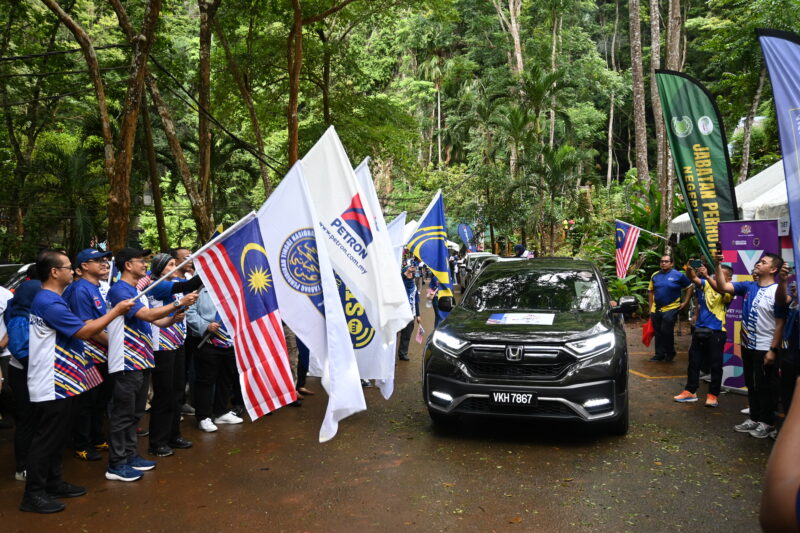
The Road Transport Department (JPJ) has announced the suspension of an officer found guilty of overtaking on a double line, as seen in a video that has gone viral on social media.
In addition to the suspension, the officer involved has also been fined, subjected to a driving ban of departmental vehicles, and reassigned to a group position at the JPJ Headquarters until the investigation is completed.
Following this incident, the JPJ has also initiated further investigations into other offenses committed by the officer for additional action.
In the viral video, a JPJ vehicle, a Honda CR-V, was seen overtaking heavy vehicles on a bend that had double lines.
JPJ expresses its highest appreciation and urges the public to continue reporting violations committed by road users through the MyJPJ app or via email at aduantrafik@jpj.gov.my.
The Rally Finland event, set to take place from July 31 to August 3, will witness the debut of a vehicle specially developed by Toyota Gazoo Racing and powered by hydrogen.
The rally vehicle in question is the Toyota GR Yaris Rally2 H2 Concept, built on the proven GR Yaris Rally2 chassis.
Developed at the TGR-WRT headquarters located in Jyväskylä, Finland, the true capabilities of this hydrogen rally vehicle have also been tested on roads around the area, including the gravel surfaces typically used in Rally Finland.
For its inaugural appearance, the GR Yaris Rally2 H2 Concept will be driven by four-time world champion Juha Kankkunen, who is also the deputy principal of the TGR-WRT team.
The combination of Toyota and hydrogen engines is not unfamiliar in the world of motorsports.
Hydrogen-powered internal combustion engines were used in racing through the Corolla vehicle in 2021, during the Super Taikyu endurance racing series.
This technology was showcased on the European rally stage for the first time in 2022 with the experimental GR Yaris H2 at the FIA World Rally Championship round in Belgium, driven by Akio Toyoda and Juha Kankkunen.
Unlike the GR Yaris Rally1, which uses a four-cylinder inline engine, the GR Yaris Rally2 uses the same engine found in the production version of the GR Yaris, which is the G16E-GTS 1.6-liter turbo unit.
However, the fuel supply and injection systems have been modified to accommodate hydrogen fuel.
More importantly, this engine still manages to deliver performance, as well as the sound and sensations that rally fans crave, all while achieving near-zero emissions—a feat that is challenging for any high-performance EV to provide.
MG Motor Malaysia has announced the introduction of a new rear-wheel drive (RWD) variant of the electric roadster, the MG Cyberster.
With the arrival of the RWD variant, the MG Cyberster is now available starting at a price of RM299,900, while the Cyberster 4WD is priced at RM319,900.
In terms of specifications, the Cyberster RWD is powered by a rear-wheel drive electric motor that produces 340 PS and 475 Nm of torque.
It accelerates from 0 to 100 km/h in just five seconds, while the 77 kWh battery pack offers a driving range of up to 508 km.
The Cyberster RWD also supports DC fast charging, allowing the battery pack to be charged from 10% to 80% in just 38 minutes.
Other features include 19-inch alloy wheels and a Brembo braking system that provides control corresponding to its performance.
In terms of design, both the Cyberster RWD and 4WD variants showcase similar styling elements, including LED headlamps and a low silhouette that highlights a Kammback-style rear design.
The cabin of the Cyberster is inspired by motorsports, featuring leather and Alcantara finishes, sport seats with lumbar support, a 10.25-inch digital display, a seven-inch touchscreen, and two additional seven-inch screens.
Four attractive color options are available: Dynamic Red, Camden Grey, Inca Yellow, and English White.
MG Malaysia also offers a red soft top as a RM2,000 option in addition to the standard black roof.
Malaysians can take a closer look at the all-new MG Cyberster RWD during the “Dare to Love” roadshow series, taking place at 1 Utama (Old Wing) from July 9 to July 13.
Customers who place an order for the MG Cyberster during this period will receive a one-year unlimited JomCharge charging package, a complimentary 7kW AC wall charger, and a limited edition diecast MG Cyberster model.
The Malaysian Road Transport Department (JPJ) has announced a recall campaign affecting 8,322 units of vehicles from three brands.
Of this total, 5,123 units of the Kia Rio UB (model years 2010-2017) are being recalled due to a potential risk of short circuits that could cause a fire in the hydraulic electronic control unit (HECU).
Meanwhile, 1,649 units of the Yamaha MT-09 and 1,369 units of the Yamaha Tracer 9 GT (models manufactured from November 2021 to February 2025) are also being recalled due to malfunctioning Throttle Position Sensor (TPS) components.
Additionally, 149 units of the 2023-2024 Tenere 700 are affected by clutch operation issues that could interfere with gear shifting.
Mercedes-Benz Malaysia has also announced a recall involving 32 units of various models (S-Class, GLC-Class, AMG SL, EQE, and EQS) due to improperly reinstalled fuse boxes that may compromise the system’s functionality.
All affected owners will be contacted by their respective vehicle manufacturers to arrange inspection appointment slots.
According to JPJ, any components involved in the recall will be replaced at no cost to the owners.
Chery Malaysia has officially launched the new B-segment SUV, the Chery Tiggo Cross 2025, for the local market.
Here is a brief overview of what you need to know about this competitor to the Proton X50 and Honda HR-V:
Dimensions
The Chery Tiggo Cross measures 4,318 mm in length, 1,830 mm in width, 1,670 mm in height, and has a wheelbase of 2,610 mm.
The cargo space is 380 liters, or 350 liters for the hybrid version.
As standard, the Chery Tiggo Cross 1.5T comes with 18-inch wheels, while the HEV version is equipped with 17-inch wheels.
Engine
The Chery Tiggo Cross is powered by a 1.5-liter turbo engine producing 147 PS and 210 Nm of torque, matched with a six-speed DCT transmission.
Fuel consumption is approximately 6.3 liters per 100 km.
The Chery Tiggo Cross HEV combines a 1.5-liter naturally aspirated engine with 96 PS and 120 Nm of torque with an electric motor providing 204 PS and 310 Nm of torque, a 1.8 kWh battery pack, and a hybrid DHT transmission.
The HEV version offers a 0-100 km/h acceleration time of 8.9 seconds with a fuel consumption rating as low as 5.4 liters per 100 km.
Suspension & Brakes
Both versions of the Chery Tiggo Cross are equipped with MacPherson strut front suspension and a torsion beam at the rear.
The braking system consists of vented discs for the front axle and solid rotors for the rear axle.
Exterior Features
As standard, the Chery Tiggo Cross includes features such as LED headlights, LED daytime running lights (DRL), LED taillights, roof rails, and a sporty roof spoiler.
Additionally, it features automatic lighting and a “Follow Me Home” function.
Interior Space
For the interior, the Chery Tiggo Cross offers features such as a dual 10.25-inch screen with Apple CarPlay and Android Auto support, a 540-degree surround camera system, six speakers, and a six-way adjustable driver’s seat with lumbar support.
Other features include ambient lighting, a 15W wireless smartphone charging slot, dual-zone automatic climate control, remote start assist, and keyless entry.
Safety Features
The Chery Tiggo Cross 1.5T is equipped with six airbags, passive safety assistance features (ESP, HAC, EBA, TCS), a tire pressure monitoring system (TPMS), and several advanced driver assistance systems (ADAS) including:
Lane Departure Warning (LDW)
Blind Spot Monitoring System (BSD)
Rear Traffic Cross Alert (RTCA)
Lane Keep Assistance (LDP)
Adaptive Cruise Control (ACC)
Front Collision Warning (FCW)
Autonomous Emergency Braking (AEB)
Meanwhile, the Tiggo Cross HEV has an additional airbag and comes with ADAS features such as:
Door Opening Warning (DOW)
Rear Collision Warning (RCW)
Rear Traffic Brake System (RTBS)
Lane Change Assistance (LCA)
Multiple Collision Braking (MCB)
Traffic Jam Assistance (TJA)
Integrated Cruise Control (ICC)
Intelligent Speed Assistance (ISA)
Pricing
Chery Tiggo Cross 1.5T is sold at a starting price of RM88,800, while the Chery Tiggo Cross HEV is offered at a special price starting from RM99,800, valid for the first 2,000 customers until September 30, 2025.
The writer had the opportunity to test drive several small Volvo models before, including the Volvo V40 and the Volvo XC40 and C40 crossovers.
This time, it’s the turn of the smallest production model ever created by the Scandinavian manufacturer, the Volvo EX30.
It comes exclusively as an electric crossover, with no internal combustion engine options available.
Despite being available only in an EV version, the EX30 is not a model to underestimate.
It has a package that can meet the needs of every user—offering style, practical space, and performance capable of outperforming larger SUVs, especially when you choose the Ultra Twin Performance variant, which we drove for this test.
Here’s a summary of our experience after enjoying the EX30, priced at RM228,888, for several days.
Exterior Appearance
Yes, in terms of design, it’s hard to deny that this is a Volvo SUV.
Just look at the headlights with Thor hammer-shaped LED graphics, the front end without a grille displaying the minimalist Volvo logo, and the rear lights—all reminiscent of the Volvo EX90.
Its size is indeed quite compact, measuring 4,223 mm in length, 1,837 mm in width, 1,555 mm in height, and a wheelbase of 2,650 mm, making it smaller than its siblings, the XC40 and C40.
However, small does not mean the EX30 is less practical; the details can be found in the next section.
Practicality
Volvo seems clever in providing a comfortable and practical cabin space in the EX30.
Due to the absence of a speaker system (it has only a Harman Kardon soundbar on the dashboard), there is ample space on the door panels.
The center console appears simple, but when the weather is warm, you can place a cool drink in a pull-out cup holder that can be hidden away when not in use.
Is that not enough? The floor console is also provided, along with additional hidden compartments for smaller items and space in the console tunnel.
The glove box is positioned in the center for easy access by both the driver and front passenger.
Although it looks small from the outside, the Volvo EX30 offers a cargo space of 318 liters, which can expand up to 718 liters when the second-row seats are folded flat in a 60:40 ratio.
This is large enough to accommodate items up to 1.64 meters long and 0.86 meters high.
If you need to head to Ikea for furniture shopping, you can refer to the storage guide graphic provided on the rear tailgate.
Still not enough? There’s a frunk that offers a capacity of seven liters.
Extremely Minimalist to the Point of Confusion
Want to know why Volvo can provide such extensive space?
It’s because Volvo has taken minimalist design to an extreme level, requiring me to ‘reset’ my mindset each time before starting my journey.
The window buttons have been relocated to the center—like cars from the old days—and there are only two buttons available.
You need to press an extra button to open the rear passenger window.
To control the temperature of the air conditioning system? Use the central display screen.
To adjust the steering settings and side screens? Again, it’s done through the central display.
Want to open the glove box? Yes, you also need to press the menu on the central screen.
Fortunately, to start my journey, I didn’t have to scroll through the central screen to switch to Drive mode. The gear shift lever is provided in the steering column, complete with cruise control mode (you only need to pull the lever down once after entering Drive mode).
Finishing Touches
One commendable aspect of the Volvo EX30 is its extensive use of sustainable materials within the cabin.
For example, the upholstery for the seats, dashboard, and doors is made from recycled materials such as denim, hemp, and a wool blend.
The use of these materials does not compromise the comfort factor throughout the driving experience.
What I particularly like is the seating that fully supports the lower legs, along with the comfortable armrest panel on the door.
However, if you look closely, the plastic finishes in certain areas seem inconsistent with the luxurious image Volvo is trying to portray in the EX30. After all, it is made from recycled plastic.
Agile Driving on the Road
The Ultra Twin Performance variant of the EX30 comes equipped with two electric motors that produce 422 hp and 543 Nm of torque, allowing it to accelerate from 0 to 100 km/h in just 3.6 seconds.
With its small, agile body package, the EX30 has no trouble outperforming any sports car out there.
Its suspension tuning is excellent, effectively absorbing all the imperfections found on the road and providing a delightful driving experience, especially when encountering curves.
To be frank, I believe the suspension tuning in the EX30 is significantly better compared to its bigger siblings, the XC40 and C40.
Most of the time, the power delivered by the rear motor is sufficient, and I hardly relied on the Performance mode for the AWD system (which has to be accessed through the central screen).
The NMC 69 kWh battery pack allows you to achieve an impressive driving range of 450 km, making it well-suited for urban driving.
The steering response is also quite good, ensuring that the EX30 stays precisely on its intended path.
Unexpected Off-Road Capability
Clearly, the Volvo EX30 has its unique strengths, making it suitable as an everyday vehicle.
However, one unexpected advantage I discovered is the comfort it offers when the Volvo EX30 is taken off-road (more appropriately, soft-road).
I admit that this EV is already quite comfortable on paved roads, but when the tires hit gravel paths, the EX30’s suspension system effectively filters out all the roughness of unpaved roads.
It’s perfect for driving across rough terrain, allowing you to enjoy outdoor weekend activities like picnicking by the river or camping on the beach.
Given this impressive potential, it’s no surprise that Volvo showcased the EX30 Cross Country version earlier this year for those who seek a more rugged driving experience in this compact EV.
Will the EX30 Cross Country be realized in the future? We can only wait and see what plans Volvo has for this electric SUV.
Charging
The 69 kWh NMC battery supplied in the Volvo EX30 supports AC charging at 11 kW, taking eight hours for a full charge.
If you’re short on time, simply charge the EX30 at any fast-charging station, as this EV supports DC charging up to 153 kW.
In just half an hour, the 69 kWh battery can be charged from 10% to 80% state of charge.
Alternatively, you can visit any shopping center with fast-charging facilities, allowing you to shop for your desired items while the vehicle charges.
One feature I particularly like about this EV is the Google-based mapping system that displays the estimated battery state of charge upon arrival at your destination or after a round trip.
Safety
As a Volvo, the EX30 is equipped with nearly comprehensive safety features in this compact package.
These include adaptive cruise control, traffic jam assistance, collision avoidance assistance, autonomous emergency braking, lane keeping assistance, lane departure warning, blind spot monitoring, and rear cross-traffic alert.
Ironically, it also features a driver attention monitoring system that alerts the driver if it detects a lack of attention on the road.
What can you expect from a car that crams all sorts of settings and functions into a single 12.3-inch screen?
Essential information such as speed, battery state of charge, traffic light notifications, and gear position (RND) is displayed at the top of the screen.
During driving, I find myself looking to the left to ensure that this EV is being driven at the speed allowed by law.
Or every time my left finger pushes the lever to activate the turn signal.
Or each time I feel the cabin temperature is too cold and want to adjust the air conditioning.
It would be more pleasant if the EX30 had a separate screen behind the steering wheel, so that eye movement would be minimized compared to having to rely entirely on the central screen.
Directly installing a head-up display screen would probably be more practical.
Conclusion
For an urban-use EV, I find the Volvo EX30 has a solid foundation and an attractive design, making it suitable for young people with active lifestyles.
That is, if you don’t mind the overly minimalist dashboard layout presented in this Volvo.
Try taking the time to get used to it, and it won’t be a major issue.
However, it can be somewhat problematic for old-school drivers like me, who are still adjusting because we’re used to physical buttons and controls.
In terms of driving, the EX30 is certainly suitable as an everyday car, enjoyable to drive, and, most importantly, it does not compromise practicality and safety elements, which are the primary foundations of the Volvo brand.
However, if you aren’t concerned about all-wheel-drive performance or the panoramic glass roof, you can opt for a lower variant (priced from RM189k) to enjoy a longer driving range.
Specifications of the Volvo EX30 Ultra Twin Performance (RM228,888)
Suzuki Motor Corporation has announced the arrival of two new neo-retro motorcycle models in the 800 cc class, namely the GSX-8T and GSX-8TT, for the global market.
Although both models utilize the more modern GSX-8 platform, they can be distinguished through their styling, where the GSX-8T draws inspiration from the classic T500 motorcycle.
It features a round LED headlight housing, a uniquely designed fuel tank and seat, as well as handlebars complete with end-mounted mirrors.
Meanwhile, the more muscular design of the GSX-8TT takes its inspiration from machines of that era, such as the Yoshimura GS1000.
The GSX-8TT retains the same headlight housing as the GSX-8T model; however, this section is refined with angular fairings, followed by a radiator guard and an engine under-cowl.
In terms of power, both the GSX-8T and GSX-8TT are powered by the same 776 cc parallel-twin engine found in any of the GSX-8 models, delivering 80 hp at 8,500 rpm and 77 Nm of torque at 6,800 rpm.
Additionally, they are equipped with a cross balancer component designed to reduce vibrations.
Both motorcycles feature a steel frame and an aluminum swingarm, KYB upside-down front forks, KYB rear shock absorbers, and a Nissin braking system consisting of dual 310 mm rotors at the front and a single 240 mm rotor at the rear.
The fuel tank has a capacity of 16.5 liters, while the seat height is as low as 810 mm (815 mm for the GSX-8T model).
As standard, the GSX-8T and GSX-8TT come equipped with electronic aids such as a bidirectional quickshifter, Suzuki Easy Start, traction control, Suzuki Drive Mode Selector (SDMS), and Low RPM Assist.
The full-color TFT display shows all the important information required by the rider, including the RPM meter, speed, and gear position.
In June 2025, Proton reported total sales of 11,069 units, bringing its year-to-date (YTD) sales figure to 72,156 units.
This positions Proton as the second-largest brand in the industry, despite a 21 percent decline in total industry volume (TIV) to 53,500 units compared to 68,007 units in May.
Proton’s market share for June is estimated at 20.7 percent, reflecting an increase of 1.1 percent compared to the previous month and up 1.2 percent from the YTD figure of 19.5 percent.
According to Proton, the decline in automotive sales in June was influenced by external factors such as increased tensions in the Middle East and the expansion of the Sales and Service Tax (SST), which negatively affected buyer sentiment.
So far, the Proton Saga continues to top the chart as Proton’s best-selling car with 5,206 units sold, followed by the Proton X50 (1,657 units), Proton S70 (1,402 units), Proton Persona (1,171 units), Proton X70 (533 units), Proton Iriz (288 units), and Proton X90 (174 units).
Meanwhile, the only EV model, the Proton e.MAS 7, concluded the first half of 2025 with 4,253 units sold in the domestic and export markets, achieving a 24 percent market share.
Proton’s vehicle exports surged by 56.8 percent to 414 units in June 2025 compared to June 2024, resulting in a total export figure for the first half of the year that increased by 39.9 percent to 2,250 units.
Proton anticipates that these figures will continue to rise as the Proton e.MAS 7 model is introduced in more countries in the future.
Returning to the local market, Proton is expected to launch the facelifted X50 model this July, featuring changes in design, engine specifications, and enhancements to the ADAS 2.0 system.
Hap Seng Trucks Distribution (HSTD), the authorized distributor of Mercedes-Benz Vans in Malaysia, recently launched the new electric minivan model, the 2025 Mercedes-Benz EQV 300.
Offered in a single Avantgarde variant, the EQV 300 is powered by a 204 PS electric motor with a torque of 365 Nm, paired with a 90 kWh battery pack.
With a full charge, the EQV 300 can travel up to 418 km.
The EQV 300 also supports AC charging at 11 kW, allowing for a 10-hour charging time, as well as fast DC charging at 110 kW, in which the battery pack can be charged from 10% to 80% in just 45 minutes.
This seven-seater minivan is equipped with LED lighting units, 17-inch alloy wheels, a panoramic glass roof, as well as an electric tailgate and sliding doors.
The cabin features dual 12.3-inch MBUX display screens, Apple CarPlay and Android Auto support, a Burmester audio system, automatic climate control, ambient lighting with 64 color options, Lugano leather upholstery, and wireless smartphone charging facilities.
In terms of safety, the EQV 300 is equipped with features such as a 360-degree camera, Hill Start Assist (HSA), a blind spot monitoring system, a tire pressure monitoring system, Active Distance Assist Distronic, Active Brake Assist, and airbags covering the front, side, and all A-D pillars.
The Mercedes-Benz EQV 300 Avantgarde is priced starting from RM450,000.
Every purchase includes a free Wallbox charging package, a complimentary three-year maintenance package, and a special RM10,000 booking rebate.
As standard, the EQV 300 comes with a two-year warranty (or a mileage limit of 200,000 km, whichever comes first), and a battery warranty of up to eight years or 160,000 km, whichever comes first.
Hap Seng Trucks Distribution will also hold a roadshow at Bangsar Shopping Centre from July 21 to July 27, where Malaysians can get a closer look at the EQV 300 model.
Malaysia’s largest annual Kustom &Counter Culture event, Art of Speed, is set to once again shake the grounds of the Malaysia Agro Exposition Park, Serdang (MAEPS) on July 26-27 this year with the theme “Kustom Ada Gaya”.
As always, AOS will feature several special guests, including Shige Suganuma, Hiro “Wildman” Ishii, and Hey Murakami (Mooneyes), Brendon Vetuskey (Hot Wheels), Mark Hawwa (The Distinguished Gentleman’s Ride Australia), along with various custom motorcycle builders from around the world.
Three modified motorcycles from abroad will also be on display: the BMW R18 “Ground 0” by Yuichi Yoshizawa from Custom Works Zon, a Harley-Davidson Knucklehead chopper by Masa Sugihara (Luck MC), and a Harley-Davidson Flathead by Ben Forster (Benflathead).
Additionally, AOS has announced five new collaborations:
AOS x Hot Wheels Collection – the first Porsche 911 left & right convention cars in Southeast Asia
AOS x FK – the latest shoe design
AOS x High Cultured – a local streetwear brand
AOS x XOCKS
AOS x Mooneyes – celebrating a decade of excellence
AOS is also introducing the World of Wheels (WOW), a special Show & Shine segment that will provide high-quality photography experiences for vehicle owners, managed by NoEqual.co.
It is reported that more car and motorcycle entries will be accommodated for AOS 2025, spanning classic to contemporary categories.
Winners of Best of Show in both the car and motorcycle categories will qualify to participate in The 33rd Annual Yokohama Hot Rod Custom Show in December 2025.
As always, AOS wouldn’t be complete without Hot Wheels, with Hall C set to be lively with the 3rd edition of the Hot Wheels Collectors Convention Malaysia (HWCCM), bringing together Hot Wheels enthusiasts from across the country.
A variety of exciting activities will include rare Hot Wheels displays and collections, a Swap Buy & Sell event, sharing sessions, and HW custom competitions.
Not to be missed, a lineup of fantastic artists will light up the SoundCircus Takeover 2025, including Noh Salleh, Ruffedge, Romantic Echoes, and Restore Iboe, all taking place in Hall A.
For a limited time, AOS is offering Early Bird tickets for RM35.00 (Weekend Pass) and RM40.00 (Sunday Pass) while stocks last. Visitors can also obtain VIP Parking valet tickets for RM30.00, allowing them to park on the Ground Level, Hall D, valid for one day of admission.
Proton has officially opened bookings for the facelifted model of its B-segment SUV, the 2025 X50.
The first 10,000 customers will receive an exclusive offer that includes a cash rebate of RM1,000, a limited edition Touch ‘n Go card, as well as a “Gempak” offer to be announced during its official launch.
At this time, Proton has yet to disclose the sales price of the X50 2025, but it is reported that there are three main variants: Executive, Premium, and Flagship.
As standard, all three variants are powered by a 1.5-liter turbocharged inline-four engine that generates 181 PS at 5,500 rpm and 290 Nm of torque at 2,000-3,500 rpm.
This power is transmitted to the front wheels through a seven-speed dual-clutch transmission (DCT).
The acceleration from 0 to 100 km/h is now as quick as 7.6 seconds, and it is said to be 4.7% more fuel-efficient compared to the previous model.
Here are the new details for each variant:
X50 Executive
New LED headlights with daytime running lights
New LED taillights
New front grille
New 17-inch alloy wheels
New dashboard
Center console with a storage space of 10 liters
14.6-inch infotainment screen and 8.88-inch cluster screen
Hi Proton voice command support in Malay
Apple CarPlay and Android Auto support
Fabric seats
Six speakers
Automatic climate control with N95 cabin filter
Six airbags
Rearview camera
Lane Change Assist (LCA), Rear Collision Warning (RCW), Rear Cross Traffic Alert (RCTA), Door Opening Warning (DOW)
X50 Premium (features additional to the above)
18-inch alloy wheels
Powered tailgate
Roof rails
Red brake calipers
72-color ambient lighting system
Leatherette upholstered seats
HD 360-degree camera + 180-degree transparent display
Autonomous Emergency Braking (AEB), Forward Collision Warning (FCW), Adaptive Cruise Control (ACC), Intelligent Cruise Control (ICC), Lane Departure Warning and Prevention (LDW & LDP), Lane Centering Control (LCC), Traffic Sign Information (TSI), High Beam Assist (IHBC), and Tire Pressure Monitoring System (TPMS)
X50 Flagship (features additional to the above)
Sporty roof spoiler
Two-tone exterior finish
Gloss black finish on side mirrors
Semi-transparent sun visor
Wireless charging slot
Panoramic glass roof
Two-tone interior finish
Auto Park Assist (APA)
Five colors are offered for the Proton X50: Snow White, Passion Red, Jet Grey, Armour Silver, and the new Teal Bayou Green.
According to Proton, the X50 2025 model features approximately 245 new components, with a development period that took about 412,000 hours and has undergone road testing over a distance of 4.3 million km.
Boon Siew Honda Sdn Bhd has announced the launch of the limited edition Honda CBR150R Special Edition for the local market.
Uniquely, it now features a fierce tiger livery complete with a CyberRoar color theme that enhances the aggressive image of this 150 cc sports bike.
With each purchase of this special edition model, customers will receive gifts including a sports camera, an intercom communication device, and an LED reflective bag.
The Honda CBR150R Special Edition will be offered in a limited run of 250 units at Impian X showrooms starting July 15, with each unit priced at RM14,399, excluding road tax, insurance, and registration fees.
For those who miss out, the standard Honda CBR150R is still available in Honda Tricolor and Silver, each priced at RM13,399.
The basic specifications of this machine remain unchanged; it is powered by a 150 cc single-cylinder engine that produces 16 hp at 9,000 rpm and a torque of 13.7 Nm at 7,000 rpm, paired with a six-speed transmission and an assist & slipper clutch.
Other features include upside-down front forks, front and rear disc brake systems, a two-channel ABS system, a 12-liter fuel tank, LED lighting, and a full digital meter.
For your information, the Honda CBR150R has received a five-star safety rating from MyMAP.
The one make racing event, Vios Challenge, was exceptionally unique this time as it featured a different format compared to the previous two races.
For the first time, the Vios Challenge made its international debut concurrently with the Autobacs Super GT round in Malaysia, held from June 26-28.
Additionally, this second round of the 8th season of the Vios Challenge introduced a one-hour race format covering a total distance of 5.543 km, as opposed to the previous 10-lap sprint races that utilized half of the Sepang circuit.
To make the race more exciting, all 36 drivers from three racing classes (Super Sporting, Sporting, and Rookie) were released simultaneously, which significantly increased the challenge and provided a fairer opportunity for all competitors.
This was reflected in the final results of both races, where podium positions varied for each racing class.
The Vios Challenge still has two rounds remaining, with the third round scheduled to coincide with the Malaysia Championship Series (MCS) on August 8-10.
Meanwhile, the fourth round is planned for October 2025 in Johor, with the exact location and date to be announced later.
Below are the race results of the Vios Challenge by class:
Super Sporting Class
Race 1 1. Freddie Ang (Telagamas Toyota)
2. Nabil Azlan (Wheelcorp)
3. William Ho (Toyotsu Toyota)
Race 2 1. Mitchell Cheah (Team Prima Pearl SP Selatan)
2. Ady Rahimy (Laser Motor Racing)
3. Freddie Ang (Telagamas Toyota)
Sporting Class
Race 1 1. Jwan Hii (Hong Huat x Armada KK Racing)
2. Dato Dr Ken Foo (Kulim Top Wheels)
3. Warunchit Wattanathanakun (RUK Team Nexzter PMC 52)
Race 2 1. Justin Toh (BAE Racing by ES Yang)
2. Elson Lew (BAE Racing by ES Yang)
3. Warunchit Wattanathanakun (RUK Team Nexzter PMC 52)
The Vios Challenge still has two rounds remaining, with the third round scheduled to take place concurrently with the Malaysia Championship Series (MCS) on August 8-10.
Meanwhile, the fourth round is planned for October 2025 in Johor, with the exact location and date to be announced later.
Round 3 of the Super GT Malaysia 2025 saw the Deloitte TOM’s GR Supra and UPGARAGE AMG GT3 excel in the GT500 and GT300 classes, respectively, under track temperatures reaching 42°C.
Here are the final results of Round 3 of Super GT Malaysia 2025:
GT500 Class
Deloitte TOM’s GR Supra #37
Arta Mugen Civic Type-R GT #8
TRS Impul with SDG Z #12
GT300 Class
Upgarage AMG GT3 #18
Green Brave GR Supra GT #52
Goodsmile Hatsune Miku AMG #4
After the Malaysian round, Super GT will return to Japan, where the fourth round will take place at Fuji Speedway on August 2-3.
Malaysia remains the only location outside of Japan to host Super GT races, and this year marks the first time this prestigious event has returned to the Sepang Circuit since its last hosting in 2013.
Proton has announced a comprehensive update for the B-segment SUV model, the 2025 X50.
Unlike its predecessors, the heavily facelifted X50 now features a distinctly different appearance on the exterior, a revamped cockpit, and, notably, a more powerful engine offering.
Here are some key details about the 2025 X50 facelift:
1. Engine
Say goodbye to the three-cylinder engine; the X50 facelift now comes equipped with a 1.5-liter inline four-cylinder turbo engine.
It delivers a power output of 181 PS and 290 Nm, transmitted to the front wheels via a seven-speed dual-clutch transmission (DCT).
The acceleration from 0 to 100 km/h is now as quick as 7.6 seconds, all while offering 4.7 percent improved fuel efficiency.
2. Stylish Exterior
The Proton X50 facelift boasts a refreshed front and rear design with new headlight units, taillights, bumpers, spoilers, and a new set of 18-inch alloy wheels.
Four existing colors are available (Snow White, Passion Red, Jet Grey, and Armour Silver), along with a new color option: Teal Bayou Green.
3. More Elegant Cabin
In the cabin, the dashboard layout has been completely redesigned, featuring a smaller cluster screen and a 14.6-inch infotainment screen that now supports Apple CarPlay and Android Auto as standard.
The center area is more spacious and includes a wireless charging slot for smart devices, as the gear shift lever has been relocated to the steering column.
Additional features include ambient lighting with 72 color options, a central console with under-storage space, and voice commands now supporting the Malay language.
4. Enhanced ADAS
The safety features of the Proton X50 have been upgraded with an improved Level 2 Advanced Driver Assistance System (ADAS) that includes the following functions:
Rear Side Radar System (RSRS)
Automatic Parking Assistance (APA) with a 360-degree HD camera
180-degree under-vehicle transparent display
More details will be announced in the near future.
The legacy of the iconic Volvo 240 as the best-selling Volvo car in history has officially come to an end.
This is because that title has now been claimed by the Volvo XC60, with over 2.7 million units sold worldwide since its introduction in 2008.
Initially produced for the European market, this mid-size SUV became Volvo’s first global model to be assembled in China.
It was also named World Car of the Year in 2018.
When the Volvo 240 was launched in 1974, it set new safety standards, including a body design capable of absorbing frontal and rear impacts.
It was also among the first to introduce side impact protection, which later evolved into the Side Impact Protection System (SIPS).
In 1978, Volvo introduced the innovative child booster cushion.
The legacy of safety in cars continues with the XC60, which features various advanced technologies, such as the City Safety automatic braking system that can prevent or reduce collisions at speeds of up to 30 km/h.
In 2017, the XC60 became the first car in the world to introduce the Oncoming Lane Mitigation system, designed to avoid collisions with oncoming traffic.
According to Susanne Hägglund, Head of Global Offering at Volvo Cars, “Growing up in Sweden in the 1980s, the Volvo 240 was the iconic family car – almost every household had one.
“Today, the XC60 carries on that role – not just as a family option, but also as the most successful model in our history.”
Proton recently signed four joint venture agreements as well as two technical agreements with local vendors and global suppliers for Geely’s products.
This new collaboration aims to strengthen the company’s local supply chain and enhance the capabilities of local vendors.
It also aims to accelerate the localization of key components for Proton models in the internal combustion engine (ICE) and electric vehicle (EV) segments.
Among the key components involved are as follows:
ADAS (Advanced Driver Assistance Systems) for model AMA01 (Delloyd Technology Bhd & Imotion Automotive Technology (Suzhou) Co. Ltd)
Brake systems for model AMA01 and Series X (PEPS JV (M) Sdn Bhd & Liuzhou Sanly Autoparts Co. Ltd)
Lighting systems (JHM Consolidation Bhd & Jiangsu Dekai Auto Parts Co. Ltd)
HVAC (Heating, Ventilation, and Air Conditioning) systems (Trillion Speed (M) Sdn Bhd & Shanghai Yinlun Heat Exchange Systems Co. Ltd)
Additionally, a technical agreement has been finalized between SHJ Interia Sdn Bhd and Changcun Fawsn Automotive Trim Co. Ltd to develop and transfer new manufacturing technologies for interior components, particularly roof linings.
The second technical agreement involves Xenso Electronics Sdn Bhd and Freetech Intelligent Systems Co. Ltd, aimed at developing advanced driver assistance systems (ADAS), specifically for blind spot monitoring and lane change assistance functions.
“With high-tech components becoming increasingly important in our models, it is essential for PROTON to bring the development and production of these components into the local ecosystem. This is not only for cost reduction but also to enhance the capabilities of our R&D team and vendors.
These joint venture and technical agreements reflect our long-term commitment to manufacturing vehicles in Malaysia while making the country an automotive hub by contributing to the realization of the Automotive High Tech Valley (AHTV) led by the company’s shareholders,” said Wang Huaibing, Chief Procurement Officer of PROTON.
Proton continues to expand its strategic partnership with Grab Malaysia by introducing more car model options to meet the needs of drivers on this e-hailing platform.
This collaboration follows the success of the previous campaign, “Saga Power Up for Grab Driver-Partners,” which was launched in November 2024.
Apart from the Proton Saga, Grab driver partners can choose to acquire the Proton S70 sedan and the premium model range of the X Series (Proton X50, Proton X70, and Proton X90), tailored under the GrabCar Plus and GrabCar (6-seater) categories.
This collaboration also offers attractive incentives, such as cash rebates of up to RM13,000, as well as a 5 percent service discount for the first two years or up to 40,000 km.
It also provides petrol support worth RM500 to ease initial ownership operating costs.
Ong Chee Wooi, Deputy Sales Director of Proton EDAR, stated, “This strengthened collaboration with Grab Malaysia is an important step in reinforcing the e-hailing sector. PROTON is pleased to offer the S70 model and the premium X series to Grab driver partners.
“For gig workers, this comprehensive program not only provides exclusive advantages but also guarantees reliability and affordable maintenance – crucial factors for those who use their vehicles as the primary tool for earning a living.”
Rashid Shukor, Director of Country Operations and Mobility at Grab Malaysia, said, “We are pleased to strengthen our collaboration with PROTON, which reflects our ongoing commitment to providing flexible opportunities for Malaysians.
“This initiative has made it easier for our driver partners to acquire vehicles, enabling them to generate income and support their families while meeting the growing demand from passengers.
“With the expansion of this collaboration – including the S70 model and the premium X series – driver partners now have the opportunity to enhance their driving experience, upgrade their vehicles, and meet the diverse needs of customers. We hope to continue moving forward together in building a future that is more inclusive and full of opportunities for all.”
Castrol has announced a new lineup of riders for the Castrol Power1 Honda Yuzy Racing team, which will compete in the 2025 Petronas MAM Malaysia Cub Prix Championship.
The two new riders are Muhammad Haziq Hakimy Kamaruddin and Aisy Izz Hafiy Hairul Hafiz.
Both riders will join the current racer Aqeel Danish Zaiermanhady to compete in the CP125 category.
Haziq Hakimy and Aisy both come with impressive achievements from the Honda One Make Challenge, where Hakimy finished third in the 2022 competition, and Aisy was a runner-up in 2021.
Their addition signifies a fresh start and a strong drive to secure podium positions this season, following Md Haziq Hamdan’s success in securing third place in the ninth round of the 2024 season.
“We are optimistic about our new roster this season and confident that all three riders will deliver outstanding performances and be top contenders for podium finishes,” said Castrol Power1 Honda Yuzy Racing Team Manager, Shahrol Yuzy Ahmad Zaini.
“Their recent training performances have been very encouraging, and we believe this team will achieve excellent results throughout the season,” he added.
Keow Mei-Shan, Marketing Director of Castrol Malaysia & Singapore, remarked, “This new lineup of riders reflects our commitment to nurturing new talent while striving for success on the racetrack. We are very excited to have Aqeel, Haziq Hakimy, and Aisy representing the Castrol Power1 Honda Yuzy Racing team.”
Internationally, Castrol serves as the primary sponsor and technical partner for Honda Racing Corporation (HRC) Factory MotoGP for the 2025 MotoGP season.
As part of this collaboration, Castrol will supply lubricants and fuels, as well as provide technical support to the team.
This partnership marks a new chapter in the long-term relationship between Castrol and Honda, further strengthening their mutual commitment to excellence in motorsport.
The team made its debut during the MotoGP pre-season test at the Sepang International Circuit on February 5, 2025.
“Castrol has a long history of using motorsport to showcase technical capabilities and new technologies developed together. This collaboration represents a valuable opportunity to build closer ties with motorcycle racing fans and two-wheeler enthusiasts worldwide,” stated Castrol Chief Marketing Officer, Sandeep Sangwan.
“HRC and Castrol share a steadfast commitment to performance and innovation. We have achieved significant success together in the past, so it is no surprise that we chose to renew this collaboration,” explained Koji Watanabe, President of Honda Racing Corporation.
Looking for a robust and stylish workhorse that isn’t a pickup truck? Toyota Europe has the answer for you.
Introducing the Toyota Land Cruiser, a light commercial vehicle (LCV) specification specifically for the UK market, built at the Burnaston Toyota factory in Derbyshire.
The Land Cruiser LCV is aimed at professionals seeking off-road capability, with a closed cargo capacity of 2,000 liters.
The original second-row seating has been removed and replaced with a steel panel, a flat cargo floor, and a divider between the cargo space and the front cabin.
Additionally, Toyota has equipped this Land Cruiser LCV with 18-inch alloy wheels, an electrically adjustable driver’s seat, heated seats and steering wheel, as well as a powered tailgate with an opening glass window.
Not to be missed are features like an auto-dimming rearview mirror, electronic parking brake, dual-zone climate control, a 9-inch infotainment screen, and Toyota’s Safety Sense safety equipment.
In terms of power, the panel version of the Land Cruiser is powered by a 2.8-liter turbo diesel engine matched with a full-time four-wheel drive system—there are no changes in power (201 hp/500 Nm), off-road capability, towing capacity of up to 3.5 tons, and water wading capability of up to 700 mm.
According to Toyota, the Land Cruiser LCV will be available for sale this August, with a starting price of £51,729 (approximately RM299,000).
Toyota has also announced an update to the existing Land Cruiser offerings, where the 2.8-liter turbo diesel engine will be replaced with a 48V mild hybrid unit that adds 16 hp and 65 Nm.
This mild hybrid version is said to provide a quieter, smoother, and more responsive engine while also reducing CO2 emissions compared to the previous configuration.
Mercedes-Benz Malaysia has just launched the electric-powered off-road SUV model, the Mercedes-Benz G 580 with EQ Technology, for the local market.
Built on the existing G-Class platform, the G 580 EQ features a setup of four electric motors, delivering up to 587 hp and a torque of 1,164 Nm.
It accelerates from 0 to 100 km/h in just 4.7 seconds, with a top speed limited to 180 km/h.
There are several driving modes available through the Electric Dynamic Select system, including Comfort, Sport, Individual, and off-road modes such as Trail and Rock.
The G 580 EQ is equipped with a 116 kWh battery pack, offering a range of up to 473 km on a full charge.
It also supports AC charging of up to 22 kW, allowing for a 0-100% state of charge (SoC) in 12 hours, as well as fast DC charging at 200 kW that enables the battery to charge from 10-80% in just 32 minutes.
Despite being electrically powered, the G 580 EQ maintains the unique features characteristic of the G-Class, including its boxy shape. However, it is refined with a more modern approach, featuring a black front grille and a storage box at the rear.
The suspension system of the G 580 consists of a double-wishbone setup in the front, followed by a De Dion suspension setup at the rear, offering a ground clearance of 250 mm, the ability to wade through water up to 850 mm deep, and the capability to climb slopes of up to 35 degrees.
Key off-road angles for the G 580 EQ include:
Approach angle: 32 degrees
Departure angle: 30.7 degrees
Breakover angle: 20.3 degrees
It also offers special functions for off-road use, such as:
Creep function
G-Turn for tight turns
G-Steering to reduce the turning radius in confined spaces
AMG G-Roar artificial sound system
Bonnet viewing system
Inside the cabin, the G 580 EQ retains the same dashboard layout as the standard G-Class, featuring dual 12.3-inch screens, a Burmester 3D sound system, separate rear entertainment systems, and support for Apple CarPlay and Android Auto.
Safety features include Active Distance Assist DISTRONIC, Active Steering Assist, Active Lane Keeping Assist, a Parking Package with a 360-degree camera, and a Pre-Safe system.
In addition to standard specifications, buyers can also opt for the exclusive Edition One, which offers the following features:
Three special color options
Blue stripes on the side body
Blue brake calipers
Mercedes-Benz branding on the front
There are also extensive customization options available through the Manufaktur program, which offers a variety of paint colors, seating graphics, decorative stitching, and bespoke instrument panel materials for this model.
The starting price for the Mercedes-Benz G 580 with EQ Technology is RM958,888, while the G 580 with EQ Technology Edition One is priced at RM998,888. The prices mentioned include the cost of installing a wall charger.
Malaysia’s Leading Automotive News | ENGEAR ENGLISH