Honda Malaysia has announced updates to the Honda CR-V SUV model lineup for the year 2026.
A new variant has been introduced: the base e:HEV E variant, which replaces the turbo E variant of the CR-V.
The selling prices are as follows:
e:HEV E – RM178,200
V AWD – RM181,900
e:HEV RS – RM195,900
New features of the 2026 Honda CR-V
Among the changes introduced to the CR-V are a new Blazing Red Pearl color and 18-inch alloy wheels with a Sparkle Silver finish.
The e:HEV variant features alloy wheels with a Berlina Black finish, along with a darker hairline film finish on the dashboard (in the RS model).
The CR-V also comes with new standard features across all variants, which include:
A 9-inch Display Audio screen with support for Google Audio Services, Apple CarPlay, and wireless Android Auto
A Digital Key that allows owners to lock and unlock the vehicle using a smart device
A Blind Spot Information System (BSI) replacing the Honda LaneWatch feature
A Cross Traffic Monitor (CTM)
The hybrid Honda CR-V is powered by a 2.0L e:HEV engine with an output of 184 PS and 335 Nm of torque.
There are three driving modes: EV Drive, Hybrid Drive, and Engine Drive, while the Individual Drive Mode can be customized to the driver’s preferences.
The Mitsubishi Xforce 2026 arrives at a time when the subcompact SUV (B segment) market in Malaysia is increasingly crowded and competitive.
Based on our initial brief test drive, it is clear that this new model is not merely trying to ride the wave of SUV popularity.
The question is: How will the Xforce stand out in a market flooded with various options from local manufacturers, as well as those from China and Japan?
Here are five aspects that captivated us about Mitsubishi Malaysia’s latest offering.
Distinctive Appearance
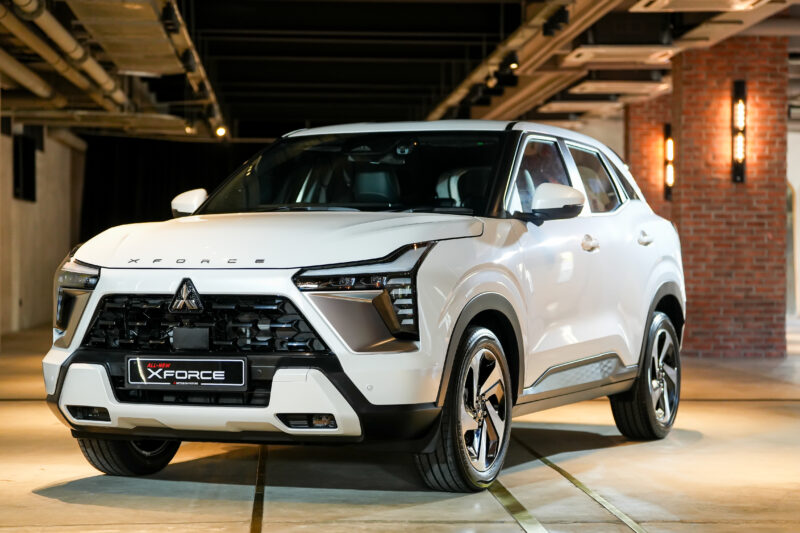
The Mitsubishi Xforce features a modern Dynamic Shield design approach.
With characteristics like large, sharp headlights and 18-inch alloy wheels, it’s no surprise that this SUV looks more striking and prominent on the road.
Fortunately, Mitsubishi has not followed the trend of horizontal LED light bars like many other manufacturers.
The exterior design of the Xforce also contributes to superior aerodynamics compared to its competitors.
When was the last time you saw a Mitsubishi car styled as elegantly as the Xforce?
Modern Cabin Space
In the author’s opinion, the layout of the Mitsubishi Xforce’s cockpit is one of the tidiest in the B-segment SUV category.
The menu display is easy to read, and the digital cluster screen is intentionally placed deeper, providing a more natural feel.
It doesn’t feel like you’re looking at two iPads perched on the dashboard.
What I particularly liked? The display shows the driving score reminiscent of the Pajero, complete with an airplane-style meter on the central screen.
The physical controls for the air conditioning system and drive mode switch are large and easy for drivers to reach.
Additionally, the Xforce offers quite comfortable seating in both the front and back rows, although it only has manual adjustments.
The cargo space is quite ample, around 410 liters, to accommodate daily necessities.
The next point will position the Xforce as one of the unique SUVs in its segment.
Yamaha Audio System
Unique in its segment due to an audio system specifically developed by Yamaha!
There are up to eight speakers installed in the Xforce cabin, including the following components:
25mm tweeter × 2 on the A-pillars
160mm woofer × 2
160mm/25mm co-axial × 2 for the second-row passengers
Based on our brief experience, I admit that the sound quality and output from this Yamaha audio system resonate more with me compared to competing models.
It feels like driving a much more expensive vehicle.
Evo-Inspired Driving Dynamics
This SUV is built with daily use in Southeast Asia as its main goal.
Even though it uses the Xpander platform, the Xforce features a stiffer chassis structure combined with suspension tuning better suited to local road conditions.
It’s no surprise that the Xforce offers improved driving dynamics compared to the Xpander.
It might even be better than most competitors in the market.
The secret? The Xforce received input from Masahiro Tamura, the Chief Product Engineer at MMC and a former engineer for Mitsubishi’s high-performance Lancer Evolution!
The proof lies in the presence of Active Yaw Control (AYC) to ensure more confident handling of this SUV on the road.
Body roll is minimized, and steering feedback is more precise and reassuring, even when the SUV is driven a bit aggressively through corners.
The 1.5-liter MIVEC 4A91 engine, producing 103 hp and 141 Nm, is paired with a CVT for a smoother initial driving experience.
The throttle response is light, enhanced by a reassuring braking system to ensure the SUV stops effectively.
However, it may not be suitable for those who tend to put too much weight on the accelerator since the engine response may feel lacking when extra power is needed.
In our view, the Mitsubishi Xforce is more suited for relaxed driving, fitting its character as an urban SUV. Where would you rush to?
Driving Modes for ASEAN Weather Conditions
The Mitsubishi Xforce is equipped with several driving modes including Normal, Gravel, Mud, and Wet.
Not limited to adjusting power output, the Xforce’s driving modes modify throttle response, traction control, handling, and Active Yaw Control features based on the situation.
The most useful driving mode for the current weather conditions is undoubtedly the Wet mode.
We were given the opportunity to assess this mode’s effectiveness on a road intentionally wet to simulate conditions during rain.
In normal circumstances, the SUV would skid out when speed is increased.
However, handling became much easier to control when the Wet mode was activated, and the Xforce felt more glued to the slick road.
According to Mitsubishi, this Wet mode is a new feature developed specifically for ASEAN customers in regions with high rainfall frequency.
Conclusion
The Mitsubishi Xforce is an intriguing product offered by MMM for the local market.
With a more mature design, a far more modern cabin, and tuning tailored for Southeast Asian roads, it suggests that Mitsubishi genuinely wants to return as a top choice in this class.
The Mitsubishi Xforce 2026 will be launched soon, and we believe the estimated selling price starting from RM110,000 is not a significant hurdle for avid Mitsubishi fans.
Aveta Motor Malaysia has announced the arrival of the upgraded 2026 version of the Vanguard 250, with a retail price of RM16,688. This 250 cc scooter will be available in the market starting early March.
10 new features of the Aveta Vanguard 250
For the 2026 model year, the Vanguard 250 comes equipped with 10 new features, including:
A 7-inch TFT touchscreen
Electrically adjustable windscreen
New control switch design
Longer exhaust guard
New engine cover
More comfortable passenger footpeg design
Under-seat storage capable of holding a full-face helmet
Redesigned seat
Adjustable rear shock absorber
Switchable ABS and TCS (Traction Control System)
New colour options
The Aveta Vanguard 250 will be available in the following colour options:
Nano Green
Desert Bronze
Specifications remains unchanged
The 2026 Vanguard 250 retains its 244.2 cc engine, producing 24.8 hp at 8,500 rpm and a torque of 22.5 Nm at 6,500 rpm.
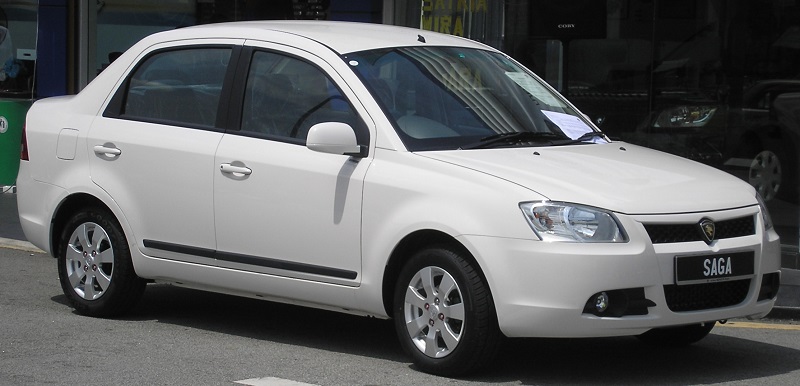
First introduced in 1985, the Proton Saga remains one of the most important models in Malaysia’s automotive landscape.
The Saga is not merely a mode of transport from point A to point B — it’s a necessity for those who want a comfortable, modern, and safe car.
The third facelift (MC3) launched last year, arrived with a strong package that easily embarrasses its rivals.
This was proven when Saga sales surpassed the Perodua Bezza throughout January 2026.
We had the chance to test-drive the Saga, and here are our thoughts on Proton’s new sedan.
A More Premium Saga Design
This entry-level sedan has gone through three design eras:
Mitsubishi’s boxy design (1985)
Proton’s original design (2008)
Geely-influenced design (2025)
There’s no denying that the new Saga offers a more sophisticated image, especially with a front fascia aligned with Proton’s other X models (X70 & X90).
Previously, DRLs came as a separate package, but the new Saga integrates DRLs into the main headlamp unit.
It also features bright LED projector headlamps for night driving.
The Saga’s image is further elevated with full-width LED taillights, matching current automotive design trends.
Unfortunately, the sedan’s side profile still reveals that it sits on the existing platform.
New Saga owners should probably thank the Proton Savvy for that.
A More Advanced and Premium Cabin
Since the original dimensions haven’t changed much, the cabin doesn’t feel significantly more spacious than before.
The dashboard layout has been refreshed.
Our Premium variant test unit comes with a 7-inch digital instrument cluster and a 9-inch infotainment screen in the centre.
Physical climate control buttons are retained, but with a simpler design and smaller knobs and switches.
There’s no denying that the new Saga delivers a more premium-feeling experience for an entry-level sedan.
The climate control knobs don’t feel cheap when turned, and the indicator/wiper stalks feel solid during use.
The air-conditioning system is excellent — a long-standing Proton trademark.
Another point, Saga now supports Apple CarPlay and Android Auto. Wirelessly.
The audio system also delivers pleasant sound quality, complementing the quiet cabin during drives.
Driving Experience
One of the biggest highlights of the new Saga is its new 1.5-litre i-GT engine.
This 1,499 cc engine produces 120 PS @ 6,100 rpm and 150 Nm @ 4,000 rpm — far more powerful than the old Campro’s 94 hp/120 Nm.
Fuel efficient? Absolutely.
A full tank can take the Saga more than 500 km, which is more than sufficient.
Fuel consumption is recorded at around 6.5 litres per 100 km.
Ride and handling have also been improved, making the Saga more exciting to drive, especially on winding roads.
The MacPherson strut and torsion beam suspension tuning feels just right — sporty yet still prioritising comfort.
Rough surfaces and vibrations are well-filtered, giving the Saga a surprisingly premium feel even when the road outside resembles the moon’s surface.
Engine noise no longer roars like the old Campro days.
The naturally aspirated i-GT engine produces only a low-frequency hum that doesn’t distract the driver even under heavy throttle.
Saga Is Not a Perfect Car
Despite the many positives, the Saga isn’t perfect.
A few things need attention to make it even better:
First, the CVT transmission response can be frustrating, especially at low rpm.
At normal speeds it’s fine, but the Saga can test your patience on roads with many traffic lights. Or Shah Alam, the Land of Roundabouts.
It’s hard to achieve smooth driving patterns because of this.
As someone used to manual cars, the writer hopes Proton will one day offer a six-speed transmission.
Second, the brake pedal bite point feels too far forward. Not that the braking system is bad — it still stops the car effectively.
But if you plan to drive the Saga fast, keep your foot ready for anything unexpected.
Third, the tyres. The standard Atlas tyres aren’t terrible, and they’re okay in the wet, but there are better options in the market.
If you’re buying a Saga, set aside some budget for tyre upgrades if you want a more confidence-inspiring drive.
Cabin weaknesses that can be improved
A few cabin improvements would make the Saga even better:
One, the instrument cluster brightness can be lowered further — it’s too bright at night, to the point the car next to you might notice.
Two, although Saga now supports wireless Apple CarPlay and Android Auto, the Altas operating system isn’t very stable.
Sometimes it restarts on its own, which is troublesome when you’re relying on navigation.
Three, the solution to sudden CarPlay/Android Auto disconnections is using a USB cable.
But the USB port is positioned too close to your knee, making driving uncomfortable — and the Saga doesn’t even have a left footrest.
Four, the driving position feels quite high, even at the lowest seat setting.
Your eye level ends up close to the rear-view mirror height.
This makes it difficult when going up or down multi-storey car parks.
Maybe this is a preview of the upcoming Saga Cross. Maybe.
Safety: Better Than Iriz and Persona
After a long wait, Proton has finally equipped an entry-level car with all the necessary safety features.
Six airbags come standard on the Premium variant, along with advanced safety features such as:
Autonomous Emergency Braking (AEB)
Lane Departure Warning (LDW)
Rear Cross Traffic Alert (RCTA)
Rear Collision Warning (RCW)
Door Opening Warning (DOW)
Auto High Beam (AHB)
And finally, the Saga now gets Blind Spot Monitoring (BSM) — a very welcome addition. Even the Iriz and Persona don’t get this.
Saga also gets front and rear parking sensors, which are quite sensitive and annoying in traffic jams.
There’s also a speed limit warning if the system detects the car exceeding the allowed limit.
One feature worth praising is the alert reminding drivers about children (and valuables) in the back seat whenever the engine is turned off.
The sound is loud and clear to ensure no Saga owner suffers from “forgotten child syndrome.”
Lose items and you can replace them. Lose a child and regret will haunt you.
Conclusion
Looking at the package and specifications offered, the Proton Saga is no longer a model you can take lightly.
It has everything needed in an entry-level sedan — power, comfort, space, and technology that makes daily life easier.
Most importantly, it’s priced within reach for most first-time car buyers.
Just like the Iriz in 2014, the Proton Saga has now set a new benchmark for the entry-level sedan segment.
Mitsubishi Motors Malaysia (MMM), the official distributor of Mitsubishi vehicles in Malaysia, is proud to announce that the Mitsubishi Xforce has secured over 1,000 bookings within just one week of its pre-launch and booking period.
The strong response underscores Malaysians’ growing excitement for Mitsubishi Motors’ latest compact SUV, ahead of its official launch scheduled for early April.
In appreciation of the encouraging support, Mitsubishi Motors Malaysia is extending its exclusive Early Bird Package to the next 1,000 customers who place their bookings before the official launch.
Customers who secure their Mitsubishi Xforce during this extended Early Bird period will also enjoy:
RM5,000 cash rebate
Three times free labour service
Participation in a “Buy 1 Free 1” Contest, where customers who book before the official launch stand a chance to win another Mitsubishi Xforce Ultimate.
The stylishly designed Mitsubishi Xforce combines bold styling with everyday practicality.
Recognised with the iF DESIGN AWARD 2024, its distinctive, modern character stands out on the road while delivering driving excitement through superior handling. With four selectable drive modes, Active Yaw Control (AYC), and best-in-class 222mm ground clearance, it inspires confidence across varying road conditions.
Inside, the Mitsubishi Xforce offers ultimate comfort and seamless convenience. A spacious cabin with 8-step reclining rear seats, Dynamic Sound Yamaha Premium Audio System, 12.3-inch Display Audio with wireless Apple CarPlay™ and Android Auto™, and nanoe™ X dual-zone air-conditioning create a refined driving experience.
Complemented by smart features such as the Power Tailgate with Kick Motion, Mitsubishi Motors Safety Sensing (ADAS), 23 storage compartments with a centre cooler box, and an All-Round Monitor with parking sensors, the Mitsubishi Xforce is thoughtfully engineered for modern lifestyles.
Didi Group, the official distributor of Triumph motorcycles has launched two new models:
Street Triple 765 RX – RM81,100
Trident 800 – from RM53,900
Street Triple 765 RX
The Street Triple 765 RX is equipped with a 765 cc, 3-cylinder engine, producing approximately 130 PS at 12,000 rpm and 80 Nm at 9,500 rpm.
This bike features exclusive RX finishes, including a laser-engraved logo on the exhaust, RX seat, subframe, and red wheels, along with a Matt Aluminium Silver finish.
As a powerful weapon on the track, the Street Triple 765 R comes with adjustable Ohlins NIX30 front forks offering 115 mm of travel.
At the rear, it features an adjustable single shock Ohlins STX40 with 131.2 mm of travel.
The braking system utilizes Brembo Stylema four-piston calipers gripping dual 310 mm rotors in the front, alongside a single piston Brembo caliper and 220 mm rotor at the rear.
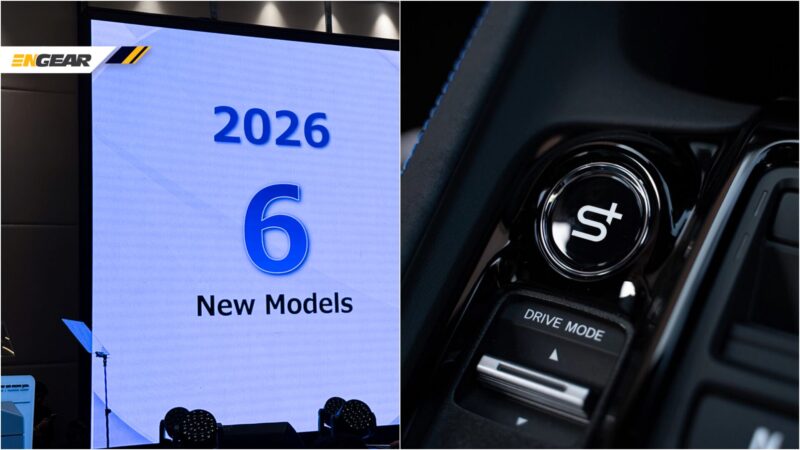
Honda Malaysia has announced plans to introduce up to six new models in 2026.
In line with its business direction, Honda Malaysia has also set a sales target of 60,000 units for this year.
Introduction of New Technology
In addition to announcing six new models, Honda has confirmed the introduction of the S+ Shift technology for the Malaysian market for the first time.
This technology is a power unit control system in the e:HEV hybrid that simulates manual gear shifting, providing a driving experience akin to that of a manual car.
So far, several models equipped with S+ Shift have emerged, including the Honda Prelude and the Honda Super ONE.
This feature is expected to be extended to more Honda e:HEV models in the future.
Expanding the e:HEV Model Lineup
Honda Malaysia is also anticipated to further expand its e:HEV model lineup for the local market.
As a leader in this segment since 2004, this approach demonstrates Honda Malaysia’s commitment to continually acquiring efficient, reliable, and high-performance hybrid technology.
The ‘Fun to Drive’ Spirit
The core strategy of Honda Malaysia is its commitment to continuously offering customers a ‘Fun to Drive’ experience.
According to Narushi Yazaki, Managing Director and CEO of Honda Malaysia, “The spirit of ‘Fun to Drive’ reflects our commitment to delivering vehicles that connect with our customers’ emotions.”
“The introduction of S+ Shift technology for the first time is a clear example of our direction.”
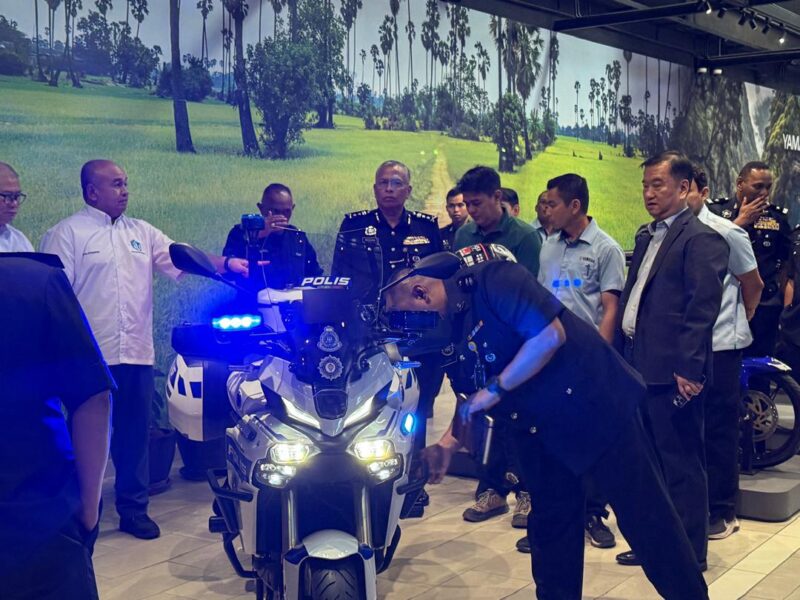
Hong Leong Yamaha Motor (HLYM) recently handed over 200 units of the Yamaha Tracer 9 GT to the Royal Malaysia Police (PDRM), marking HLYM’s largest single big bike supply to PDRM to date.
Selected for its rider comfort, strong performance, advanced technology, durability, and proven reliability, the Tracer 9 GT is dedicated to high-level escort duties and specialised patrol assignments, where stability, endurance, and performance are non-negotiable.
PDRM’s confidence is further reinforced by Yamaha’s global reputation for quality and reliability, supported locally by HLYM’s extensive aftersales network, including over 250 Yamaha Quality Service (YQS) centres nationwide and strong spare parts availability through HLYM’s Parts Centre and authorised dealers.
This collaboration reinforces Yamaha’s position as a trusted mobility partner in supporting national security and public safety.
Mitsubishi Motors Malaysia (MMM) recently marked a significant milestone with the official mass-production line-off of the all-new Mitsubishi Xforce from its assembly line at the Pekan plant.
Bookings for the all-new Mitsubishi Xforce will open within the same week.
The introduction of the all-new Mitsubishi Xforce underscores Mitsubishi Motors Malaysia’s continued commitment to product expansion and advanced local manufacturing.
To support this milestone, MMM has upgraded its Pekan manufacturing operations, including the establishment of a new Sub-Assembly Body Shop and the installation of advanced equipment across the paint, outfitting, and tester lines to support the all-new Mitsubishi Xforce.
Production of the all-new Mitsubishi Xforce at Pekan is carried out in accordance with Mitsubishi Motors’ globally established production standards, developed through decades of Japanese manufacturing expertise.
From body assembly to painting and final inspection, each process is governed by disciplined workmanship and stringent quality controls to ensure consistent build quality, durability, and long-term reliability.
Commenting on the milestone, Takashi Sakamaki, Chief Executive Officer of Mitsubishi Motors Malaysia, said: “Mass production of the all-new Mitsubishi Xforce represents the application of Mitsubishi Motors’ Japanese manufacturing philosophy at our Pekan plant. Built on precision, process discipline, and continuous improvement, these standards ensure that every Xforce produced here meets the same quality benchmarks as Mitsubishi vehicles manufactured anywhere in the world. Our priority is to deliver vehicles that embody Mitsubishi Motors’ highest global standards, giving customers confidence, reliability, and pride of ownership from the very first day.”
Mitsubishi Motors Malaysia aims to deliver the first 800 units of the all-new Xforce within April, following comprehensive quality validation and production readiness checks.
The roll-out of the all-new Xforce from Pekan reaffirms Mitsubishi Motors Malaysia’s long-term commitment to local manufacturing and to delivering vehicles engineered for driving performance, reliability, and peace of mind.
Proton has announced an incentive offer of up to RM4,000 for all its current models, in line with the Malaysian Government’s implementation of the Vehicle Replacement Grant Matching Program.
This program aims to reduce the number of old vehicles on the road and encourage the use of safer, more energy-efficient cars.
Through this initiative, customers who trade in their old cars will be eligible to receive incentives from PROTON, which will be matched by the Ministry of Transport for up to RM2,000.
For the Proton Saga and Proton e.MAS 5 models, PROTON offers incentives of up to RM1,000, and up to RM2,000 for the X50, X70, and e.MAS 7 models.
According to Dr. Li Chunrong, the Chief Executive Officer of Proton, “The incentives offered by Proton are a continuation of the Proton Xchange Program introduced in May 2025.”
He further stated that by the end of 2025, a total of 4,344 transactions had been recorded, involving the disbursement of approximately RM6.68 million to assist in the purchase of new vehicles.
UMW Toyota Motor (UMWT) today officially launched the 2026 Toyota Vios HEV, a hybrid sedan in the B-segment.
This locally assembled unit (CKD) is available in two variants: the Vios 1.5 HEV and the Vios 1.5 HEV GR Sport.
Here are some key facts you need to know:
Chassis
Due to the addition of a hybrid battery, the Vios HEV is essentially heavier than the standard Vios.
Therefore, Toyota has taken steps to reduce weight in certain areas, such as the bonnet, fenders, door panels, and boot lid.
Hybrid Engine
The Vios HEV is powered by Toyota’s fourth-generation electric hybrid system, which includes:
A 1,496 cc engine (code 2NR-VEX) producing 91 PS/121 Nm
An electric motor with 80 PS/141 Nm
A lithium-ion battery pack rated at 4.3 Ahr
Total power reaches 111 PS, directed to the front wheels via an E-CVT transmission.
Fuel consumption is approximately 3.6 liters per 100 km (NEDC data).
Exterior
There are not many changes to the exterior, apart from the addition of the HEV logo and dark chrome accents on the front grille.
Notably, there is a sound alert system to inform pedestrians and cyclists of the approaching sedan.
Interior
The 2026 Vios HEV comes with new features such as upgraded cabin lighting, a larger 10.1-inch Digital Audio display screen, and the inclusion of an EV Mode button.
Additionally, the cabin of the Vios HEV is quieter thanks to the use of acoustic windscreen glass.
Vios HEV GR Sport
The GR Sport variant is making a return to the Vios lineup.
Unlike the standard variant, the Vios HEV GR Sport features:
GR Sport aerodynamic body kit
17-inch GR Sport alloy wheels
Continental PremiumContact 6 tires
Combination leather and suede seats
The Vios HEV GR Sport also benefits from chassis tuning that enhances its driving dynamics.
Furthermore, this hybrid sedan is equipped with re-tuned springs and shock absorbers for a sportier experience, along with a more responsive electric power steering (EPS) system.
Safety
As standard, the Toyota Vios HEV and Vios HEV GR Sport are equipped with Toyota Safety Sense (TSS), which includes the following functions:
Pre-Collision System (PCS)
Autonomous Emergency Braking (AEB)
Lane Keeping Assist (LKA)
Adaptive Cruise Control (ACC)
Forward Movement Alert (FMA)
High Beam Assist
Blind Spot Monitoring (BSM)
Colour Options
The Toyota Vios HEV is available in a new exclusive colour, Celestite Grey Metallic, along with four existing colors: Platinum White Pearl, Scarlet SE, Attitude Black, and Silver Metallic.
Meanwhile, the Vios HEV GR Sport is offered in two two-tone colour options: Platinum White Pearl/Black and Scarlet SE/Black.
Price
The Vios HEV hybrid sedan is priced starting from RM103,900, while the HEV GR Sport version is priced at RM109,900.
Denza Malaysia has announced that the selling price of the luxury electric MPV, the Denza D9, will remain unchanged at RM259,000 for the FWD variant and RM309,000 for the AWD variant.
These prices are valid only for the 2025 model year.
Since its launch in February 2025, over 1,200 units of the Denza D9 have been sold, making it the number one luxury MPV in Malaysia.
In conjunction with its first anniversary, Denza Malaysia continues to offer rewards worth up to RM15,000, including:
A complimentary 22 kW wall charger
A free 6-year or 120,000 km service package
A 6-year vehicle warranty
Denza customers will also have the opportunity to enjoy an exclusive lifestyle experience that includes invitations to the Denza Golf Cup, premium culinary experiences, and special travel privileges that will be introduced gradually.
According to Eagle Zhao, Managing Director of Denza Malaysia, “As Malaysia moves into the next phase of electric vehicle adoption, we want to ensure that our customers feel confident and valued throughout their ownership experience.
“The first year has laid the foundation for trust, and the years to come will focus on delivering a more meaningful experience that reflects Denza’s premium lifestyle,” he stated.
Volvo Car Malaysia has just launched the electric sedan, the Volvo ES90 for the local market.
Assembled at the Shah Alam plant, the Volvo ES90 is priced starting from RM339,888.
Here are some key facts about the ES90 that you need to know:
Dimensions
The ES90 measures 5,000 mm in length, 2,120 mm in width, and 1,550 mm in height, with a wheelbase exceeding 3 meters (3,102 mm), contributing to a more spacious cabin.
Standard cargo space is 424 liters, which can expand to 904 liters when the second-row seats are folded down.
The front trunk has a capacity of 27 liters.
All four wheel arches are fitted with 22-inch rims.
The drag coefficient is an impressive low of just 0.25.
Single Motor Extended Range variant
For the Malaysian market, the Volvo ES90 is available in a single variant, the Single Motor Extended Range.
This sedan is powered by a rear-wheel-drive electric motor that produces 333 hp and 480 Nm of torque.
It accelerates from 0 to 100 km/h in 6.6 seconds and has a top speed of 180 km/h.
Battery & Charging
The ES90 is equipped with a 92 kWh NCM battery pack and an 800-volt electrical architecture, allowing a range of up to 651 km (WLTP data).
This electric sedan supports AC charging at 11 kW (a full charge at 100% in 10 hours) and DC fast charging of up to 350 kW.
This means the battery can be charged from 10% to 80% state of charge (SoC) in as little as 22 minutes.
Standard features
The Volvo ES90 comes with active air suspension, headlights designed with Thor’s hammer graphics, and C-shaped LED taillights.
The cabin features include a panoramic glass roof with electrochromatic functionality, a 9-inch digital display, a center screen measuring 14.5 inches, a Bowers & Wilkins sound system with 1,610 watts and Dolby Atmos and Abbey Road Studios sound experiences, as well as a 4-zone climate control system.
The ES90 is also the first Volvo model equipped with the NVIDIA DRIVE AGX Orin computing system, featuring 5G capabilities and support for over-the-air updates.
Safety
In addition to a robust frame, the Volvo ES90 comes with seven cameras, five radars, and 12 ultrasonic sensors, as well as a system that can detect the driver’s level of attention on the road.
Safety features included in the Volvo ES90 consist of nine airbags, a collision avoidance system, automatic emergency braking, rear collision warning, blind spot information system, rear cross-traffic alert, door opening warning, and emergency stop assist.
Additionally, this sedan is equipped with a 360-degree three-dimensional surround camera system to ease maneuvering in tight spaces.
As the Malay proverb goes, “better late than never.”
After more than three years since its global debut, Nissan distributor Edaran Tan Chong Motor (ETCM) is finally set to officially launch the Serena e-Power this March.
Although its arrival may be considered somewhat late, ETCM claims to have already received 400 orders for the MPV model.
Naturally, there are several features of the Serena e-Power that have piqued the interest of existing Nissan Serena owners in this new model.
Last week, ETCM invited a group of journalists for a test drive session from Petaling Jaya to Kuantan, allowing us to assess the improvements made.
Here are some positive aspects we found in the Serena e-Power:
e-Power is More Powerful
One of the most significant upgrades in this family MPV is the e-Power system (163 PS/315 Nm), which replaces the S-Hybrid system in the C27 model.
Whereas the Serena S-Hybrid previously felt like it could “manage… but don’t ask for more,” this new e-Power system offers a much more confident drive.
Its electric motor provides a more immediate response, more strength, and operates quietly, akin to an electric vehicle (EV).
It’s not to say it suddenly becomes a speedster, but this time the Serena feels less heavy when overtaking or climbing, compared to the previous S-Hybrid system.
Press the pedal, and the car moves smoothly without drama. This is the characteristic that should be present in a modern family MPV.
The Serena e-Power boasts fuel consumption as low as 5.4 liters per 100 km, with a driving range of up to 1,000 km.
Quiet Cabin
In addition to the efficient e-Power system, we also noticed a significant improvement in NVH (Noise, Vibration, and Harshness).
The cabin feels quieter and more comfortable, to the point that we forgot we were not driving an electric MPV.
This is attributed to several factors, including the use of acoustic glass and air curtains on the front bumper, which contribute to improved driving stability.
Wind noise is only noticeably heard at higher speeds; however, this isn’t a major issue as the MPV will most often be driven within the national speed limit.
Engine noise is also less pronounced when the e-Power system is engaged aggressively, almost as if Nissan has placed the 1.4L NA engine at the front of the bumper.
It doesn’t roar; rather, it produces a low hum that does not distract the driver.
Less Motion Sickness
One new feature in the Serena e-Power is the redesigned front suspension system, aimed at enhancing ride stability and comfort.
According to Nissan, the Serena e-Power utilizes SUV-based suspension architecture at the front to reduce body roll and improve control.
Overall, the suspension tuning of the Serena e-Power is designed to provide a more comfortable ride with less bouncing, aided by Zero Gravity seats to reduce motion sickness, especially for rear passengers.
A Champion of Practicality
As a family MPV, the Nissan Serena offers ample space for storage.
In line with current trends where people heavily rely on smart devices, the Serena includes designated spots for mobile phones, including a wireless charging slot and six USB ports.
The second-row passengers benefit from foldable tables and seats that can adjust in four directions.
Additionally, there are 22 cup-holder locations throughout the cabin.
It can be said that the Serena understands the realities of life: kids have toys, mothers have small bags, fathers have power banks – everyone has their place.
Retaining Elements of Previous Serena Models
Although the Serena e-Power introduces numerous enhancements, it still maintains the true identity of the Serena, such as the seating layout allowing easy passage from the first to the third row.
It also retains wide sliding doors on both the left and right, a high cabin dimension, large windows, and ease of access.
The Serena maintains the Dual Back Door feature with dual opening methods, making it convenient for loading and unloading items, especially in tight parking spaces.
Thus, exemplary fathers need not worry, as the identity of the previous Serena model is still preserved and passed down to the new Serena.
Conclusion
With its practical features and innovations, the Nissan Serena e-Power has the potential to be an ideal family car choice for 2026.
According to ETCM, the Serena e-Power is expected to be priced between RM160,000 and RM180,000.
Specifications for the Nissan Serena e-Power (including safety features) can be viewed at THIS LINK.
Edaran Tan Chong Motor Sdn Bhd has announced that the new Nissan Serena e-Power model will be launched in March 2026.
This locally assembled (CKD) model will be sold at a price range of RM160,000 to RM180,000.
During a test drive organized with media representatives, Christopher Tan, the Executive Vice President of ETCM, announced that they have received 400 bookings for the MPV model thus far.
The Nissan Serena e-Power 2026 will be offered in Premium Highway Star specification.
e-Power System
It is powered by the e-Power system, which consists of a 1.4-liter engine that acts as a power generator for the electric motor (163 PS/315 Nm), paired with a 1.769 kWh lithium-ion battery pack.
With a single-speed automatic transmission, the Serena e-Power offers fuel consumption as low as 5.4 liters per 100 km, with a driving range of up to 1,000 km.
It also features a one-pedal driving function or e-Pedal.
The Serena e-Power utilizes a MacPherson strut setup at the front and a torsion beam for the rear axle.
Exterior
In terms of exterior design, the Serena e-Power features a V-Motion front grille, three-layer LED projector headlights with Auto Levelling function, boomerang-style LED taillights, and automatic sliding doors on both the left and right.
Standard equipment includes 16-inch wheels wrapped in 205/65R16 tires, which prioritize both comfort and presence.
The Serena e-Power also inherits the Dual Back Door feature from the previous Serena model.
Interior
Cabin features include seats with Zero Gravity technology, black Nappa leather upholstery, second-row captain’s chairs complete with armrests and four-way sliding functions, a foldable table for second-row passengers, and an additional 14-inch display screen.
There is also a 12.3-inch TFT display, a 12.3-inch infotainment screen, support for Apple CarPlay and Android Auto, a climate control panel with a digital display, wireless charging slots, and six USB ports.
Safety
The Serena e-Power is equipped with six airbags, ABS, EBD, Brake Assist, Hill Start Assist (HSA), ISOFIX anchors, Vehicle Dynamic Control (VDC), and Traction Control System (TCS).
Advanced safety features include a semi-autonomous ProPilot system, Intelligent Around View Monitor (IAVM), Smart Moving Object Detection (MOD), Intelligent Forward Collision Warning (IPFCW), Intelligent Emergency Braking (IEB), Driver Attention Warning (IDA), Lane Departure Warning (LDW), Blind Spot Warning (BSW), and Rear Cross Traffic Alert (RCTA).
Colour Options
The Nissan Serena e-Power will be available in four two-tone colour options: Turquoise Blue, Dark Metal Gray, Brilliant White, and Diamond Black, all featuring a black roof.
Proton New Energy Technology (Pro-Net), the new energy vehicle division of Proton, has announced the specifications for the upcoming e.MAS 7 PHEV SUV model.
Here are some key facts you need to know:
Dimensions
The e.MAS 7 PHEV measures 4,740 mm in length, 1,905 mm in width, and 1,685 mm in height, with a wheelbase of 2,755 mm.
Compared to the electric version of the e.MAS 7, the PHEV version is 125 mm longer, 39 mm wider, and 15 mm taller, with a wheelbase that is 5 mm longer.
The cargo space is 528 liters, which can expand to 2,065 liters when the second-row seats are folded down.
PHEV System
The e.MAS 7 PHEV uses Geely’s Super Hybrid EM-i powertrain unit, which consists of a 1.5-liter NA engine (98 hp/125 Nm) and a single electric motor (215 hp/262 Nm).
The total power output reaches 258 hp and 262 Nm, driving the front wheels.
There are two battery capacity options for the e.MAS 7 PHEV.
The Premium Plus variant features a short blade Aegis 29.8 kWh battery that offers a range of 170 km (NEDC data) and supports fast DC charging of 60 kW.
Charging from 30% to 80% takes less than 16 minutes.
Meanwhile, the Premium and Prime variants use an 18.4 kWh CATL battery, providing a driving range of 105 km and DC charging up to 30 kW.
This PHEV system offers three hybrid modes: Series Hybrid Mode, Parallel Mode, and Direct Drive Mode.
Overall, the e.MAS 7 PHEV can travel up to 1,065 km.
Exterior
The e.MAS 7 PHEV features a MacPherson strut suspension setup in the front and a multi-link system in the rear axle.
It also has unique lighting designs compared to the e.MAS 7 EV.
The Prime variant comes equipped with 18-inch rims, while the two higher variants feature 19-inch rims.
Interior
The cabin offers up to 30 storage compartments, including a hidden 100L storage space under the rear cargo floor.
It features a 15.4-inch central screen with the Flyme Auto operating system, direct charging map support, Apple CarPlay and Android Auto, a 13.8-inch head-up display, and WANOS surround audio system with 16 speakers.
Additional features include a panoramic glass roof, leatherette-wrapped seats with power adjustment, memory, and ventilation, ambient lighting, and a wireless device charging slot.
Safety
The e.MAS 7 PHEV comes with seven airbags and 15 Level 2 Advanced Driver Assistance Systems (ADAS) functions, including Adaptive Cruise Control (ACC), Forward Collision Warning (FCW), Automatic Emergency Braking (AEB), Lane Departure Warning (LDW), Lane Keeping Assist (LKA), Rear Collision Warning (RCW), Rear Cross Traffic Alert (RCTA), and Traffic Sign Recognition (TSR) systems.
The Proton e.MAS 7 PHEV will be available in Obsidian Black, Lithium White, Mercury Silver, Galena Grey, and Azure Blue colors.
The estimated selling price ranges from RM110,000 to RM130,000. This Proton plug-in hybrid SUV will be officially launched next month.
UMW Toyota Motor (UMWT) has officially launched the luxurious Toyota Vellfire 2.5 HEV Executive Lounge for the Malaysian market today.
The Vellfire HEV is powered by a self-charging hybrid system that consists of a 2.5-liter Dynamic Force engine (code A25A-FXS) producing 187 PS and 233 Nm, paired with an electric motor delivering 182 PS and 270 Nm, along with an e-CVT transmission.
Overall, this HEV system can generate a power output of up to 250 PS, which is 37 percent more powerful than the standard 2.5-liter model.
The fuel consumption rate is as low as 5.7 liters per 100 km, allowing the Vellfire HEV to cover a driving distance of up to 1,000 km on a 60-liter fuel tank.
In addition to Eco and Normal driving modes, the Vellfire HEV also offers an EV mode for zero-emission driving over short distances without using a drop of petrol.
In line with the Japanese hospitality philosophy of omotenashi, the Vellfire HEV provides a unique level of comfort.
The VIP Executive Lounge seats offer power adjustments, ventilation systems, as well as massage functions and ottomans, all controllable via a touchscreen panel.
Other features include foldable tables, larger armrests, anti-shake functions, Nappa leather upholstery, a 64-color ambient lighting system, a 14-inch rear screen, and a JBL audio system with 15 speakers.
In terms of safety, the Vellfire HEV comes equipped with the Toyota Safety Sense 3.0 package, which includes features such as Pre-Collision System (PCS), Lane Departure Alert (LDA), Dynamic Radar Cruise Control (DRCC) with Lane Tracing Assist (LTA), Adaptive High Beam System (AHS), Blind Spot Monitoring (BSM), Rear Cross Traffic Alert (RCTA), and Parking Brake Support (PKSB).
Three color options are available for the Vellfire HEV: Platinum White Pearl, Precious Metal, and black, which can be paired with either black or Sunset Brown interior finishes.
Aside from the Vellfire HEV, customers can still opt for the Vellfire equipped with a 2.5-liter engine (code 2AR-FE) producing 182 PS and 235 Nm, paired with a Super CVT-i 7-speed transmission.
The Vellfire 2.5 comes with features such as synthetic leather upholstery, Executive seating without control panels, and lacks rear seat entertainment and a head-up display (HUD).
The selling prices are as follows:
Toyota Vellfire 2.5 – RM448,000
Toyota Vellfire 2.5 HEV Executive Lounge – RM549,900
UMW Toyota Motor (UMWT) closed 2025 on a strong note, recording 14,284 units in December, bringing total annual sales to 102,417 units and marking its fourth consecutive year surpassing the 100,000 unit milestone.
This achievement establishes Toyota as the first and only non-national automotive brand in Malaysia to record over 100,000 vehicle sales for four consecutive years, a milestone never before achieved by a non-national automotive brand in the Malaysian market.
Delivered amid intensifying competition, rapid electrification, and shifting customer expectations, the milestone reflects Toyota’s position as a trusted and sought-after brand in Malaysian car purchase decisions, built on decades of consistency, credibility, and proven ownership experience.
In a year defined by aggressive new entrants and evolving mobility narratives, UMWT’s consistent performance reflects more than market momentum, it reflects enduring brand preference and loyalty across generations of Malaysian drivers. From first-time buyers to long-standing Toyota households, consistent demand across the brand’s diverse lineup underscores Toyota’s reputation for vehicles that Malaysians rely on not just at the point of purchase, but throughout years of ownership.
This sustained success is driven by Toyota’s Multi-Pathway Approach, which recognises that mobility needs differ across communities, usage patterns, and infrastructure readiness. By offering a balanced portfolio spanning efficient internal combustion engines, hybrid electrification, and future-ready technologies, Toyota continues to advance its commitment to Mobility for All, ensuring progress is inclusive and grounded in the realities of the Malaysian market.
“Achieving over 100,000 vehicle sales for four consecutive years is a meaningful milestone for Toyota and a celebration of the trust Malaysians place in us,” said Datuk Ravindran K, President of UMW Toyota Motor.
“Sustaining this level of performance in a highly competitive and fast-changing market reflects the strength of our long-term strategy, our investment in local capabilities, and our deep understanding of how Malaysians use their vehicles. Guided by our Best in Town philosophy and a Customer First mindset, we remain committed to delivering mobility solutions that are practical, inclusive, and reliable, ensuring Toyota continues to serve Malaysians today and for generations to come.”
Building on the momentum of 2025, UMWT will continue expanding its network, strengthening service excellence, and introducing initiatives aligned with evolving customer expectations. As the brand closes the year on a historic high, Toyota remains firmly focused on shaping Malaysia’s mobility future through solutions that are trusted, inclusive, and built to last.
As part of its year-end initiatives, UMWT introduced the Toyota Extend Plan on 1 December 2025, reinforcing its Customer First commitment to long-term ownership confidence. The programme allows eligible customers to extend Toyota’s existing five-year warranty by up to three additional years, offering coverage of up to eight years depending on vehicle eligibility and package selection.
Available for selected Toyota models including Vios, Corolla Cross, Yaris, and Corolla, the Extended Warranty Plan offers both Basic and Premium coverage options. All warranty claims can be processed at authorised Toyota Service Centres nationwide, with coverage transferable to the next owner, supporting vehicle value retention and peace of mind throughout the ownership journey.
Malaysia’s Leading Automotive News | ENGEAR ENGLISH