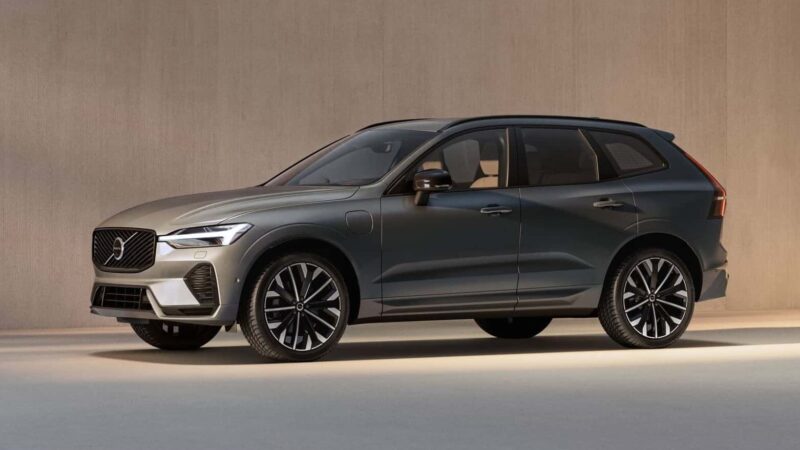
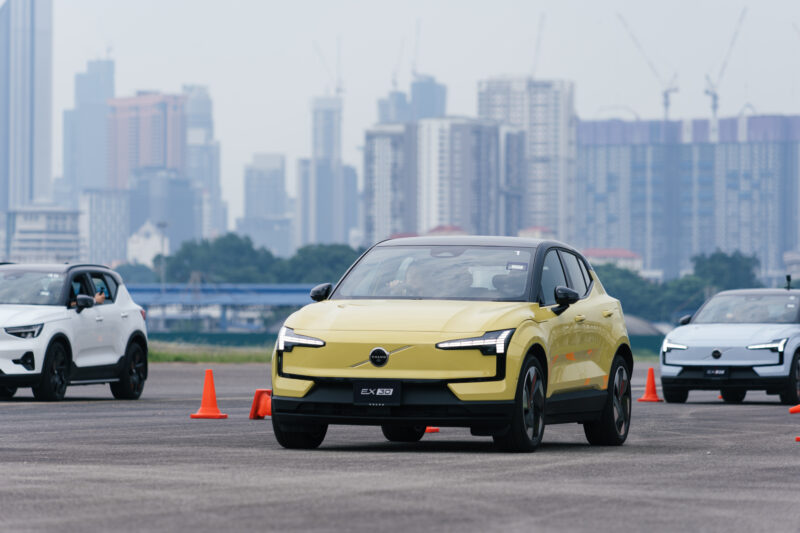
Volvo Car Malaysia has announced the arrival of the updated XC60, the most popular SUV for the 2025 model year.
Since its launch in the local market, the Volvo XC60 has sold over 6,200 units, solidifying its reputation as the top choice SUV for those prioritizing comfort, quality, and driving confidence.
The 2025 Volvo XC60 is offered in two variants: the B5 AWD mild hybrid with an estimated price starting from RM333,888, and the T8 AWD plug-in hybrid (PHEV) with an estimated selling price starting from RM367,888.
Official prices will be announced later.
Here are the brief specifications of the powertrain for both variants:
XC60 B5 AWD
2.0L mild hybrid engine + 48V mild hybrid system
Power: 249 hp
Acceleration 0-100 km/h: 6.9 seconds
Fuel consumption rate: 7.6L/100 km
XC60 T8 AWD
2.0L engine with 317 hp
Electric motor: 145 hp
Total power: 462 hp
Acceleration 0-100 km/h: 4.8 seconds
Fuel consumption rate: 1.6L/100 km
Battery: 19 kWh
Zero-emission range: 89 km
Similar to the updates made to the facelifted XC90 model, the XC60 also features cosmetic changes, such as a new front grille design, iconic Thor’s Hammer headlights, and darkened rear light housings.
In addition to new wheels, the Volvo XC60 is also available in Forest Lake and Bright Dusk color options.
Exclusive to the T8 AWD variant is an air suspension system offered for a limited time at no additional cost.
The cabin has been refreshed with new features, including a repositioned wireless charger for improved ergonomics, redesigned cup holders, and more flexible cargo space.
Additionally, there is air purification technology, an 11.2-inch central screen with built-in Google support, and a Bowers & Wilkins High Fidelity audio system.
As standard, the 2025 Volvo XC60 is equipped with smart safety features, including adaptive cruise control, lane-keeping assistance, and collision avoidance support.
Volvo has officially unveiled its latest SUV, the 2026 XC70, marking the start of the pre-sales for the Chinese market.
Built on the Scalable Modular Architecture (SMA) platform, the Volvo XC70 is no longer just a high wagon, as seen in its previous versions.
For the Chinese market, the XC70 is equipped with a plug-in hybrid (PHEV) powertrain, featuring a 1.5-liter turbo engine (161 hp/255 Nm) paired with an electric motor and a 3DHT transmission.
Specifications are as follows:
Two-Wheel Drive Variant
Power: 318 hp
Acceleration 0-100 km/h in 8 seconds
Battery pack: 21.2 kWh
Zero-emission range: 116 km
Fuel consumption: 1.27L/100 km
Four-Wheel Drive Variant
Power: 462 hp
Three electric motors
Acceleration 0-100 km/h in 5.3 seconds
Battery pack: 39.6 kWh
Zero-emission range: 212 km
Fuel consumption: 0.98L/100 km
Additional features include support for AC charging at 7 kW, fast DC charging at 87 kW (0-80% in as little as 23 minutes), a fuel tank capacity of 60 liters, and four driving modes (Hybrid, Sport, Electric, and Off-road).
As a mid-size crossover, the XC70 has dimensions of 4,815 mm in length, 1,890 mm in width, 1,650 mm in height, and a wheelbase of 2,895 mm.
Inside, the cabin features a 12.3-inch digital cluster screen, a 15.4-inch central display, a 9.2-inch HUD display with augmented reality (AR), a Harman Kardon audio system with 23 speakers, a panoramic glass roof, and 50W wireless device charging.
The starting price for the Volvo XC70 PHEV 2026 is 299,900 yuan (RM177,000) for the 2WD version, and goes up to 329,900 yuan (RM196,000) for the 4WD version.
In conjunction with the Independence Month celebrations, Volvo Car Malaysia has announced a special sales campaign, the Volvo Executive Merdeka Sales, which will take place on August 16 and 17.
Located at Symphony Square, Petaling Jaya, this year’s exclusive sale promises a wider selection of attractive options, with prices starting as low as RM160,000.
The lineup includes pre-owned vehicles from the corporate fleet of Volvo Car Malaysia, including models utilized by the company’s management team.
Each car under the Volvo Selekt program undergoes a comprehensive inspection and testing process to ensure the highest quality and durability standards.
Some models have recorded mileage as low as 5,000 km, and all are still covered by the remaining unlimited mileage warranty for five years, 24-hour roadside assistance, and access to Volvo’s digital service connectivity.
Among the models offered are the compact SUV EX30, XC40 Recharge, XC60, and XC90, as well as exclusive models like the S60, S90, and V60.
Through Volvo Car Finance, you can secure interest rates as low as 2 percent and receive same-day approval.
The writer had the opportunity to test drive several small Volvo models before, including the Volvo V40 and the Volvo XC40 and C40 crossovers.
This time, it’s the turn of the smallest production model ever created by the Scandinavian manufacturer, the Volvo EX30.
It comes exclusively as an electric crossover, with no internal combustion engine options available.
Despite being available only in an EV version, the EX30 is not a model to underestimate.
It has a package that can meet the needs of every user—offering style, practical space, and performance capable of outperforming larger SUVs, especially when you choose the Ultra Twin Performance variant, which we drove for this test.
Here’s a summary of our experience after enjoying the EX30, priced at RM228,888, for several days.
Exterior Appearance
Yes, in terms of design, it’s hard to deny that this is a Volvo SUV.
Just look at the headlights with Thor hammer-shaped LED graphics, the front end without a grille displaying the minimalist Volvo logo, and the rear lights—all reminiscent of the Volvo EX90.
Its size is indeed quite compact, measuring 4,223 mm in length, 1,837 mm in width, 1,555 mm in height, and a wheelbase of 2,650 mm, making it smaller than its siblings, the XC40 and C40.
However, small does not mean the EX30 is less practical; the details can be found in the next section.
Practicality
Volvo seems clever in providing a comfortable and practical cabin space in the EX30.
Due to the absence of a speaker system (it has only a Harman Kardon soundbar on the dashboard), there is ample space on the door panels.
The center console appears simple, but when the weather is warm, you can place a cool drink in a pull-out cup holder that can be hidden away when not in use.
Is that not enough? The floor console is also provided, along with additional hidden compartments for smaller items and space in the console tunnel.
The glove box is positioned in the center for easy access by both the driver and front passenger.
Although it looks small from the outside, the Volvo EX30 offers a cargo space of 318 liters, which can expand up to 718 liters when the second-row seats are folded flat in a 60:40 ratio.
This is large enough to accommodate items up to 1.64 meters long and 0.86 meters high.
If you need to head to Ikea for furniture shopping, you can refer to the storage guide graphic provided on the rear tailgate.
Still not enough? There’s a frunk that offers a capacity of seven liters.
Extremely Minimalist to the Point of Confusion
Want to know why Volvo can provide such extensive space?
It’s because Volvo has taken minimalist design to an extreme level, requiring me to ‘reset’ my mindset each time before starting my journey.
The window buttons have been relocated to the center—like cars from the old days—and there are only two buttons available.
You need to press an extra button to open the rear passenger window.
To control the temperature of the air conditioning system? Use the central display screen.
To adjust the steering settings and side screens? Again, it’s done through the central display.
Want to open the glove box? Yes, you also need to press the menu on the central screen.
Fortunately, to start my journey, I didn’t have to scroll through the central screen to switch to Drive mode. The gear shift lever is provided in the steering column, complete with cruise control mode (you only need to pull the lever down once after entering Drive mode).
Finishing Touches
One commendable aspect of the Volvo EX30 is its extensive use of sustainable materials within the cabin.
For example, the upholstery for the seats, dashboard, and doors is made from recycled materials such as denim, hemp, and a wool blend.
The use of these materials does not compromise the comfort factor throughout the driving experience.
What I particularly like is the seating that fully supports the lower legs, along with the comfortable armrest panel on the door.
However, if you look closely, the plastic finishes in certain areas seem inconsistent with the luxurious image Volvo is trying to portray in the EX30. After all, it is made from recycled plastic.
Agile Driving on the Road
The Ultra Twin Performance variant of the EX30 comes equipped with two electric motors that produce 422 hp and 543 Nm of torque, allowing it to accelerate from 0 to 100 km/h in just 3.6 seconds.
With its small, agile body package, the EX30 has no trouble outperforming any sports car out there.
Its suspension tuning is excellent, effectively absorbing all the imperfections found on the road and providing a delightful driving experience, especially when encountering curves.
To be frank, I believe the suspension tuning in the EX30 is significantly better compared to its bigger siblings, the XC40 and C40.
Most of the time, the power delivered by the rear motor is sufficient, and I hardly relied on the Performance mode for the AWD system (which has to be accessed through the central screen).
The NMC 69 kWh battery pack allows you to achieve an impressive driving range of 450 km, making it well-suited for urban driving.
The steering response is also quite good, ensuring that the EX30 stays precisely on its intended path.
Unexpected Off-Road Capability
Clearly, the Volvo EX30 has its unique strengths, making it suitable as an everyday vehicle.
However, one unexpected advantage I discovered is the comfort it offers when the Volvo EX30 is taken off-road (more appropriately, soft-road).
I admit that this EV is already quite comfortable on paved roads, but when the tires hit gravel paths, the EX30’s suspension system effectively filters out all the roughness of unpaved roads.
It’s perfect for driving across rough terrain, allowing you to enjoy outdoor weekend activities like picnicking by the river or camping on the beach.
Given this impressive potential, it’s no surprise that Volvo showcased the EX30 Cross Country version earlier this year for those who seek a more rugged driving experience in this compact EV.
Will the EX30 Cross Country be realized in the future? We can only wait and see what plans Volvo has for this electric SUV.
Charging
The 69 kWh NMC battery supplied in the Volvo EX30 supports AC charging at 11 kW, taking eight hours for a full charge.
If you’re short on time, simply charge the EX30 at any fast-charging station, as this EV supports DC charging up to 153 kW.
In just half an hour, the 69 kWh battery can be charged from 10% to 80% state of charge.
Alternatively, you can visit any shopping center with fast-charging facilities, allowing you to shop for your desired items while the vehicle charges.
One feature I particularly like about this EV is the Google-based mapping system that displays the estimated battery state of charge upon arrival at your destination or after a round trip.
Safety
As a Volvo, the EX30 is equipped with nearly comprehensive safety features in this compact package.
These include adaptive cruise control, traffic jam assistance, collision avoidance assistance, autonomous emergency braking, lane keeping assistance, lane departure warning, blind spot monitoring, and rear cross-traffic alert.
Ironically, it also features a driver attention monitoring system that alerts the driver if it detects a lack of attention on the road.
What can you expect from a car that crams all sorts of settings and functions into a single 12.3-inch screen?
Essential information such as speed, battery state of charge, traffic light notifications, and gear position (RND) is displayed at the top of the screen.
During driving, I find myself looking to the left to ensure that this EV is being driven at the speed allowed by law.
Or every time my left finger pushes the lever to activate the turn signal.
Or each time I feel the cabin temperature is too cold and want to adjust the air conditioning.
It would be more pleasant if the EX30 had a separate screen behind the steering wheel, so that eye movement would be minimized compared to having to rely entirely on the central screen.
Directly installing a head-up display screen would probably be more practical.
Conclusion
For an urban-use EV, I find the Volvo EX30 has a solid foundation and an attractive design, making it suitable for young people with active lifestyles.
That is, if you don’t mind the overly minimalist dashboard layout presented in this Volvo.
Try taking the time to get used to it, and it won’t be a major issue.
However, it can be somewhat problematic for old-school drivers like me, who are still adjusting because we’re used to physical buttons and controls.
In terms of driving, the EX30 is certainly suitable as an everyday car, enjoyable to drive, and, most importantly, it does not compromise practicality and safety elements, which are the primary foundations of the Volvo brand.
However, if you aren’t concerned about all-wheel-drive performance or the panoramic glass roof, you can opt for a lower variant (priced from RM189k) to enjoy a longer driving range.
Specifications of the Volvo EX30 Ultra Twin Performance (RM228,888)
The legacy of the iconic Volvo 240 as the best-selling Volvo car in history has officially come to an end.
This is because that title has now been claimed by the Volvo XC60, with over 2.7 million units sold worldwide since its introduction in 2008.
Initially produced for the European market, this mid-size SUV became Volvo’s first global model to be assembled in China.
It was also named World Car of the Year in 2018.
When the Volvo 240 was launched in 1974, it set new safety standards, including a body design capable of absorbing frontal and rear impacts.
It was also among the first to introduce side impact protection, which later evolved into the Side Impact Protection System (SIPS).
In 1978, Volvo introduced the innovative child booster cushion.
The legacy of safety in cars continues with the XC60, which features various advanced technologies, such as the City Safety automatic braking system that can prevent or reduce collisions at speeds of up to 30 km/h.
In 2017, the XC60 became the first car in the world to introduce the Oncoming Lane Mitigation system, designed to avoid collisions with oncoming traffic.
According to Susanne Hägglund, Head of Global Offering at Volvo Cars, “Growing up in Sweden in the 1980s, the Volvo 240 was the iconic family car – almost every household had one.
“Today, the XC60 carries on that role – not just as a family option, but also as the most successful model in our history.”
In 1959, Volvo made history by introducing the modern three-point seatbelt, a technology that has proven to save over a million lives.
Now, in 2025, Volvo is set to make history once again with the introduction of a new innovation: the multi-adaptive seatbelt, designed to further enhance user safety.
This first-of-its-kind feature will be showcased in the Volvo EX60, which is slated for launch in 2026.
What you need to know about Volvo’s latest innovation:
The system utilizes data from various sensors (external, internal, accident) to analyze factors such as impact direction and speed in real-time within the blink of an eye.
Additionally, the system assesses individual profiles based on height, weight, body shape, and seating position. This information is shared with the seatbelt system to select the most appropriate settings.
In unexpected situations, larger passengers will receive a higher seatbelt load setting to reduce the risk of head injuries. Conversely, in minor collision scenarios, smaller passengers will receive a lower seatbelt load to mitigate the chance of rib fractures.
The modern seatbelt system employs load limiters to control the impact force on the human body during a collision.
As a result, Volvo is increasing the load limit profile from three in the existing system to eleven, allowing for optimized protection based on varying scenarios and individual factors.
The system can also be updated through over-the-air (OTA) software updates.
Based on the data gathered, vehicles will become smarter in understanding passengers, new scenarios, and crafting more accurate response strategies.
This latest innovation has been tested and developed at the Volvo Cars Safety Centre, which is celebrating its 25th anniversary this year.
There, Volvo safety engineers can recreate almost all types of road accidents and conduct tests that exceed official regulatory requirements.
The facility plays a crucial role in maintaining Volvo Cars’ position as a leader in automotive safety.
Earlier this month, Volvo announced the return of the iconic XC70 nameplate, complementing its existing SUV model lineup.
The XC70 is no longer a crossover wagon; instead, it has transformed into a true SUV model.
The Volvo XC70 is the first Volvo vehicle built on the Scalable Modular Architecture (SMA) platform. This platform has previously served as the foundation for the Lynk & Co 07 and 08 models.
According to information disclosed on the website of China’s Ministry of Industry and Information Technology, the Volvo XC70 PHEV will measure 4,815 mm in length, 1,890 mm in width, 1,650 mm in height, and have a wheelbase of 2,895 mm.
There will be options for 19-inch or 20-inch wheels.
Utilizing the SMA platform, the Volvo XC70 features a plug-in hybrid (PHEV) system that includes an electric motor and a 1.5-liter engine developed by Aurobay.
For your information, Aurobay is now part of the Geely-Renault joint venture known as Horse Powertrain.
For the Chinese market, there will be two battery pack options.
The base variant will come with a 21.22 kWh LFP CATL battery, allowing for an all-electric range of 100 km (CTLC data).
Meanwhile, the top variant will feature a 39.63 kWh NMC battery pack, enabling the XC70 to travel 180 km without a drop of petrol.
In terms of design, the XC70 adopts the styling used in the XC90 facelift, such as the Thor hammer-designed headlights and vertical LED taillight graphics.
It also features hidden door handles and a frameless window design.
Currently, the Volvo XC70 is being developed specifically for the Chinese market, responding to the growing demand for PHEV models with longer electric ranges there.
The full-size electric SUV, the Volvo EX90, has been crowned the winner of the World Luxury Car of the Year 2024 award.
This prestigious recognition was announced at the New York International Auto Show by a panel of judges comprising 96 prominent automotive journalists from 30 countries.
The Volvo EX90 has been praised for its sophisticated Scandinavian luxury, dynamic electric performance, and world-class safety innovations.
Officially launched in April, the Volvo EX90 is available in a single Ultra Twin variant, featuring twin electric motors that produce 517 horsepower and 910 Nm of torque.
Its 111 kWh NMC battery pack offers a driving range of up to 623 km on a full charge.
As the most advanced SUV, the Volvo EX90 is described as a mobile computer, equipped with an NVIDIA DRIVE AI processing unit that manages every aspect of the vehicle, from infotainment and advanced driver assistance to safety features.
In addition to passenger detection functions, the Volvo EX90 includes a driver understanding feature, which monitors real-time data and provides alerts or safely stops the vehicle in the event of an emergency.
The Volvo EX90 is also equipped with a comprehensive array of sensors, including radar, cameras, ultrasonic sensors, and a LIDAR unit designed to support higher levels of autonomy in driving in the future.
In the Malaysian market, the Volvo EX90 is priced at RM442,888, complete with an unlimited mileage vehicle warranty, 24-hour roadside assistance, and five years of free digital services.
The first 50 customers will receive a wall charger voucher and a foldable panoramic sunshade worth RM5,000 for free.
The executive sedan Volvo S90 has been available in the market since 2016 as an alternative to luxury sedans from Germany.
Following an update in 2020, Volvo is once again attempting to refresh its S90 offering with a second facelift model.
As expected, it features a design approach similar to the previously facelifted SUV model, the XC90.
Changes noticeable on the exterior include new headlight units with Thor’s hammer LED graphics, a redesigned grille and bumper, and rear lights featuring hammer-shaped graphics.
Inside the cabin, the Volvo S90 is equipped with an 11.2-inch central screen that also includes over-the-air (OTA) update functionality, along with sound insulation features for a quieter cabin.
The use of adaptive suspension contributes to a higher level of comfort.
In terms of power, this facelifted S90 is available with a choice of a 2.0-liter mild hybrid engine or a PHEV version that offers a zero-emission driving range of up to 80 km.
In less favorable news, the Volvo S90 facelift will not be available in the United States and Europe; instead, Volvo will focus on selling the S90 in China and several key Asian markets.
Volvo Car Malaysia has officially launched two models of three-row SUVs today: the 2025 Volvo EX90 and the facelifted 2025 Volvo XC90 for the local market.
As showcased last month, the Volvo EX90 is a fully electric SUV built on the SPA2 platform, in contrast to the second-generation Volvo XC90, which uses the SPA platform.
Here are some brief details regarding both the EX90 and XC90 SUVs for the local market:
Volvo EX90
Volvo Malaysia is offering the EX90 in a single variant, the Twin Motor Performance, which features a power output of 517 hp and 910 Nm. It is paired with a 111 kWh nickel manganese cobalt (NMC) battery pack that offers a range of 623 km.
The EX90 can accelerate from 0 to 100 km/h in just 4.9 seconds.
In terms of dimensions, the EX90 is indeed larger than the XC90, measuring 5,037 mm in length, 1,964 mm in width, 1,747 mm in height, and with a wheelbase of 2,985 mm.
The EX90 supports AC fast charging of up to 11 kW (10-hour charging time) and DC fast charging of up to 250 kW, allowing the battery to charge from 10% to 80% state of charge (SoC) in just 30 minutes.
Standard features of the EX90 include 21-inch wheels, front and rear LED lights, doors with soft-close functionality, and the new Sand Dune color.
Inside the cabin, equipment includes a nine-inch digital instrument cluster, a 14.5-inch infotainment screen, Bowers & Wilkins 3D audio system with 25 speakers, four-zone climate control, front seat massage functions, and a panoramic glass roof.
Additionally, the Volvo EX90 is equipped with a housing for a LIDAR sensor, along with five radars, eight cameras, and 16 ultrasonic sensors.
The Volvo EX90 Ultra Twin is priced at RM442,888.
Volvo XC90 facelift
This marks the second facelift for the XC90 model after the first facelift was introduced in 2019.
A significant change is the design approach, which now resembles that of the EX30 and EX90 models, featuring more pronounced Thor’s Hammer headlights and a wider grille.
Moreover, the XC90 facelift is equipped with an Active Chassis Air suspension system and 20-inch wheels.
Volvo has placed greater emphasis on the cabin space, with an updated layout, an 11.2-inch vertical infotainment screen that supports Google Maps, a crystal Orrefors gear selector, Nappa leather upholstery, and much more.
For the Malaysian market, the Volvo XC90 is offered in the T8 AWD variant, powered by a 2.0-liter turbo engine (310 PS/400 Nm) paired with an electric motor (145 PS/309 Nm).
The total power output of this SUV reaches 462 hp, enabling acceleration from 0 to 100 km/h in just 5.3 seconds, while achieving fuel consumption as low as 1.8 liters per 100 km.
The battery pack capacity is 18.8 kWh, allowing for a zero-emission range of 77 km, with a full AC charge at 6.4 kW taking three hours.
In the Malaysian market, the Volvo XC90 Ultra T8 PHEV is priced starting from RM434,888, or the light hybrid version, the Ultra B5, which is priced at RM418,888.
Volvo Car Malaysia has announced that it has opened orders for its two soon-to-be-launched seven-seat SUVs: the Volvo EX90 and the XC90.
The official pricing for both models has not yet been disclosed; however, according to Volvo, the EX90 and XC90 are expected to retail at around RM450,000.
Details regarding the variants and specifications remain undisclosed, but for the EX90, it is likely that Volvo Car Malaysia will offer the range-topping Twin Motor Performance variant, which was previewed to the media last week.
With a pair of electric motors (one on each axle) delivering 517 PS and an earth-shattering 910 Nm, the EX90 Twin Motor Performance can accelerate from 0 to 100 km/h in just 4.9 seconds.
The Twin Motor variant also features two electric motors, but with lower output at 408 PS and 770 Nm. That being so, the century sprint time is also longer, at 5.9 seconds.
For the battery, the EX90 is equipped with an NMC battery with a capacity of 111 kWh, providing a range of up to 600 km for the Twin Motor and 590 km for the Twin Motor Performance. Charging from 10% to 80% takes approximately 30 minutes via a DC fast charger.
Built on the SPA2 platform (in contrast to the XC90 which uses the SPA platform), the EX90 measures 5,037 mm in length, 1,964 mm in width, and 1,747 mm in height, meaning it is longer, wider, and lower compared to the XC90. Its wheelbase measures 2,985 mm, just 1 mm longer than that of the XC90.
As can be seen, the exterior design closely resembles that of the EX30, featuring the Iron Mark logo at the front, Thor’s Hammer-shaped LED pixel daytime running lights, and C-shaped LED tail lights. Unless turned on, the main headlight units are not visible, as they are ‘hidden’ behind the row of pixel lights.
Inside, the EX90 showcases a minimalist theme that has become synonymous with the Swedish brand. Key features include a 14.5-inch touchscreen, a 9.0-inch digital instrument panel, a Bowers & Wilkins audio system, and a panoramic glass roof.
Volvo XC90 facelift
As for the XC90, the facelift version is expected to continue being offered here in a PHEV variant known as the T8. It is powered by a combination of a 2.0-litre four-cylinder engine and an electric motor at the rear axle, producing 455 PS and 709 Nm of torque.
Chris Wailes, Managing Director of Volvo Car Malaysia commented, “With the imminent introduction of the Volvo EX90 and new XC90 for Malaysia, we are making good progress towards our global ambitions of 90 to 100 percent electrified car sales before the end of the decade. Last year, our BEV and PHEV models already made up more than 80 percent of our sales.”
Honestly, we believe Volvo has been one of the best manufacturers of beautiful wagon designs since the first model (the Duett) was introduced in 1953, and that reputation continues to this day.
However, the expertise that Volvo is known for may not be needed in the future.
According to CEO Jim Rowan in an interview with AutoExpress, the future of Volvo will no longer include wagon models; instead, the brand will focus on sedan and SUV models.
This represents a significant shift for a brand widely recognized for its elegant wagon tradition over the years.
Rowan explained that it’s quite costly to introduce different vehicle models to the market and keep them there.
“It’s more cost-effective to drive higher volumes through the same platform and body style,” he said.
With the absence of wagon models, Volvo aims to position its existing SUV lineup with various offerings, such as the Black Edition and Cross Country, which are more tailored for specific customer segments.
Interestingly, this recent announcement comes shortly after a statement from Volvo UK’s commercial director, Robert Deane, who admitted that the decision to stop selling the V60 and V90 models in 2023 was a mistake.
“When you tell customers that a model (wagon) is no longer available, they will start looking for alternatives from other brands,” he added.
Undoubtedly, aside from Volvo, several other manufacturers, such as Audi and BMW, still offer wagon models, even though that market is dwindling year by year.
Further explaining Volvo’s direction, Rowan stated that the company is intentionally narrowing its focus at this time.
“We’re making very conscious choices about where we want to play the game. Where we’re differentiating is with SUVs; nice high ride height, very safe – and we think we can protect that beachhead against the competition.
“It’s much easier than us becoming distracted by too many models.”
For 2025, Volvo has already planned to introduce five new models, including the ES90 sedan and the upcoming EX60 electric SUV.
One thing is clear: wagons are no longer a priority for Volvo at this time.
Here it is, the sixth electric vehicle from Volvo, the ES90. Like the EX90 introduced nearly three years ago, the ES90 is a flagship model, meaning it is packed with only the best features and technologies.
But before we delve further into the topic, let’s take a closer look at the shape. Volvo has not clearly stated whether the ES90 is a sedan, fastback, or SUV but according to the automaker, it combines the best qualities of all three body types.
Design-wise, the front of the ES90 is quite similar to that of the EX90 and EX30, featuring Thor’s hammer-shaped headlights, the Iron Mark logo right in the centre, and a small intake at the bottom of the bumper.
At the back, you will see C-shaped lights that are quite similar to the tail lights of the other two EX models. More importantly though, the ES90 does come a conventional boot lid like a sedan. Instead, it gets a tailgate hatch that offers a wider opening.
The hatch provides access to a boot space of 424 litres, or 733 litres if the rear seats are fully folded down. If you need more space, there’s a 22-litre frunk that can accommodate charging cables.
As for the interior, it comes as no surprise that the ES90 follows in the footsteps of the EX90 with its minimalist concept. The centrepiece here is a 14.5-inch screen with Volvo’s new-gen infotainment system with Google built-in that allows the driver to use Maps, Assistant, and various other apps available through Google Play.
Additionally, the car also comes with a nine-inch digital driver display, a head-up display, an ambient lighting system with six themes, a four-zone climate control system, and a panoramic roof with electrochromic functionality.
For the audio system, there are three levels available, including the top-of-the-line Bowers & Wilkins system with 25 speakers (including those in the headrests and ceiling). Exclusive to this system is a special mode replicating the sounds of London’s legendary Abbey Road Studios.
The ES90 is built on the SPA2 platform and is the first Volvo car to use an 800V architecture. There are three powertrain options available, namely Single Motor, Twin Motor, and Twin Motor Performance.
As the name suggests, the Single Motor comes with a single electric motor on the rear axle. It generates a healthy 333 PS (245 kW) and 480 Nm, enabling it to accelerate from 0 to 100 km/h in 6.9 seconds.
The Twin Motor variant has a two-motor setup that generates 177 PS (130 kW) and 265 Nm at the front axle and 272 PS (200 kW) and 405 Nm at the rear axle. With a total system output of 449 PS and 670 Nm, the car requires 5.5 seconds to reach a speed of 100 km/h.
The Twin Motor Performance also features a pair of electric motors but tuned to produce 299 PS (220 kW) and 390 Nm at the front axle and 381 PS (280 kW) and 480 Nm at the rear axle. This gives it a total output of 680 PS and 870 Nm, which reduces the century sprint to a scant 4.0 seconds.
As for the battery, the Single Motor version comes with a 92 kWh battery that provides a driving range of 650 km based on the WLTP cycle. The Twin Motor and Twin Motor Performance versions have a range of 700 km on a single full charge, thanks to a 106 kWh battery.
The Single Motor supports fast charging up to 300 kW, while the Twin Motor and Twin Motor Performance can handle a bit more power at 350 kW. According to Volvo, the charging time from 10% to 80% for all three versions is the same – 20 minutes.
Volvo Car Malaysia has announced that two models from the 90 series SUV lineup will be arriving soon: the electric SUV EX90 and the plug-in hybrid SUV XC90.
Currently, Volvo Malaysia has not announced the launch dates for either model; however, further information will be disseminated through the official website.
Volvo EX90
First unveiled in 2022, the Volvo EX90 is designed to be the safest vehicle ever produced by Volvo.
This seven-seater electric SUV is equipped with active safety technology aimed at reducing and preventing accidents.
It is also the first Volvo vehicle to use LIDAR technology, the first model to employ advanced computing technology, and the first equipped with hardware for full autonomous driving.
Malaysia is among the first Asia-Pacific markets to receive the Volvo EX90, following its introduction in Thailand.
Volvo XC90
This will be the second facelift of the Volvo XC90, introduced in 2024, featuring several cosmetic changes primarily focused on the front fascia and the infotainment system within the cabin.
It’s worth noting that the Volvo XC90 PHEV was the first plug-in hybrid vehicle manufactured in Malaysia, launched in 2016.
According to Volvo Malaysia, both flagship models offer outstanding driving range, safety, and practicality for family use.
The Volvo EX90 will join Volvo’s electric vehicle lineup, which currently includes the Volvo EX30, Volvo XC40 Recharge Pure Electric, and the Volvo C40 Recharge Pure Electric.
Following the EX90 and EX30, Volvo appears ready to launch another electric vehicle, this time in the form of the sedan model ES90.
Built on an 800-volt electric architecture, the Volvo ES90 is claimed to offer a range of up to 700 km based on WLTP cycle data, which is 86 km farther than the range of the EX90.
With this 800V architecture, the Volvo ES90 allows for shorter charging times.
Using a 350 kW DC fast charger, the ES90’s battery can be charged from 10% to 80% in just 20 minutes.
Based on the teaser images provided, the Volvo ES90 features the proportions of a three-box sedan, but with a more aerodynamic roofline that slopes toward the rear.
Other notable features include additional LED light units on the rear pillars, physical side mirrors complete with camera units, and a LIDAR module housing on the roof.
In addition to LIDAR, the Volvo ES90 will be equipped with various components, including five radar units, eight cameras, twelve ultrasonic sensors, and Safe Space Technology supported by artificial intelligence (AI).
The Volvo ES90 will also be the first model from Volvo to come with dual Nvidia Drive AGX Orin systems, providing the most advanced computing capabilities.
It is understood that Volvo will also update the ICE variant of the Volvo S90 as an alternative for those who remain skeptical about electric vehicles—similar to the approach taken with the EX90 and XC90 models previously.
Based on leaked images circulating on social media, the facelifted Volvo S90 will feature a redesigned front end, resembling the changes made to the facelifted XC90.
More information is expected to be announced ahead of the official introduction of the ES90 next month.
The second-generation mid-size premium SUV Volvo XC60 has been on the market since 2017.
This best-selling Volvo model has been updated for the 2026 model year, featuring several cosmetic changes borrowed from the XC90.
For instance, it has a redesigned grille structure, darker rear light units, and new wheel designs.
In addition, the Volvo XC60 is now offered in two new colors: Forest Lake and Aurora Silver, along with Mulberry Red for the first time.
Stepping inside the cabin, the XC60 is equipped with a larger infotainment screen (11.2 inches), supported by the latest software, over-the-air (OTA) updates, and upgraded hardware.
Thanks to the use of Qualcomm’s new-generation Snapdragon Cockpit Platform, this infotainment system is significantly faster than the existing one.
There have been no changes to the engine offerings, meaning the XC60 continues to feature the B5 mild hybrid variant with 250 PS, the T6 PHEV with 350 PS, or the T8 PHEV with 461 PS, depending on the market.
In the past, the name “Cross Country” was used by Volvo to bridge the gap between wagon models and SUVs.
However, it is now being applied to the brand’s most compact SUV, the Volvo EX30 Cross Country.
This rugged version of the Volvo EX30 features unique characteristics, such as matching protective plastic paneling, a skid plate, and exclusive 18-inch rims fitted with all-terrain tires.
Additionally, Volvo has modified the rear suspension settings of the EX30 Cross Country to better handle more challenging terrains.
At the front, a black panel displays a relief map of the Kebnekaise mountain range in Sweden.
As standard, the Volvo EX30 Cross Country is equipped with a dual electric motor producing 422 hp and 542 Nm of torque, paired with a 69 kWh battery pack.
While the originally stated range of 427 km may be difficult to achieve with the aforementioned all-terrain tire setup, there’s no need to worry.
The Volvo EX30 supports DC fast charging at 153 kW, allowing the battery to charge from 10 to 80 percent in just 28 minutes.
Volvo Car Malaysia wrapped up the year 2024 with a record sales figure of 1,953 vehicles. Of this total, 30 percent were battery electric vehicle (BEV) models, representing an 18 percent increase compared to 2023.
Overall, BEV and plug-in hybrid (PHEV) models accounted for 83 percent of total sales for the year 2024, up from 71 percent the previous year.
This achievement aligns with the brand’s ambition to sell between 90 to 100 percent electric vehicles by 2030.
Less than 20 percent of Volvo Car Malaysia’s total sales were comprised of mild hybrid electric vehicles (MHEV), down from one-third recorded in 2023.
Globally, Volvo Cars reported total sales of 763,389 vehicles, marking an 8 percent increase.
There was a growth in sales within the electric vehicle segment, with 175,194 BEVs and 177,593 PHEV models sold, representing increases of 54 percent and 16 percent, respectively.
In total, 46 percent of Volvo’s global sales were electric vehicles, while BEV sales alone accounted for 23 percent, up from 16 percent in 2023.
For 2025, Volvo Car Malaysia plans to launch another BEV model, the Volvo EX90, a luxurious seven-seater SUV.
Volvo Car Malaysia has officially opened bookings for the locally assembled (CKD) electric SUV model, the Volvo EX30.
For the 2025 model year, the Volvo EX30 is available in two variants: Ultra (RM208,888) and Ultra Twin Performance (RM228,888). It comes in three color options: Cloud Blue, Vapour Grey, and Crystal White.
The first unit deliveries are expected in the second week of January 2025.
In terms of specifications, the Volvo EX30 Ultra is powered by a single electric motor producing 272 PS and 343 Nm of torque, with an acceleration from 0 to 100 km/h in just 5.3 seconds.
In contrast, the Volvo EX30 Ultra Twin Performance features a dual electric motor setup delivering 428 PS and 543 Nm of torque, achieving 0 to 100 km/h in a swift 3.6 seconds.
Both variants are equipped with a 69 kWh NMC battery pack, offering a driving range of 450 km for the Ultra Twin Performance version and up to 476 km for the Ultra version.
The vehicle supports fast DC charging at 175 kW, allowing the battery pack to be charged from 10 to 80 percent in just 28 minutes.
Each Volvo EX30 comes with a five-year/unlimited mileage vehicle warranty, alongside an 8-year/160,000 km high-voltage battery warranty.
Volvo Car Malaysia also provides the Volvo Service Package (VSP), which covers essential services such as cabin air filter replacement, brake fluid inspections, windshield wiper replacement, and software updates for up to five years or 100,000 km. This package also includes components like brake pads and discs to ensure peace of mind for owners.
Customers will also be protected by a 24-hour roadside assistance program for five years, guaranteeing towing services to the nearest authorized Volvo service center.
Volvo Car Malaysia (VCM) has announced that it is now accepting bookings for the Volvo XC40 B5 Plus, which has been updated for model year 2025 (MY25).
The XC40 B5 is one of Volvo Car Malaysia’s more popular cars, clearing off its MY24 stock (known as the XC40 B5 Ultimate) within the period of three months, just this year.
The mild-hybrid variant combines a 2.0-litre turbo petrol engine with an electric motor (14 hp/40 Nm), producing a total output of 249 hp and 350 Nm of torque. Power is transmitted to all four wheels via an eight-speed Geartronic automatic transmission.
Standard equipment includes dynamic Pixel headlights, 19-inch alloy wheels, and an Android-powered infotainment system featuring built-in Google services such as Google Maps and Google Assistant.
Buyers will also receive five years of complimentary digital services, providing them access to remote functions via the Volvo Cars app, alongside Google Play Store services.
For MY25, the XC40 B5 is available in a new colour, Cloud Blue, alongside existing shades like Onyx Black, Crystal White, Silver Dawn, and Sage Green.
On the safety front, the XC40 B5 Plus is equipped with features such as Run-Off Road Protection, a Whiplash Protection System, Front and Rear Collision Warning and Mitigation Support, a Blind Spot Information System with Steer Assist, Lane Keep Assist, Cross-Traffic Alert, and a 360-degree camera.
Malaysia’s Leading Automotive News | ENGEAR ENGLISH