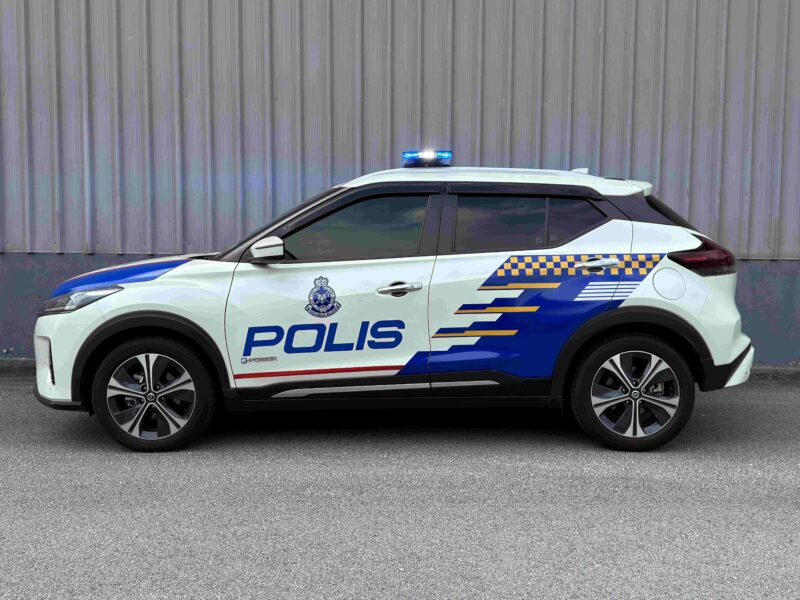
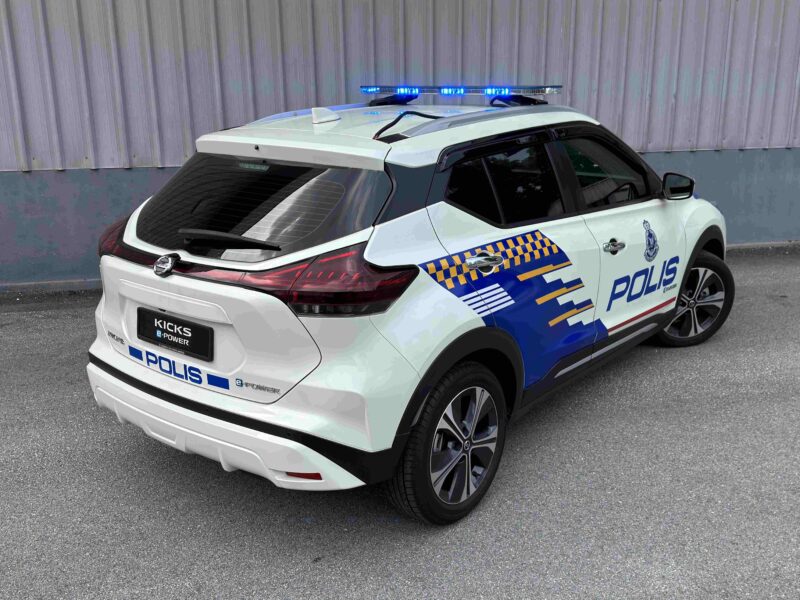
Edaran Tan Chong Motor Sdn Bhd (ETCM) has handed over two units of the Nissan Kicks e‑Power to the Royal Malaysia Police (PDRM) for evaluation purposes.
Both Nissan Kicks e‑Power units will undergo a two‑month proof‑of‑concept programme to assess their performance, practicality, and suitability for real‑world patrol operations.
Bukit Aman Logistics and Technology Department Director, Commissioner of Police Redzuan Bin Abd Hamid, said it is crucial for every new technology to be evaluated in an actual operational environment.
“This Proof of Concept programme allows us to assess the performance, practicality, and suitability of the Nissan Kicks e‑Power for frontline operational use.
“The findings from this evaluation will support our ongoing efforts to identify the most appropriate mobility solutions to meet operational needs,” he added.
ETCM Executive Vice President Christopher Tan said the best innovations are those that meet real‑world requirements.
“Nissan e‑Power delivers an EV‑like driving experience without the need for external charging, eliminating range anxiety.
“Through this evaluation programme, we hope to see how the Nissan Kicks e‑Power can support various fleet applications, including frontline service operations,” he said.
The Nissan Kicks e‑Power is powered by the e‑Power system, consisting of:
The 2026 Nissan Kicks has officially gone on sale in Japan, featuring the brand’s third‑generation e‑Power system and the option of the e‑4ORCE all‑wheel‑drive setup.
For context, the Japanese‑market Kicks is the second‑generation model, which closely resembles the version sold in the United States.
This makes it entirely different from the first‑generation Kicks available in Malaysia, including the first facelift and the second facelift recently introduced in Thailand.
In Japan, the Nissan Kicks e‑Power is priced from 2,999,700 yen (RM76,774) for the 2WD version, going up to 4,248,200 yen (RM108,728) for the range‑topping e‑4ORCE variant.
e‑Power & e‑4ORCE system
In Japan, the Nissan Kicks is offered exclusively with the e‑Power powertrain, which integrates five key components:
electric motors
generators unit
inverters
reducers
speed-up drivers
The FWD variant uses a 141 hp electric motor, while the e‑4ORCE version adds a second electric motor on the rear axle producing 67 hp.
A 1.4‑litre HR14DDe engine (97 hp/123 Nm) functions solely as a generator to supply power to the electric motors and recharge the battery.
Nissan claims this new setup is 10 percent more energy‑efficient than the previous system.
Exterior & Interior Equipment
As mentioned earlier, the Japanese‑market Kicks adopts a different design from the one we’re familiar with. It takes after the U.S. model, featuring a wider grille and overlapping daytime running lights (DRL).
At the rear, the SUV sports L‑shaped taillight housings with a layered graphic similar to the DRL signature.
Inside, the cabin is equipped with dual 12.3‑inch displays, a dedicated climate control panel, PRND buttons on the centre console, Zero Gravity seats, and a choice of synthetic leather or fabric upholstery.
Safety features under the ProPILOT suite include:
Intelligent Around View Monitor
Intelligent Emergency Braking (IEB)
Intelligent Backward Collision Prevention Support System (IBSI)
Backward Vehicle Detection Warning (BSW)
Rear Cross Traffic Alert (RCTA)
Nissan Kicks Rock Creek
This is the more rugged Kicks variant developed by Nissan Motorsports & Customize (NMC).
It features a distinctive exterior package that includes silver grille accents, black front bumper trim, Lava Red highlights, an aluminium skid plate, and five‑spoke alloy wheels.
The cabin receives water‑resistant upholstery and Lava Red contrast stitching.
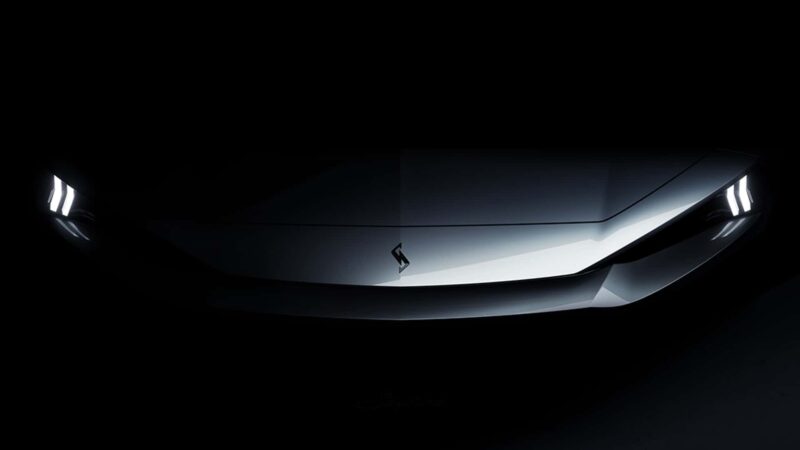
After 12 years, Nissan is finally ready to replace the existing Skyline sedan with a new generation model.
The Japanese manufacturer has also revealed several teaser images showcasing the front and rear design of this sporty sedan.
Inspiration from Previous Models
According to Nissan’s global design director, Alfonso Albaisa, the new Skyline draws inspiration from earlier versions of the model.
The design influence from previous sedans, particularly the Hakosuka, is evident in the angular and aggressive headlight shape.
The front also features an ‘S’ logo.
The rear showcases dual round taillights, accompanied by the ‘Skyline’ lettering on the side fender.
Currently, no further details have been provided regarding the engine specifications for the new Skyline model.
Is a GT-R Version Coming?
Unfortunately, the arrival of the new generation Skyline does not indicate the introduction of a new GT-R model.
This is because the GT-R has been a standalone high-performance nameplate since it separated from the R34 model and has been used on the R35 since 2007.
Three New Models Besides Skyline
Nissan Juke EV
Nissan Rogue e-Power
Nissan XTerra
At the same time, Nissan has revealed three entirely new models: the Nissan Juke EV, Nissan Rogue/X-Trail e-Power, and Nissan XTerra.
The Nissan Juke EV is built on the CMF-EV platform and features a significantly more radical design.
The Nissan Rogue e-Power comes equipped with a powertrain system consisting of a 3-cylinder engine and two electric motors.
Lastly, the Nissan XTerra, a body-on-frame SUV, is set to arrive in 2028, boasting an aggressive front design.
Edaran Tan Chong Motor (ETCM) has announced that it has received 1,300 bookings for the new-generation 2026 Nissan Serena e-Power MPV model.
So far, 250 units of the MPV have been delivered to their respective owners since its official launch last March.
According to Christopher Tan, Executive Vice President of ETCM, “For most families today, mobility is more than just transportation—it is a part of our everyday lifestyle.”
He added, “The Nissan Serena e-Power reflects Nissan’s commitment to ensuring that advanced technology enriches real-world journeys and meets the needs of families.”
He further explained that this MPV is specifically designed to address the daily realities faced by parents, children, and the elderly, who often experience discomfort, dizziness, or fatigue in traditional vehicles.
The Nissan Serena e-Power 2026 is available in five variants:
Serena X – RM154,800
Serena X Plus – RM159,800
Serena Highway Star – RM169,800
Serena Premium Highway Star – RM174,800
Serena Shiro Premium Highway Star – RM179,800
In light of the positive response, ETCM has extended a rebate offer of up to RM5,000 along with an accessory package worth RM8,000.
Edaran Tan Chong Motor Sdn Bhd (ETCM) has officially launched the 2026 Nissan Serena e-Power hybrid MPV for the Malaysian market.
The 2026 Nissan Serena e-Power arrives as a locally assembled (CKD) unit and is available in five distinct variants:
Serena X: RM154,800
Serena X Plus: RM159,800
Serena Highway Star: RM169,800
Serena Premium Highway Star: RM174,800
Serena Shiro Premium Highway Star: RM179,800
Early bird customers will benefit from rebates of up to RM5,000 and an accessory package valued at RM8,000.
The e-Power System
The vehicle is driven by Nissan’s proprietary e-Power system, which consists of:
A 1.4-liter naturally aspirated (NA) engine acting solely as a power generator.
An electric motor producing 163 PS and 315 Nm of torque.
A 1.77 kWh lithium-ion battery pack.
A single-speed automatic transmission.
The Serena e-Power boasts impressive efficiency with a fuel consumption rate as low as 5.4 liters per 100 km, providing a total driving range of up to 1,000 km.
It also features the e-Pedal function, allowing for single-pedal driving.
The chassis setup utilizes MacPherson struts at the front and a torsion beam for the rear axle.
Exterior Features
On the outside, the Serena e-Power showcases Nissan’s signature V-Motion front grille design. Standard exterior highlights include:
Three-tier LED projector headlamps with Auto Leveling.
LED boomerang-style taillights.
Dual-side sliding doors with automatic opening.
16-inch alloy wheels wrapped in 205/65R16 tires.
A signature Dual Back Door for easier access in tight spaces.
The Highway Star variants and above receive additional aerodynamic front and rear bumpers, LED fog lamps, and dual-sided electric power sliding doors.
Interior and Technology
The base Serena X variant comes equipped with:
A 7-inch digital instrument cluster and a 9-inch infotainment touchscreen.
Apple CarPlay and Android Auto support.
Dual-zone automatic climate control.
Water-repellent fabric seats and dual USB charging ports.
The X Plus adds leatherette upholstery, V-Kool tint film, and a 14-inch roof-mounted monitor.
Stepping up to the Highway Star variant introduces:
Larger 12.3-inch digital cluster and 12.3-inch infotainment screens.
Wireless Apple CarPlay and Android Auto.
Folding tables for second-row passengers, a wireless device charger, and six USB ports.
ProPilot System: Including Intelligent Cruise Control, Lane Intervention, and Blind Spot Intervention.
Intelligent Around View Monitor (360-degree camera) with Moving Object Detection (MOD).
The Premium Highway Star further enhances the cabin with Premium Black Nappa leather upholstery, a 14-inch roof monitor, and V-Kool window film.
The range-topping Shiro Premium Highway Star features Luxurious White Nappa leather, a motorized 14-inch roof monitor, a powered tailgate, and LED side sill plates.
Color Options
Color availability varies by variant:
X & X Plus: Brilliant White and Diamond Black.
Highway Star: Turquoise Blue, Dark Metal Grey, Brilliant White, and Diamond Black.
Premium Highway Star & Shiro: Exclusive two-tone finishes featuring a contrasting black roof.
As the Malay proverb goes, “better late than never.”
After more than three years since its global debut, Nissan distributor Edaran Tan Chong Motor (ETCM) is finally set to officially launch the Serena e-Power this March.
Although its arrival may be considered somewhat late, ETCM claims to have already received 400 orders for the MPV model.
Naturally, there are several features of the Serena e-Power that have piqued the interest of existing Nissan Serena owners in this new model.
Last week, ETCM invited a group of journalists for a test drive session from Petaling Jaya to Kuantan, allowing us to assess the improvements made.
Here are some positive aspects we found in the Serena e-Power:
e-Power is More Powerful
One of the most significant upgrades in this family MPV is the e-Power system (163 PS/315 Nm), which replaces the S-Hybrid system in the C27 model.
Whereas the Serena S-Hybrid previously felt like it could “manage… but don’t ask for more,” this new e-Power system offers a much more confident drive.
Its electric motor provides a more immediate response, more strength, and operates quietly, akin to an electric vehicle (EV).
It’s not to say it suddenly becomes a speedster, but this time the Serena feels less heavy when overtaking or climbing, compared to the previous S-Hybrid system.
Press the pedal, and the car moves smoothly without drama. This is the characteristic that should be present in a modern family MPV.
The Serena e-Power boasts fuel consumption as low as 5.4 liters per 100 km, with a driving range of up to 1,000 km.
Quiet Cabin
In addition to the efficient e-Power system, we also noticed a significant improvement in NVH (Noise, Vibration, and Harshness).
The cabin feels quieter and more comfortable, to the point that we forgot we were not driving an electric MPV.
This is attributed to several factors, including the use of acoustic glass and air curtains on the front bumper, which contribute to improved driving stability.
Wind noise is only noticeably heard at higher speeds; however, this isn’t a major issue as the MPV will most often be driven within the national speed limit.
Engine noise is also less pronounced when the e-Power system is engaged aggressively, almost as if Nissan has placed the 1.4L NA engine at the front of the bumper.
It doesn’t roar; rather, it produces a low hum that does not distract the driver.
Less Motion Sickness
One new feature in the Serena e-Power is the redesigned front suspension system, aimed at enhancing ride stability and comfort.
According to Nissan, the Serena e-Power utilizes SUV-based suspension architecture at the front to reduce body roll and improve control.
Overall, the suspension tuning of the Serena e-Power is designed to provide a more comfortable ride with less bouncing, aided by Zero Gravity seats to reduce motion sickness, especially for rear passengers.
A Champion of Practicality
As a family MPV, the Nissan Serena offers ample space for storage.
In line with current trends where people heavily rely on smart devices, the Serena includes designated spots for mobile phones, including a wireless charging slot and six USB ports.
The second-row passengers benefit from foldable tables and seats that can adjust in four directions.
Additionally, there are 22 cup-holder locations throughout the cabin.
It can be said that the Serena understands the realities of life: kids have toys, mothers have small bags, fathers have power banks – everyone has their place.
Retaining Elements of Previous Serena Models
Although the Serena e-Power introduces numerous enhancements, it still maintains the true identity of the Serena, such as the seating layout allowing easy passage from the first to the third row.
It also retains wide sliding doors on both the left and right, a high cabin dimension, large windows, and ease of access.
The Serena maintains the Dual Back Door feature with dual opening methods, making it convenient for loading and unloading items, especially in tight parking spaces.
Thus, exemplary fathers need not worry, as the identity of the previous Serena model is still preserved and passed down to the new Serena.
Conclusion
With its practical features and innovations, the Nissan Serena e-Power has the potential to be an ideal family car choice for 2026.
According to ETCM, the Serena e-Power is expected to be priced between RM160,000 and RM180,000.
Specifications for the Nissan Serena e-Power (including safety features) can be viewed at THIS LINK.
Edaran Tan Chong Motor Sdn Bhd has announced that the new Nissan Serena e-Power model will be launched in March 2026.
This locally assembled (CKD) model will be sold at a price range of RM160,000 to RM180,000.
During a test drive organized with media representatives, Christopher Tan, the Executive Vice President of ETCM, announced that they have received 400 bookings for the MPV model thus far.
The Nissan Serena e-Power 2026 will be offered in Premium Highway Star specification.
e-Power System
It is powered by the e-Power system, which consists of a 1.4-liter engine that acts as a power generator for the electric motor (163 PS/315 Nm), paired with a 1.769 kWh lithium-ion battery pack.
With a single-speed automatic transmission, the Serena e-Power offers fuel consumption as low as 5.4 liters per 100 km, with a driving range of up to 1,000 km.
It also features a one-pedal driving function or e-Pedal.
The Serena e-Power utilizes a MacPherson strut setup at the front and a torsion beam for the rear axle.
Exterior
In terms of exterior design, the Serena e-Power features a V-Motion front grille, three-layer LED projector headlights with Auto Levelling function, boomerang-style LED taillights, and automatic sliding doors on both the left and right.
Standard equipment includes 16-inch wheels wrapped in 205/65R16 tires, which prioritize both comfort and presence.
The Serena e-Power also inherits the Dual Back Door feature from the previous Serena model.
Interior
Cabin features include seats with Zero Gravity technology, black Nappa leather upholstery, second-row captain’s chairs complete with armrests and four-way sliding functions, a foldable table for second-row passengers, and an additional 14-inch display screen.
There is also a 12.3-inch TFT display, a 12.3-inch infotainment screen, support for Apple CarPlay and Android Auto, a climate control panel with a digital display, wireless charging slots, and six USB ports.
Safety
The Serena e-Power is equipped with six airbags, ABS, EBD, Brake Assist, Hill Start Assist (HSA), ISOFIX anchors, Vehicle Dynamic Control (VDC), and Traction Control System (TCS).
Advanced safety features include a semi-autonomous ProPilot system, Intelligent Around View Monitor (IAVM), Smart Moving Object Detection (MOD), Intelligent Forward Collision Warning (IPFCW), Intelligent Emergency Braking (IEB), Driver Attention Warning (IDA), Lane Departure Warning (LDW), Blind Spot Warning (BSW), and Rear Cross Traffic Alert (RCTA).
Colour Options
The Nissan Serena e-Power will be available in four two-tone colour options: Turquoise Blue, Dark Metal Gray, Brilliant White, and Diamond Black, all featuring a black roof.
The seventh-generation Nissan Z sports car (known as Fairlady Z in the Japanese market) made its debut in 2021, replacing the 370Z model.
After several years, Nissan has finally updated the Fairlady Z by introducing a facelift version at the 2026 Tokyo Auto Salon.
While there aren’t many changes, the facelifted Fairlady Z features a cleaner image compared to its predecessor, particularly with the all-new front bumper.
According to Nissan, the new bumper design not only focuses on aesthetics but also contributes to improved aerodynamic aspects by reducing front lift by 3.3 percent and drag by 1 percent.
Additionally, the Nissan emblem on the front has been replaced with a Z emblem, accompanied by two-tone alloy wheels.
Finally, Nissan has introduced a new color called Unryu Green, inspired by the Grand Prix Green from the S30 generation Z model.
For now, Nissan continues to utilize the original 3.0-liter twin-turbo V6 engine, which produces 400 hp and 475 Nm of torque.
However, the driving and handling aspects have been enhanced with a revised suspension system featuring larger monotube dampers, as well as larger brakes.
The layout of the cabin remains unchanged, but for the facelift version, Nissan offers a tan trim option for the seats, door panels, and lower dashboard.
Interestingly, the official images provided include paddle shifters behind the steering wheel in a car equipped with a manual gear knob.
The sixth generation of the Nissan Serena minivan (code C28) has been available in the market (except Malaysia) since 2022.
With three years having passed, it’s time for Nissan to update this model, coinciding with its 35th anniversary to be celebrated next year.
Several changes have been introduced in this facelifted version of the Nissan Serena:
Exterior
Compared to the pre-facelift model, the Nissan Serena facelift features a new front grille with an asymmetrical V-pattern design, complemented by newly designed alloy wheels.
Additionally, three new exterior colors are offered: Moonbow Blue, Aqua Mint, and Deep Ocean Blue.
Infotainment Powered by Google
For the first time, the Serena is equipped with the NissanConnect infotainment system powered by Google.
This system supports Google Maps, Google Assistant, and the Google Play Store.
In response to customer demand, Nissan has also added a memory function for the e-Pedal feature, allowing the system to remember the previously set operation modes before the vehicle is turned off.
Safety Enhancements
Safety features have also been improved, particularly the Intelligent Around View Monitor (IAVM), which includes 3D viewing, wide front views, and dual side views when the side mirrors are folded.
The Nissan Serena also includes a reminder function for drivers who may forget to lock the doors, turn off the hazard lights, close the windows, or check the rear seats.
Premium Autech Line Variant
Nissan offers a more premium Autech Line variant, which features:
Metallic finishing on the side mirror housings
16-inch dark metallic silver alloy wheels
Dark chrome finishing on the front grille
Tailor Fit upholstery that is softer and more comfortable
Outdoor-Friendly Multi Box Variant
In addition to seven- and eight-seater variants, the Nissan Serena is also available in a Multi Box variant.
This version features a seating arrangement that accommodates five people at a time, with the third-row seats replaced by a large-capacity storage box.
This storage box can be used as a space for storing items, a bench, or a foldable table.
The area can also be converted into a sleeping space, where users can lay down a mattress made from waterproof Cordura material.
Engine Options: 2.0L NA or 1.5L e-Power
In Japan, the Nissan Serena comes with a choice of a 2.0-liter naturally aspirated (NA) engine that produces 150 PS and 200 Nm of torque.
There is also an e-Power option, which includes a 1.5-liter three-cylinder engine that acts as a power generator for the 163 PS and 315 Nm electric motor.
The facelifted Nissan Serena is priced starting from 2,856,700 yen (approximately RM74,161).
Edaran Tan Chong Motor (ETCM) recently held a preview session for its new MPV model set to launch next year, the Nissan Serena e-Power.
The sixth generation of the Nissan Serena e-Power (C28) is powered by the e-Power drivetrain, which consists of a 1.4-liter engine, a 163 PS electric motor producing 315 Nm, and a 1.769 kWh lithium-ion battery pack.
Unlike hybrid vehicles on the market, this e-Power system relies entirely on the electric motor for propulsion.
The 1.4-liter engine serves solely as a power generator but is equipped with direct injection technology and Mirror Bore Coating, which help reduce friction, vibration, and noise.
Fuel consumption is as low as 5.4 liters per 100 km, and this MPV can travel up to 1,000 km on a full tank.
In terms of appearance, the Serena e-Power C28 features a more modern design, beginning with a V-motion grille, a sleeker bumper, boomerang-patterned taillights, and the new Nissan logo.
The wheels are 16 inches in size.
According to ETCM, the Nissan Serena e-Power will be the first e-Power model to be assembled at the Serendah plant.
The retail price and full specifications of the Nissan Serena e-Power will be announced at the official launch, expected to take place in the first quarter of 2026 (Q1 2026).
Nissan is currently facing significant challenges, forcing the company to lay off a large number of employees and close several factories around the world.
While Nissan’s focus has shifted towards high-volume vehicle models, the manufacturer acknowledges that sporty models could be a game-changer and pique the interest of younger consumers.
Speaking to Kuruma News, Nissan CEO Ivan Espinosa explained that sports cars like the IDx could help revitalize the Nissan brand.
He added that such models have the potential to appeal to a younger demographic, making it essential for manufacturers to continuously attract younger consumers to their brand.
Espinosa also expressed his desire to revive the Silvia nameplate.
“The Nissan S15, particularly with its high-output 2.0-liter turbo engine, is one of the favorite cars in Nissan’s history. In my opinion, it is one of the best lightweight sports cars we have ever produced.”
He acknowledged that it is quite challenging to reproduce a car with a lightweight chassis while simultaneously meeting today’s stricter safety regulations.
Undoubtedly, if Nissan wants to follow in Toyota’s footsteps, the IDx concept model is a suitable candidate to be highlighted.
The IDx concept model was displayed at the 2013 Tokyo Motor Show as a response to the Toyota 86/Subaru BRZ, featuring an exterior design inspired by the Datsun 510.
Unfortunately, the IDx has yet to be realized to date.
Nissan has introduced the new generation of the C-segment sedan, the 2026 Sentra, for the United States market.
Unlike previous models, the new Nissan Sentra features a fresher design, reminiscent of the Nissan Ariya electric SUV, particularly at the front.
Here are some key facts you should know:
1. Chassis
The new Sentra retains the CMF-CD platform from the previous model, albeit with larger dimensions. It measures 4,656 mm in length (+15 mm), 1,825 mm in width (+10 mm), and 1,448 mm in height (down 2 mm), with a wheelbase remaining at 2,712 mm.
Despite using the old platform, Nissan has improved the chassis stiffness, which is now 6 percent stiffer, alongside dynamic dampers in the steering system to reduce vibrations.
The suspension system now features new shock absorbers.
2. Engine
There are no mechanical changes, meaning the 2026 Sentra still comes with a 2.0-liter engine (code MR20DD) that produces 149 hp and 198 Nm of torque. The power is channeled to the front wheels through a CVT Xtronic transmission.
3. Design
As mentioned earlier, the 2026 Sentra showcases an evolution of the V-motion design, resembling modern Nissan models like the Ariya, Note, and Qashqai.
The LED projector headlights are slimmer, and the daytime running lights will appear dark when turned off.
The lighting unit of the Sentra will also emit rhythmic light when the car is unlocked.
The side does not feature the floating roof element anymore, while the rear showcases a new wide horizontal light design.
Depending on the variant, the Sentra can be equipped with wheel sizes ranging from 16 to 18 inches, as well as a two-tone color scheme with a Super Black roof.
4. Cabin Space
The interior of the Sentra presents a tidier and minimalist layout, featuring twin 12.3-inch displays, touch-sensitive climate control panels, and support for Apple CarPlay and Android Auto.
Other features include a 64-color ambient lighting system, heated steering wheel, wireless charging slot, and TailorFit upholstery.
Depending on the variant, the Sentra can be equipped with features like wireless Apple CarPlay/Android Auto connectivity and a Bose audio system with eight speakers.
5. Safety
The 2026 Nissan Sentra offers standard safety features such as intelligent cruise control, blind spot intervention, autonomous emergency braking, forward collision warning, lane departure avoidance, and a total of 10 airbags.
Additional features include the ProPILOT system and an intelligent surround monitoring system (IAVM) with a moving object detection function, which is especially useful in parking areas.
When the Nissan Z Nismo hit the market in 2024, it was seen as a strong competitor with its impressive power package of 420 hp and 521 Nm of torque, along with more serious suspension and braking systems, a limited-slip differential, and upgraded aerodynamic features.
Unfortunately, at that time, the sports car was only available in a nine-speed automatic version.
Fortunately, Nissan understands the demand and desires of Nismo fans.
According to a report from Automotive News, the Nissan Z Nismo will now be offered in a six-speed manual version to complement the existing automatic transmission option.
However, Nissan America’s Chairman, Christian Meunier, did not elaborate on whether the manual model would feature its own tuning or maintain the specifications of the existing Z Nismo.
True enthusiasts of the Nissan Z, as well as critics of the BMW Supra, can still enjoy this sports car with a three-pedal setup through the base Z Sport and Performance variants.
However, for the manual version of the Nissan Z Nismo, you will need to be patient, as Nissan has not disclosed when this model will arrive.
Edaran Tan Chong Motor (ETCM) has announced that bookings for the 2025 Nissan Navara X-Tremer pickup truck are now open.
This new trim package features exterior details such as:
Black front grille
X-Formation bumper cladding
Carbon fiber-like fender accents
New black over fenders
Shark fin antenna
Black rear bumper
Decorative trim on the tailgate door
Inside the cabin, the X-Tremer trim showcases features including:
Soft-touch dashboard with double-stitching
Stylish center console
Leather-wrapped steering wheel
8-inch infotainment screen with Apple CarPlay/Android Auto connectivity
Zero Gravity front seats
Quole Modure upholstery that is dirt-resistant and stays cool
The Nissan Navara X-Tremer retains a double-wishbone suspension setup at the front with a stabilizer bar, followed by a multi-link setup that minimizes body roll, ensuring comfort and stability.
Safety features include:
Front Collision Warning (IPFCW)
Emergency Braking (IFEB)
Blind Spot Warning (BSW)
Lane Departure Warning (LDW)
Rear Cross Traffic Alert (RCTA)
ABS, EBD, BA, TCS, VDC, HSA, HDC
Trailer Sway Assist (TSA)
Electronic Locking Rear Differential
The Nissan Navara X-Tremer is available in three variants with the following prices:
2.5L Turbo V – RM134,800
2.5L Turbo VL – RM146,900
2.5L Turbo Pro-4X – RM154,800
Customers who purchase and register the new Nissan Navara X-Tremer will also be eligible for a cash rebate of up to RM8,000 (subject to terms and conditions).
Malaysians are invited to view the Navara X-Tremer up close at the Nissan Roadshow taking place at East Coast Mall, Kuantan from September 10-14, or to visit any Nissan showroom nationwide.
This is the fourth generation of Nissan’s kei car, the 2025 Roox.
Notably, this model shares the same platform as the Mitsubishi Delica Mini and the eK Space, which bears a design more similar to the Roox.
The design of the Roox is quite similar to its predecessor; however, it features a new headlight design that conveys a premium MPV image.
Designed based on the ‘Roomy x Max’ concept, the Roox offers a more spacious cabin while maintaining the small dimensions typical of kei cars.
Compared to the previous generation, the overall interior length has increased by 115 mm to 2,315 mm.
In addition, the Roox provides the best knee space in its class, allowing children to comfortably stand to change clothes when the vehicle is stationary.
The cargo space is also quite generous, measuring approximately 675 mm in length, which can accommodate four 48-liter luggage bags.
The sliding door opening is 650 mm wide, while the rear seat can be moved up to 320 mm.
Several additional storage compartments are available, including large cup holders, a glove compartment, a device holder, and a covered space behind the display screen.
Additionally, there is a 12.3-inch display screen, among the largest ever fitted in any kei car.
The Roox also introduces a first for the kei car class: the Intelligent Around View Monitor, featuring the Invisible Hood View function.
The ProPILOT safety system now includes smart emergency braking (AEB), rear cross-traffic alert (RCTA), smart blind-spot collision avoidance (ISB), and blind-spot warning (BSW).
Buyers can choose from up to 17 color options, including six two-tone colors for the Standard and Highway STAR variants.
The estimated starting price is 1.6 million yen (approximately RM46,000).
The engine specifications are likely unchanged, still featuring the 658 cc powertrain that generates 52 hp and 60 Nm of torque.
Before it could even be assembled and sold globally, the new generation 2026 Nissan Leaf has reportedly encountered problems.
According to a report by Reuters citing Kyodo News, Nissan is forced to cut the production of the new Leaf due to export restrictions on rare earth metals imposed by China.
These restrictions have impacted the supply of components necessary for Leaf production.
In addition to Nissan, the export limitations set by China are also affecting several automotive manufacturers, including Ford and Suzuki.
The third generation of the Nissan Leaf was introduced last month, marking a shift from its traditional hatchback design to an electric crossover that shares the same AmpR Medium platform as the Nissan Ariya EV.
The 2026 Nissan Leaf will also be the first Nissan model to adopt the NACS (North America Charging System) charging standard, making it compatible with the Tesla Supercharger network.
This is no longer the electric Leaf you’ve known for years; it is in fact the third generation of the Nissan Leaf, which has transformed into an electric SUV.
This subcompact crossover (segment B) shares the same AmpR Medium platform used by the Nissan Ariya EV.
Here’s some brief information you need to know:
1. Power
The base version of the Nissan Leaf is powered by a front-wheel-drive electric motor producing 174 hp and 344 Nm of torque, equipped with a 52 kWh battery pack.
Meanwhile, the top variant is powered by an electric motor generating 214 hp and 354 Nm, along with a liquid-cooled 75 kWh lithium-ion battery pack.
2. Range
The Nissan Leaf can travel up to 487 km, which is farther compared to the 2024 Leaf model.
Versions equipped with larger wheels can achieve a range between 416 km and 463 km.
The range for the lowest variant will be announced later.
3. Charging
The Nissan Leaf supports fast charging, allowing the battery to be charged from 10% to 80% in just 35 minutes.
Interestingly, this new Leaf is equipped with two charging ports: the NACS port (compatible with Tesla chargers) and the J1772 port.
While the Leaf for the European market retains the CCS port, the Japanese version is equipped with a CHAdeMO port.
4. Aerodynamic Body
The design of the Nissan Leaf body clearly draws inspiration from popular American-made EV models.
The front features sharp LED headlights connected by a horizontal LED light bar, while the rear showcases an integrated spoiler and deliberately darkened light housings.
According to Nissan, the Leaf 2026 offers a drag coefficient as low as 0.25.
5. Dimensions
The Nissan Leaf 2026 measures 4,350 mm in length, 1,810 mm in width, and 1,550 mm in height, with a wheelbase of 2,690 mm.
In comparison, the second-generation Nissan Leaf measures 4,490 mm in length, 1,788 mm in width, and 1,530 mm in height, with a wheelbase of 2,700 mm.
It is shorter than its predecessor but has a taller profile.
6. Cabin
This new platform provides advantages for the Leaf 2026 in terms of a flatter floor structure.
It also features a pair of 12.3-inch display screens or a 14.3-inch screen for the highest variant, complete with integrated Google software, alongside Apple CarPlay and Android Auto.
The top variant is also equipped with a Bose audio system with 10 speakers and a head-up display screen.
There’s also an option for a panoramic roof with electrochromic technology that doesn’t require physical shades to block sunlight.
The cargo space in the Nissan Leaf is 437 liters.
7. Safety
As standard, all versions of the Leaf 2026 come equipped with ProPilot Assist, which includes features such as forward collision warning, automatic emergency braking, high beam assist, and lane departure warning.
Additional features include a 3D surround monitoring system, a transparent hood view system, and a wide-angle front view feature.
Once a popular choice, manual transmission passenger cars are now on the brink of extinction.
In the United States, Nissan has ceased sales of the most affordable Versa (Almera) variant, which is also the last model on the market equipped with a five-speed manual transmission.
In an official statement provided to Motor1, Nissan confirmed that “production of the manual Versa S variant will be discontinued, while other variants will continue to be sold.”
For reference, the Nissan Versa S (manual version) starts at a price of $18,330 (RM77,902), while the CVT version is priced at $20,130 (RM85,553).
Despite the Versa’s popularity in that market, the manual variant accounts for less than five percent of the total sales of the model.
The U.S. market still offers new models with six-speed manual transmission options, primarily consisting of high-performance models such as the BMW M2, Honda Civic Type R, Hyundai Elantra N, Porsche 911, and the Toyota Gazoo Racing lineup (GR86, GR Corolla, GR Supra).
Despite facing uncertain current conditions, Nissan still has its plans for upcoming models. One of Nissan’s main objectives is to focus on its high-performance sub-brand, Nismo.
According to Arnauld Charpentier, Nissan’s Vice President of Marketing and Regional Mobility, “I see a bright future for Nismo. We will position it as the brand’s focal point.”
Nissan has not disclosed details about any Nismo models, but it is certain that the new Nissan GT-R will be part of those plans.
“There are teams working on this project. When and how, honestly, we don’t know,” he stated.
He also did not specifically mention whether the GT-R would continue with its original formula (internal combustion engine) or switch to full electric (EV).
“Whether the Nissan GT-R is an electric car or hybrid, it must remain a sports car. However, if it performs the same as an electric SUV, that would be a concern.
“We need to redefine the perception of sports cars,” he added.
What is clear is that niche products like the GT-R may not be a priority for Nissan at this moment.
Realistically, Nissan is planning to cut up to 20,000 jobs and close up to seven factories worldwide.
Additionally, Nissan aims to streamline its product portfolio by eliminating up to six vehicle platforms and targeting a reduction in parts complexity by up to 70 percent.
Amid challenges with financial issues, Nissan has officially unveiled the sixth generation of its urban hatchback, the Nissan Micra 2026.
Unlike its five predecessors, the Nissan Micra now functions as a fully electric vehicle (EV).
Here are some quick facts you need to know:
1. Renault Platform
This B-segment hatchback is not developed entirely by Nissan; instead, it uses the CMF-B (or AmpR Small) platform.
Along with sharing the same body as the Renault 5, the Nissan Micra also features similar electric drive unit specifications.
2. Power
The base variant of the Nissan Micra is powered by a 121 hp/225 Nm electric motor, with a 40 kWh battery pack that provides a range of 310 km.
The most powerful version is equipped with a 148 hp/245 Nm electric motor and a 52 kWh battery pack, allowing for a driving range of 408 km.
3. Dimensions
Unlike the fifth-generation Micra, the new Micra has shorter dimensions (3,920 mm), but it is wider (1,800 mm) and has a longer wheelbase (2,540 mm). In fact, the Micra is also wider compared to the original Renault 5.
4. Design
Due to sharing its body with the Renault 5, several elements from the donor model still exist, such as the side windows, the side mirror housing structure, the wide C-pillar, and the hidden rear passenger door handle.
Unique to the Nissan Micra is the oval-shaped round headlight and taillight design inspired by the Concept 20-23 model.
As standard, this EV comes equipped with 18-inch wheels featuring three design options.
Additionally, the Nissan Micra features multi-link suspension settings at the rear—a characteristic typically found in more expensive car segments.
5. Interior
The driver-oriented dashboard layout found in the Renault 5 has been fully integrated into the Nissan Micra EV.
There is a 10.1-inch digital cluster screen supported by a matching center screen deliberately positioned facing the driver.
Besides the NissanConnect infotainment system, which includes built-in Google services, it also supports connections to Apple CarPlay and Android Auto.
The start button is located between the two screens, while the transmission lever is positioned on the steering column, close to the start button.
6. Production
The Nissan Micra EV will be assembled at the Renault ElectriCity factory located in Douai, France—which has been producing the Renault 5 since 2024. This EV is expected to enter the European market by the end of 2025 as a 2026 model.
Malaysia’s Leading Automotive News | ENGEAR ENGLISH