


First introduced in 1985, the Proton Saga remains one of the most important models in Malaysia’s automotive landscape.
The Saga is not merely a mode of transport from point A to point B — it’s a necessity for those who want a comfortable, modern, and safe car.

The third facelift (MC3) launched last year, arrived with a strong package that easily embarrasses its rivals.
This was proven when Saga sales surpassed the Perodua Bezza throughout January 2026.
We had the chance to test-drive the Saga, and here are our thoughts on Proton’s new sedan.
A More Premium Saga Design

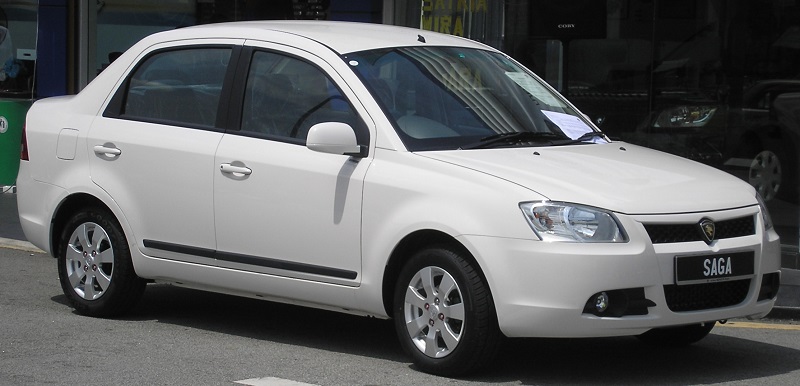
This entry-level sedan has gone through three design eras:
- Mitsubishi’s boxy design (1985)
- Proton’s original design (2008)
- Geely-influenced design (2025)
There’s no denying that the new Saga offers a more sophisticated image, especially with a front fascia aligned with Proton’s other X models (X70 & X90).


Previously, DRLs came as a separate package, but the new Saga integrates DRLs into the main headlamp unit.
It also features bright LED projector headlamps for night driving.
The Saga’s image is further elevated with full-width LED taillights, matching current automotive design trends.
Unfortunately, the sedan’s side profile still reveals that it sits on the existing platform.
New Saga owners should probably thank the Proton Savvy for that.
A More Advanced and Premium Cabin

Since the original dimensions haven’t changed much, the cabin doesn’t feel significantly more spacious than before.
The dashboard layout has been refreshed.
Our Premium variant test unit comes with a 7-inch digital instrument cluster and a 9-inch infotainment screen in the centre.
Physical climate control buttons are retained, but with a simpler design and smaller knobs and switches.

There’s no denying that the new Saga delivers a more premium-feeling experience for an entry-level sedan.
The climate control knobs don’t feel cheap when turned, and the indicator/wiper stalks feel solid during use.
The air-conditioning system is excellent — a long-standing Proton trademark.

Another point, Saga now supports Apple CarPlay and Android Auto. Wirelessly.
The audio system also delivers pleasant sound quality, complementing the quiet cabin during drives.
Driving Experience

One of the biggest highlights of the new Saga is its new 1.5-litre i-GT engine.
This 1,499 cc engine produces 120 PS @ 6,100 rpm and 150 Nm @ 4,000 rpm — far more powerful than the old Campro’s 94 hp/120 Nm.
Fuel efficient? Absolutely.
A full tank can take the Saga more than 500 km, which is more than sufficient.
Fuel consumption is recorded at around 6.5 litres per 100 km.

Ride and handling have also been improved, making the Saga more exciting to drive, especially on winding roads.
The MacPherson strut and torsion beam suspension tuning feels just right — sporty yet still prioritising comfort.
Rough surfaces and vibrations are well-filtered, giving the Saga a surprisingly premium feel even when the road outside resembles the moon’s surface.
Engine noise no longer roars like the old Campro days.
The naturally aspirated i-GT engine produces only a low-frequency hum that doesn’t distract the driver even under heavy throttle.
Saga Is Not a Perfect Car

Despite the many positives, the Saga isn’t perfect.
A few things need attention to make it even better:
First, the CVT transmission response can be frustrating, especially at low rpm.
At normal speeds it’s fine, but the Saga can test your patience on roads with many traffic lights. Or Shah Alam, the Land of Roundabouts.
It’s hard to achieve smooth driving patterns because of this.
As someone used to manual cars, the writer hopes Proton will one day offer a six-speed transmission.

Second, the brake pedal bite point feels too far forward. Not that the braking system is bad — it still stops the car effectively.
But if you plan to drive the Saga fast, keep your foot ready for anything unexpected.
Third, the tyres. The standard Atlas tyres aren’t terrible, and they’re okay in the wet, but there are better options in the market.
If you’re buying a Saga, set aside some budget for tyre upgrades if you want a more confidence-inspiring drive.
Cabin weaknesses that can be improved

A few cabin improvements would make the Saga even better:
One, the instrument cluster brightness can be lowered further — it’s too bright at night, to the point the car next to you might notice.
Two, although Saga now supports wireless Apple CarPlay and Android Auto, the Altas operating system isn’t very stable.

Sometimes it restarts on its own, which is troublesome when you’re relying on navigation.
Three, the solution to sudden CarPlay/Android Auto disconnections is using a USB cable.
But the USB port is positioned too close to your knee, making driving uncomfortable — and the Saga doesn’t even have a left footrest.

Four, the driving position feels quite high, even at the lowest seat setting.
Your eye level ends up close to the rear-view mirror height.
This makes it difficult when going up or down multi-storey car parks.
Maybe this is a preview of the upcoming Saga Cross. Maybe.
Safety: Better Than Iriz and Persona

After a long wait, Proton has finally equipped an entry-level car with all the necessary safety features.
Six airbags come standard on the Premium variant, along with advanced safety features such as:
- Autonomous Emergency Braking (AEB)
- Lane Departure Warning (LDW)
- Rear Cross Traffic Alert (RCTA)
- Rear Collision Warning (RCW)
- Door Opening Warning (DOW)
- Auto High Beam (AHB)

And finally, the Saga now gets Blind Spot Monitoring (BSM) — a very welcome addition. Even the Iriz and Persona don’t get this.
Saga also gets front and rear parking sensors, which are quite sensitive and annoying in traffic jams.
There’s also a speed limit warning if the system detects the car exceeding the allowed limit.

One feature worth praising is the alert reminding drivers about children (and valuables) in the back seat whenever the engine is turned off.
The sound is loud and clear to ensure no Saga owner suffers from “forgotten child syndrome.”
Lose items and you can replace them. Lose a child and regret will haunt you.
Conclusion

Looking at the package and specifications offered, the Proton Saga is no longer a model you can take lightly.
It has everything needed in an entry-level sedan — power, comfort, space, and technology that makes daily life easier.
Most importantly, it’s priced within reach for most first-time car buyers.
Just like the Iriz in 2014, the Proton Saga has now set a new benchmark for the entry-level sedan segment.
Well done, Proton!
Proton Saga 2026 – Quick Specs
- 1.5-litre i-GT Atkinson-cycle engine
- 120 PS @ 6,100 rpm
- 150 Nm @ 4,000 rpm
- CVT transmission
- Front-wheel drive
- MacPherson strut / torsion beam suspension
- 15-inch wheels


