The writer had the opportunity to test drive several small Volvo models before, including the Volvo V40 and the Volvo XC40 and C40 crossovers.
This time, it’s the turn of the smallest production model ever created by the Scandinavian manufacturer, the Volvo EX30.
It comes exclusively as an electric crossover, with no internal combustion engine options available.
Despite being available only in an EV version, the EX30 is not a model to underestimate.
It has a package that can meet the needs of every user—offering style, practical space, and performance capable of outperforming larger SUVs, especially when you choose the Ultra Twin Performance variant, which we drove for this test.
Here’s a summary of our experience after enjoying the EX30, priced at RM228,888, for several days.
Exterior Appearance
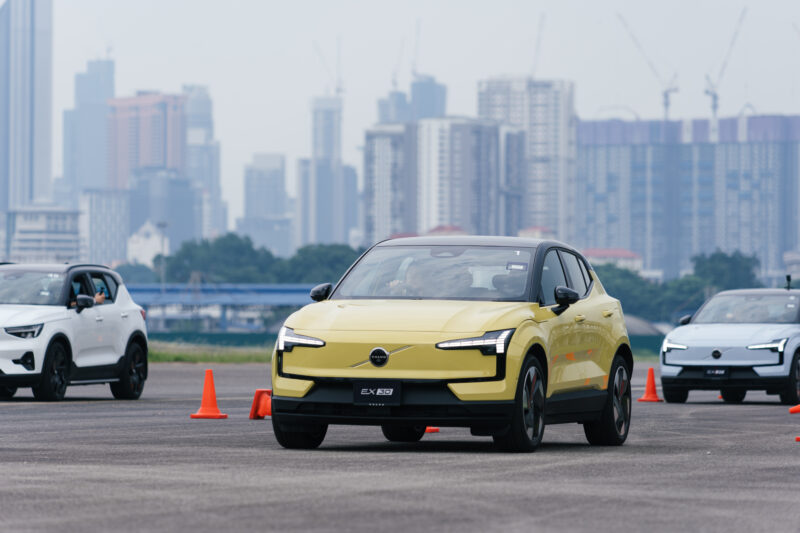
Yes, in terms of design, it’s hard to deny that this is a Volvo SUV.
Just look at the headlights with Thor hammer-shaped LED graphics, the front end without a grille displaying the minimalist Volvo logo, and the rear lights—all reminiscent of the Volvo EX90.
Its size is indeed quite compact, measuring 4,223 mm in length, 1,837 mm in width, 1,555 mm in height, and a wheelbase of 2,650 mm, making it smaller than its siblings, the XC40 and C40.
However, small does not mean the EX30 is less practical; the details can be found in the next section.
Practicality
Volvo seems clever in providing a comfortable and practical cabin space in the EX30.
Due to the absence of a speaker system (it has only a Harman Kardon soundbar on the dashboard), there is ample space on the door panels.
The center console appears simple, but when the weather is warm, you can place a cool drink in a pull-out cup holder that can be hidden away when not in use.
Is that not enough? The floor console is also provided, along with additional hidden compartments for smaller items and space in the console tunnel.
The glove box is positioned in the center for easy access by both the driver and front passenger.
Although it looks small from the outside, the Volvo EX30 offers a cargo space of 318 liters, which can expand up to 718 liters when the second-row seats are folded flat in a 60:40 ratio.
This is large enough to accommodate items up to 1.64 meters long and 0.86 meters high.
If you need to head to Ikea for furniture shopping, you can refer to the storage guide graphic provided on the rear tailgate.
Still not enough? There’s a frunk that offers a capacity of seven liters.
Extremely Minimalist to the Point of Confusion
Want to know why Volvo can provide such extensive space?
It’s because Volvo has taken minimalist design to an extreme level, requiring me to ‘reset’ my mindset each time before starting my journey.
The window buttons have been relocated to the center—like cars from the old days—and there are only two buttons available.
You need to press an extra button to open the rear passenger window.
To control the temperature of the air conditioning system? Use the central display screen.
To adjust the steering settings and side screens? Again, it’s done through the central display.
Want to open the glove box? Yes, you also need to press the menu on the central screen.
Fortunately, to start my journey, I didn’t have to scroll through the central screen to switch to Drive mode. The gear shift lever is provided in the steering column, complete with cruise control mode (you only need to pull the lever down once after entering Drive mode).
Finishing Touches
One commendable aspect of the Volvo EX30 is its extensive use of sustainable materials within the cabin.
For example, the upholstery for the seats, dashboard, and doors is made from recycled materials such as denim, hemp, and a wool blend.
The use of these materials does not compromise the comfort factor throughout the driving experience.
What I particularly like is the seating that fully supports the lower legs, along with the comfortable armrest panel on the door.
However, if you look closely, the plastic finishes in certain areas seem inconsistent with the luxurious image Volvo is trying to portray in the EX30. After all, it is made from recycled plastic.
Agile Driving on the Road
The Ultra Twin Performance variant of the EX30 comes equipped with two electric motors that produce 422 hp and 543 Nm of torque, allowing it to accelerate from 0 to 100 km/h in just 3.6 seconds.
With its small, agile body package, the EX30 has no trouble outperforming any sports car out there.
Its suspension tuning is excellent, effectively absorbing all the imperfections found on the road and providing a delightful driving experience, especially when encountering curves.
To be frank, I believe the suspension tuning in the EX30 is significantly better compared to its bigger siblings, the XC40 and C40.
Most of the time, the power delivered by the rear motor is sufficient, and I hardly relied on the Performance mode for the AWD system (which has to be accessed through the central screen).
The NMC 69 kWh battery pack allows you to achieve an impressive driving range of 450 km, making it well-suited for urban driving.
The steering response is also quite good, ensuring that the EX30 stays precisely on its intended path.
Unexpected Off-Road Capability
Clearly, the Volvo EX30 has its unique strengths, making it suitable as an everyday vehicle.
However, one unexpected advantage I discovered is the comfort it offers when the Volvo EX30 is taken off-road (more appropriately, soft-road).
I admit that this EV is already quite comfortable on paved roads, but when the tires hit gravel paths, the EX30’s suspension system effectively filters out all the roughness of unpaved roads.
It’s perfect for driving across rough terrain, allowing you to enjoy outdoor weekend activities like picnicking by the river or camping on the beach.
Given this impressive potential, it’s no surprise that Volvo showcased the EX30 Cross Country version earlier this year for those who seek a more rugged driving experience in this compact EV.
Will the EX30 Cross Country be realized in the future? We can only wait and see what plans Volvo has for this electric SUV.
Charging
The 69 kWh NMC battery supplied in the Volvo EX30 supports AC charging at 11 kW, taking eight hours for a full charge.
If you’re short on time, simply charge the EX30 at any fast-charging station, as this EV supports DC charging up to 153 kW.
In just half an hour, the 69 kWh battery can be charged from 10% to 80% state of charge.
Alternatively, you can visit any shopping center with fast-charging facilities, allowing you to shop for your desired items while the vehicle charges.
One feature I particularly like about this EV is the Google-based mapping system that displays the estimated battery state of charge upon arrival at your destination or after a round trip.
Safety
As a Volvo, the EX30 is equipped with nearly comprehensive safety features in this compact package.
These include adaptive cruise control, traffic jam assistance, collision avoidance assistance, autonomous emergency braking, lane keeping assistance, lane departure warning, blind spot monitoring, and rear cross-traffic alert.
Ironically, it also features a driver attention monitoring system that alerts the driver if it detects a lack of attention on the road.
What can you expect from a car that crams all sorts of settings and functions into a single 12.3-inch screen?
Essential information such as speed, battery state of charge, traffic light notifications, and gear position (RND) is displayed at the top of the screen.
During driving, I find myself looking to the left to ensure that this EV is being driven at the speed allowed by law.
Or every time my left finger pushes the lever to activate the turn signal.
Or each time I feel the cabin temperature is too cold and want to adjust the air conditioning.
It would be more pleasant if the EX30 had a separate screen behind the steering wheel, so that eye movement would be minimized compared to having to rely entirely on the central screen.
Directly installing a head-up display screen would probably be more practical.
Conclusion
For an urban-use EV, I find the Volvo EX30 has a solid foundation and an attractive design, making it suitable for young people with active lifestyles.
That is, if you don’t mind the overly minimalist dashboard layout presented in this Volvo.
Try taking the time to get used to it, and it won’t be a major issue.
However, it can be somewhat problematic for old-school drivers like me, who are still adjusting because we’re used to physical buttons and controls.
In terms of driving, the EX30 is certainly suitable as an everyday car, enjoyable to drive, and, most importantly, it does not compromise practicality and safety elements, which are the primary foundations of the Volvo brand.
However, if you aren’t concerned about all-wheel-drive performance or the panoramic glass roof, you can opt for a lower variant (priced from RM189k) to enjoy a longer driving range.
Specifications of the Volvo EX30 Ultra Twin Performance (RM228,888)
Volvo Car Malaysia wrapped up the year 2024 with a record sales figure of 1,953 vehicles. Of this total, 30 percent were battery electric vehicle (BEV) models, representing an 18 percent increase compared to 2023.
Overall, BEV and plug-in hybrid (PHEV) models accounted for 83 percent of total sales for the year 2024, up from 71 percent the previous year.
This achievement aligns with the brand’s ambition to sell between 90 to 100 percent electric vehicles by 2030.
Less than 20 percent of Volvo Car Malaysia’s total sales were comprised of mild hybrid electric vehicles (MHEV), down from one-third recorded in 2023.
Globally, Volvo Cars reported total sales of 763,389 vehicles, marking an 8 percent increase.
There was a growth in sales within the electric vehicle segment, with 175,194 BEVs and 177,593 PHEV models sold, representing increases of 54 percent and 16 percent, respectively.
In total, 46 percent of Volvo’s global sales were electric vehicles, while BEV sales alone accounted for 23 percent, up from 16 percent in 2023.
For 2025, Volvo Car Malaysia plans to launch another BEV model, the Volvo EX90, a luxurious seven-seater SUV.
Volvo Car Malaysia has officially opened bookings for the locally assembled (CKD) electric SUV model, the Volvo EX30.
For the 2025 model year, the Volvo EX30 is available in two variants: Ultra (RM208,888) and Ultra Twin Performance (RM228,888). It comes in three color options: Cloud Blue, Vapour Grey, and Crystal White.
The first unit deliveries are expected in the second week of January 2025.
In terms of specifications, the Volvo EX30 Ultra is powered by a single electric motor producing 272 PS and 343 Nm of torque, with an acceleration from 0 to 100 km/h in just 5.3 seconds.
In contrast, the Volvo EX30 Ultra Twin Performance features a dual electric motor setup delivering 428 PS and 543 Nm of torque, achieving 0 to 100 km/h in a swift 3.6 seconds.
Both variants are equipped with a 69 kWh NMC battery pack, offering a driving range of 450 km for the Ultra Twin Performance version and up to 476 km for the Ultra version.
The vehicle supports fast DC charging at 175 kW, allowing the battery pack to be charged from 10 to 80 percent in just 28 minutes.
Each Volvo EX30 comes with a five-year/unlimited mileage vehicle warranty, alongside an 8-year/160,000 km high-voltage battery warranty.
Volvo Car Malaysia also provides the Volvo Service Package (VSP), which covers essential services such as cabin air filter replacement, brake fluid inspections, windshield wiper replacement, and software updates for up to five years or 100,000 km. This package also includes components like brake pads and discs to ensure peace of mind for owners.
Customers will also be protected by a 24-hour roadside assistance program for five years, guaranteeing towing services to the nearest authorized Volvo service center.
Malaysia’s Leading Automotive News | ENGEAR ENGLISH