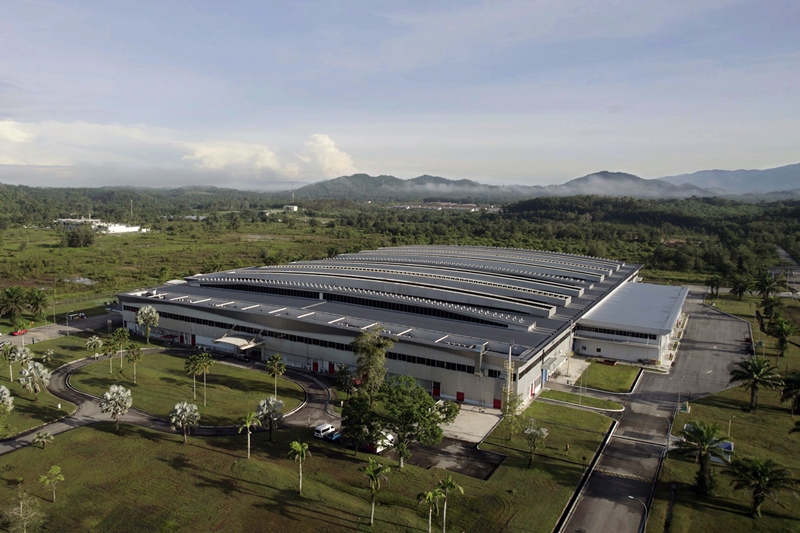
Proton has officially launched its electric vehicle (EV) production facility located in the Automotive High Technology Valley (AHTV) of Tanjung Malim.
The launch ceremony was officiated by Malaysia’s Prime Minister, YAB Dato’ Seri Anwar Ibrahim, and was also attended by the Chief Minister of Perak, Dato’ Seri Saarani Mohamad; the Minister of Transport, Anthony Loke Siew Fook; and the Minister of Investment, Trade, and Industry, Tengku Zafrul Tengku Abdul Aziz.
With operations commencing this month, the EV factory will serve as an assembly site for various models from the Global Modular Architecture (GMA) platform.
The first model to be assembled at this factory will be the Proton e.MAS 7 electric SUV, followed by the Proton e.MAS 5 in due course.
Initially, the factory will have a production capacity of up to 20,000 units per year, with the ability to scale up to 45,000 units per year depending on domestic and international demand.
This factory is also expected to generate over 200 job opportunities for the local community.
Proton’s electric vehicle (EV) manufacturing plant in Tanjung Malim is nearing completion and is set to begin operations this September.
Within six months of the groundbreaking ceremony held in February, the construction of this facility has reached 90.4%, with equipment installation at 83.5%, resulting in an overall project progress of 86.9%.
The factory will be used for assembling various models from the Global Modular Architecture (GMA) platform, starting with the Proton e.MAS 7, followed by the e.MAS 5.
With an initial production capacity of 20,000 units per year, the facility can expand to accommodate up to 45,000 units in line with the growth of domestic and international demand.
To facilitate this, each production line can be enhanced with several stations featuring a modular testing line capable of supporting platform variations or the production of multiple model types.
Logistics, utilities, storage systems, and digital traceability tools have also been optimized to support scaling for various models for both local and export markets.
Unlike the existing factory, this EV production facility has a new layout specifically designed for battery assembly, high-voltage safety measures, and electrical testing processes.
Proton is also training 30 non-executive workers with Malaysian Skills Certificate (SKM) and diploma backgrounds before the full-scale production begins this September.
This EV factory is expected to generate over 200 new job opportunities for the local community, particularly in the fields of EV industrialization and technical services.
Additionally, Proton is collaborating strategically with Politeknik Sultan Azlan Shah (PSAS) to strengthen local talent, where Proton contributes technical syllabus input and supports internship initiatives.
Geely, as Proton’s partner, provides technical guidance on the production systems, assists in equipment selection, and positions experts to support installation and trial testing.
Furthermore, Geely facilitates overseas training for Proton staff to ensure the new facility meets global EV manufacturing standards.
According to Wan Yousry bin Mohamed, Chief Manufacturing Engineer at PROTON, “This factory represents PROTON’s transformation and our unwavering commitment to a sustainable, high-tech future.
“We are also laying the groundwork for Malaysia’s leadership in the regional EV landscape by strategically expanding our EV offerings into new international markets. This is a monumental step for both the company and the country, and we are excited to see the first Malaysian-made EV roll off the production line and onto our roads,” he added.
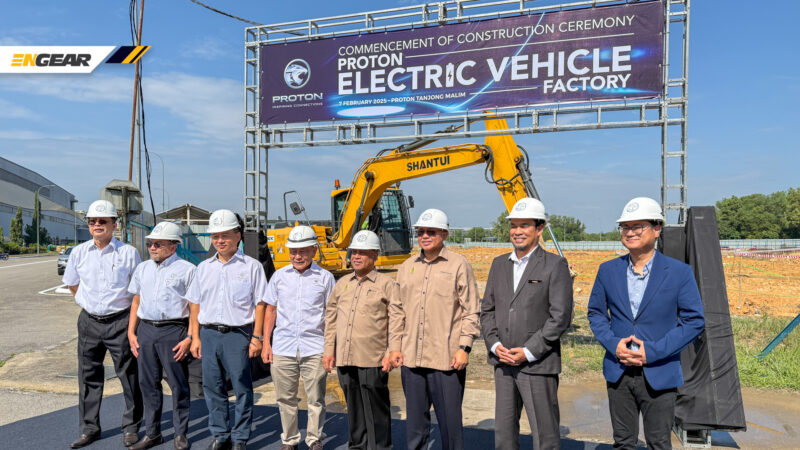
Today marked the groundbreaking ceremony for the construction of the first phase of Proton’s electric vehicle (EV) assembly plant, which is located in the high-tech facility in Tanjung Malim.
With an investment of RM82 million, the first phase of this EV assembly plant is expected to be completed by the end of 2025, with an initial production capacity of approximately 20,000 units per year.
The plant will serve as the assembly location for various types of new energy vehicles (NEVs) for both the domestic and export markets, based on the Global Modular Architecture (GMA) platform, starting with the Proton e.MAS7 model.
Various smart manufacturing technologies will be employed to ensure the plant is ready for NEV production, including robotics, cloud-based factory management, the Internet of Things (IoT), and technologies related to Industry 4.0.
At the same time, Proton’s new plant is expected to create over 200 new job opportunities for the local community.
Proton has also planned for a second phase of production as preparation for the increasing demand for EVs both domestically and internationally, with production capacity set to rise to 45,000 units per year.
According to Dr. Li Chunrong, CEO of Proton, “PROTON is transitioning to become an OEM that offers both Internal Combustion Engine (ICE) and EV models as we established PRO-NET to sell smart vehicles before launching the Proton e.MAS 7.
“With the experience we have gained over the past few years in all aspects of these vehicles and customer needs, today we take the next step in realizing our dream of producing and developing EV models in Malaysia.
“The vehicles manufactured at this new plant will meet the needs of customers in the local and export markets and will help drive the growth of the EV market.
“Once completed, production at this new facility will focus on the Proton e.MAS 7 and future NEV offerings as PROTON expands its model range. Ultimately, we hope our success will create a modern and capable automotive ecosystem to encourage more OEMs to consider Malaysia and AHTV as a regional base for EVs,” he further stated.
PERAK Mentri Besar Datuk Seri Saarani Mohamad said that the state government has agreed to provide a location for the construction of a university in Proton City, Tanjung Malim, as proposed by Zhejiang Geely Holding Group.
According to Saarani, the matter was discussed two weeks ago, during the company’s senior management visit to Perak.
“During the discussion, they asked us to provide a location for the development of the university, and at the same time, we have suggested several locations that we feel are suitable.
“However, no specific period has been set for the construction of this university, as well as other details,” he said.
Saarani added that the construction of the university was seen as significant, especially in providing job opportunities to various levels of society, especially the youth.
“In other words, the opening of this university will usually make a place a new development centre. So you can imagine all the possibilities,” he said.
In October, Geely and DRB-Hicom signed a joint venture agreement for the development of the Automotive Hi-Tech Valley (AHTV) in Tanjong Malim, Perak, which is expected to attract RM32bil in investments.
Malaysia’s Leading Automotive News | ENGEAR ENGLISH