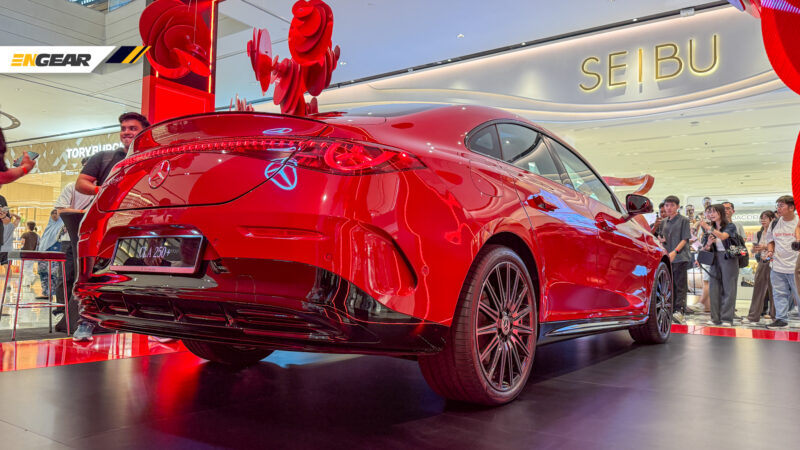
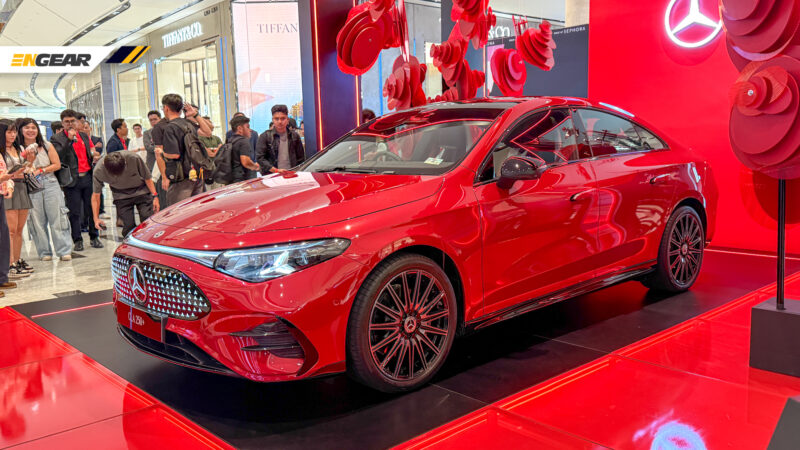
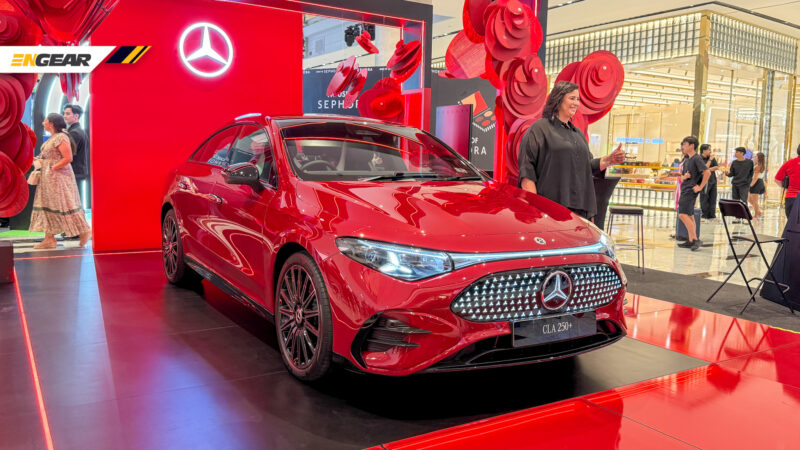
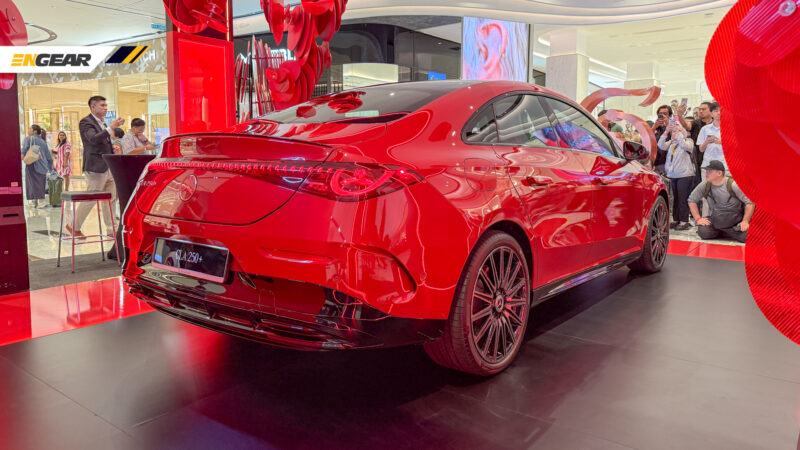
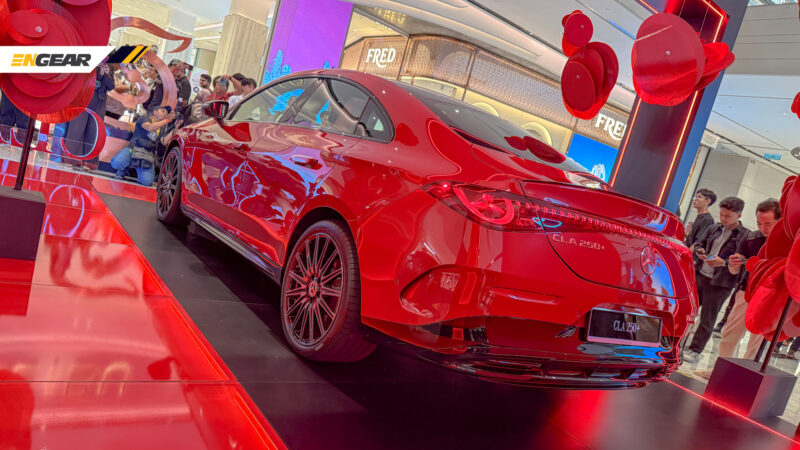
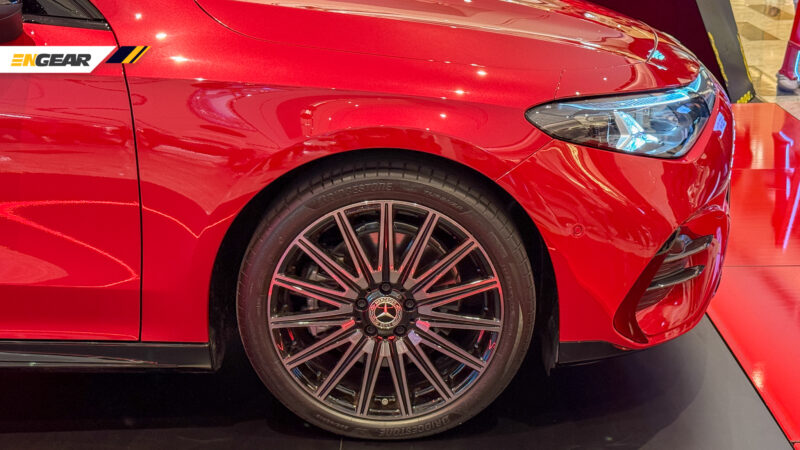
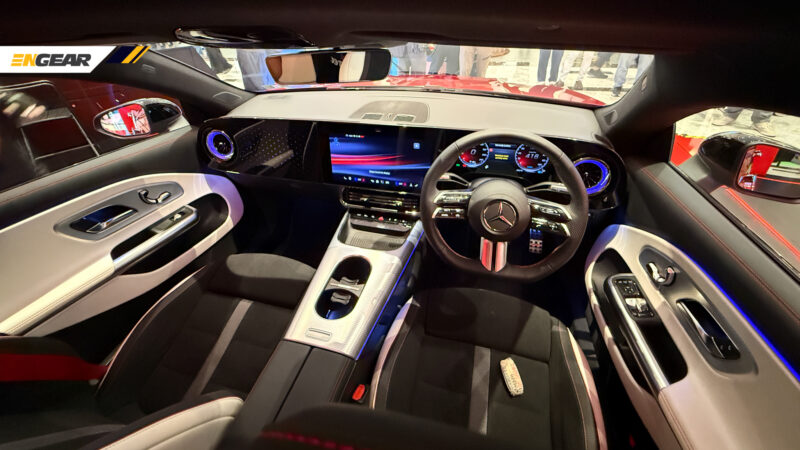
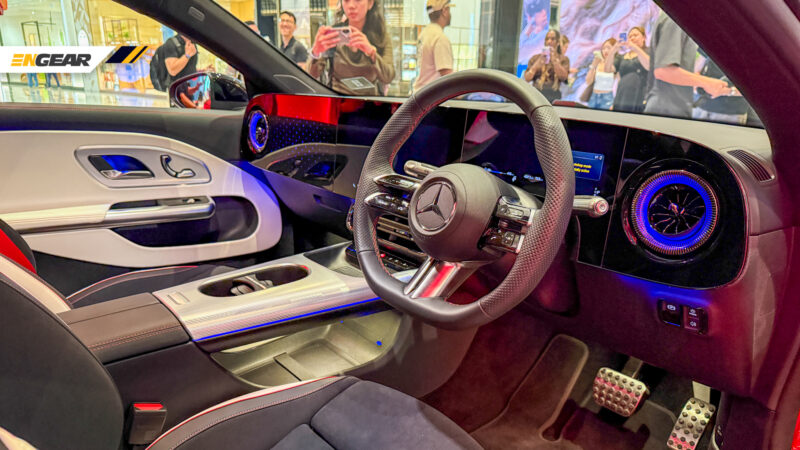
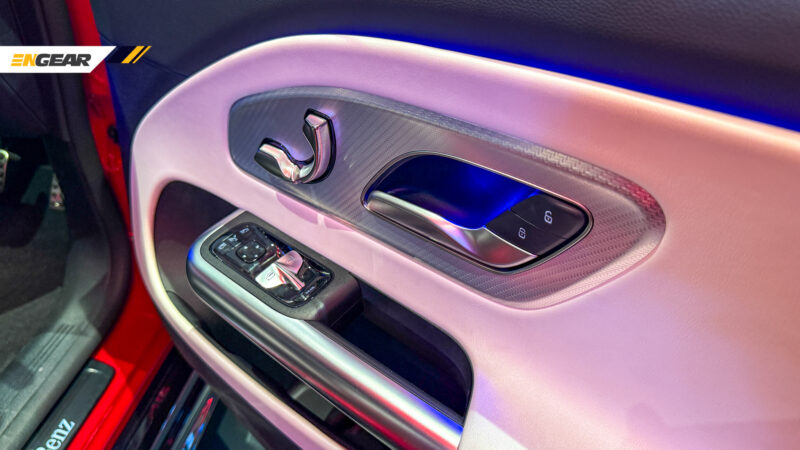
After being previewed earlier this year, Mercedes-Benz Malaysia has officially launched the all-new CLA 250+ 2026.
This brand-new electric sedan is priced from RM274,888 on-the-road without insurance.
The first 100 customers who place a booking for the new CLA or GLC electric models will receive an exclusive invitation to the Mercedes-AMG F1 Party.
Powertrain
The CLA 250+ features a single rear-mounted electric motor, producing 272 hp and 335 Nm of torque.
Paired with a 2-speed automatic transmission, the CLA 250+ accelerates from 0–100 km/h in 6.7 seconds and reaches a top speed of 210 km/h.
Battery & Charging
Equipped with an 85 kWh NMC battery, the CLA 250+ delivers up to 792 km of driving range on a full charge (WLTP).
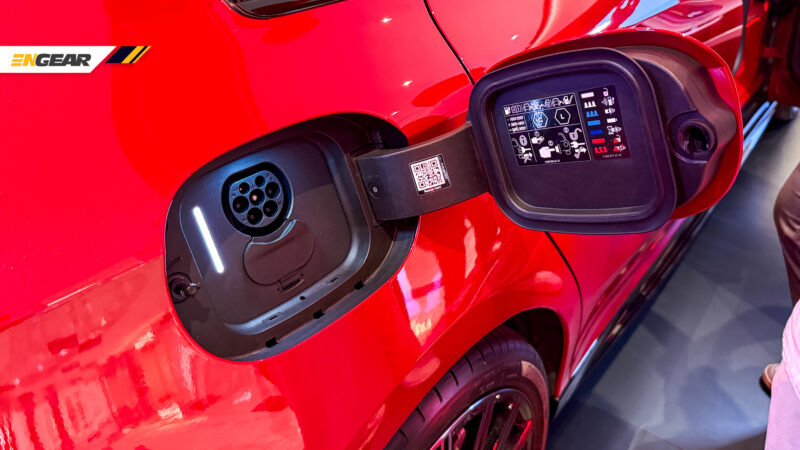
Thanks to its 800-volt electrical architecture and 320 kW DC fast-charging capability, owners can add up to 325 km of range in just 10 minutes.
Dimensions
As a compact sedan, the CLA measures 4,723 mm long, 1,855 mm wide, 1,468 mm tall, with a 2,790 mm wheelbase.
Compared to the previous generation, the new CLA is 35 mm longer, 25 mm wider, and offers a more spacious cabin.
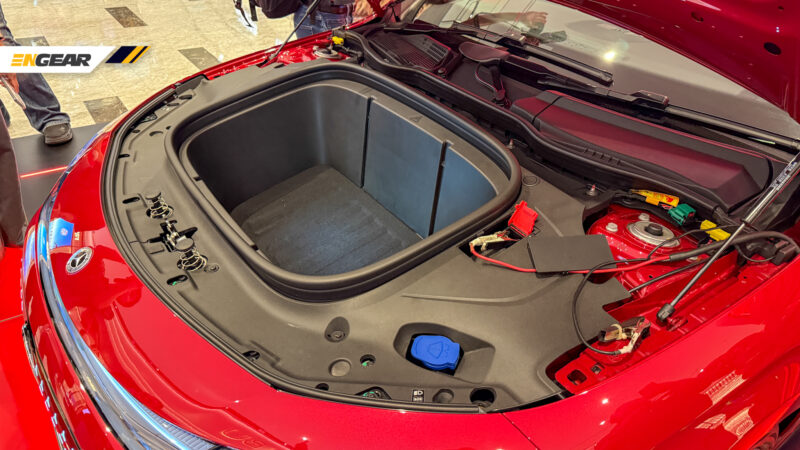
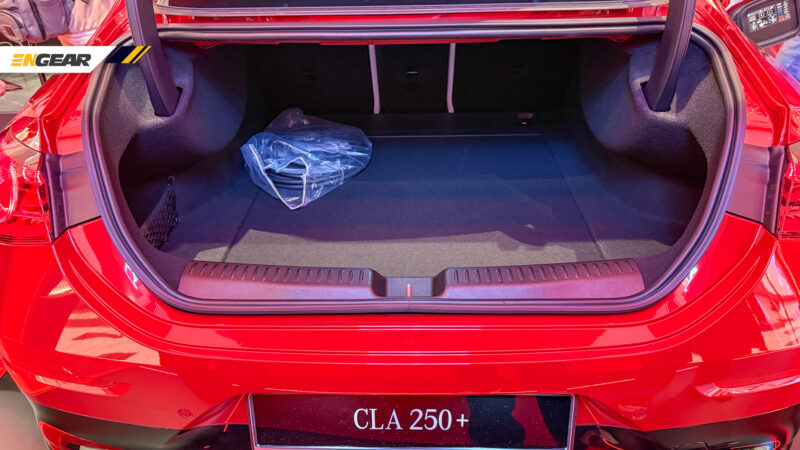
For the first time in a Mercedes-Benz model, the CLA provides a front cargo compartment (frunk) with 101 litres, complementing the 405-litre rear boot.
Exterior
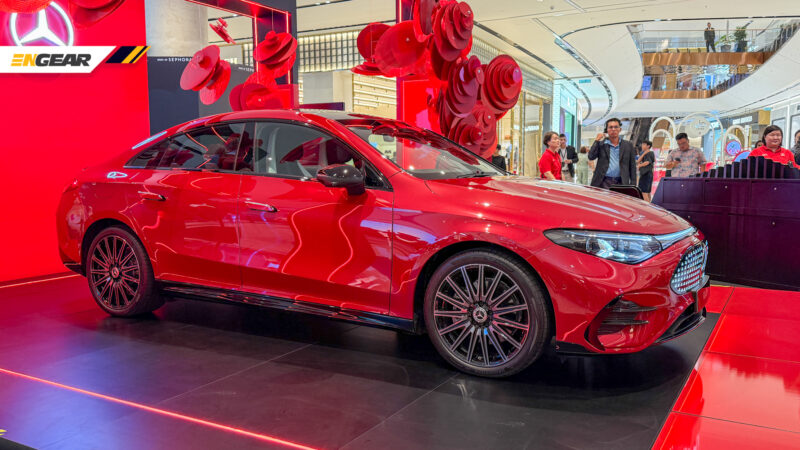
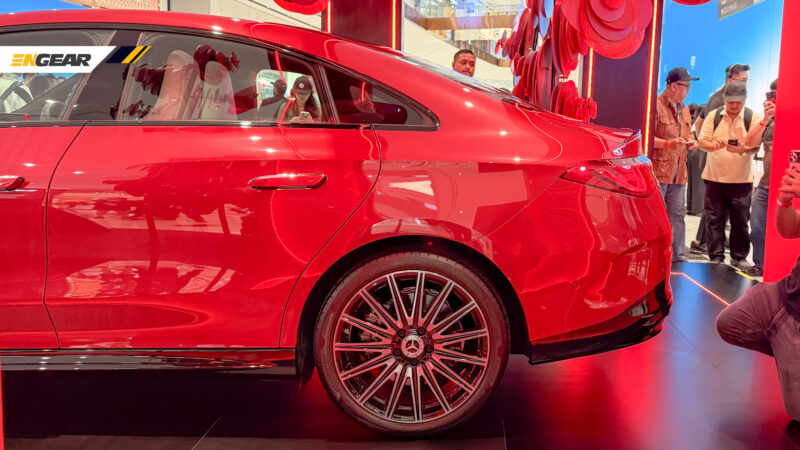
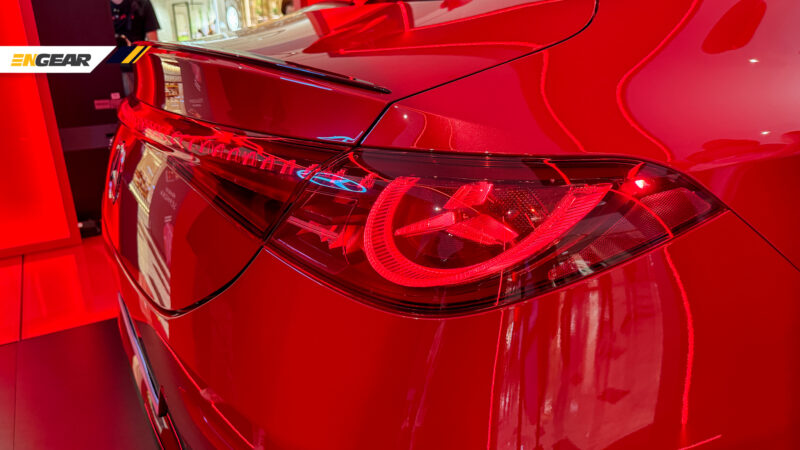
The CLA’s sporty exterior is defined by short overhangs, a GT-style rear design, and a long wheelbase.
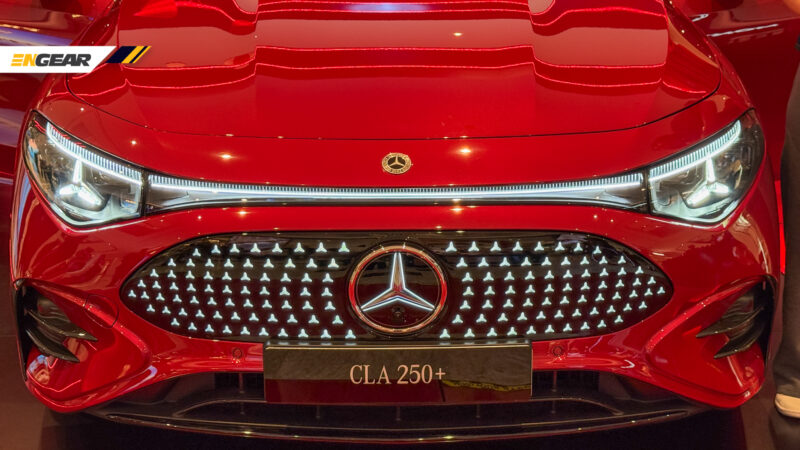
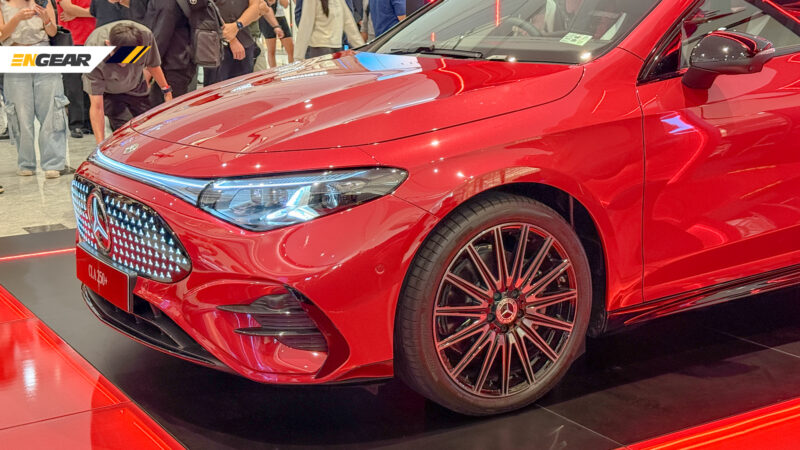
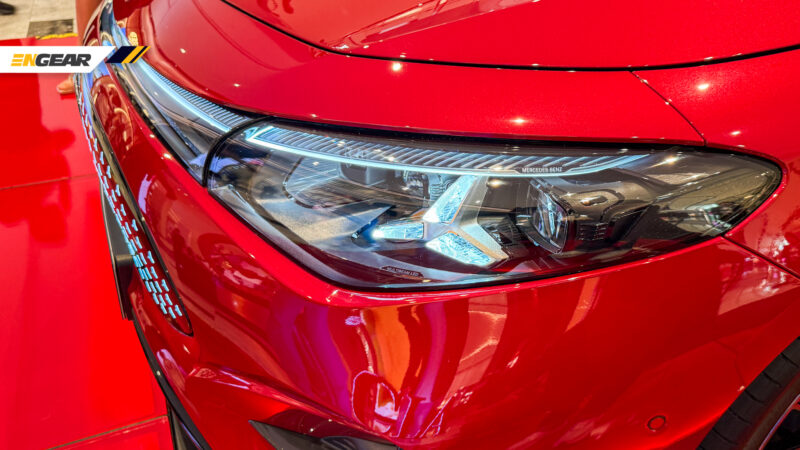
At the front, the grille panel is decorated with 142 illuminated three-pointed star LEDs.
The signature Mercedes star motif also appears within the front and rear lighting units.
The AMG Line exterior package adds aggressive front and rear bumpers, along with 19-inch AMG wheels.
Interior
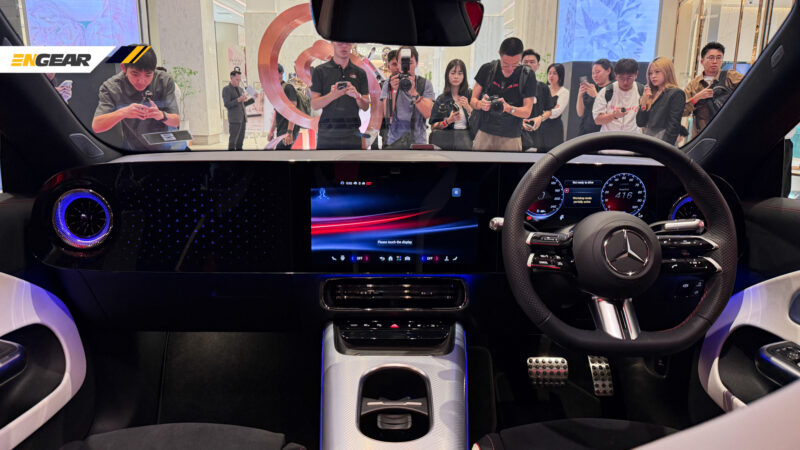
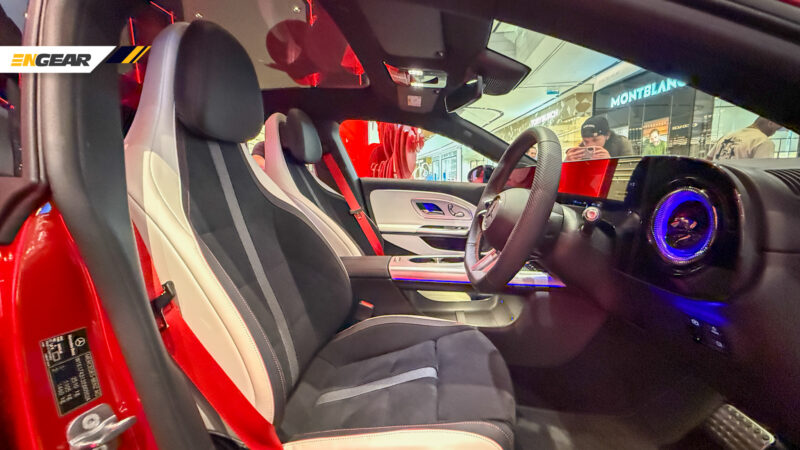
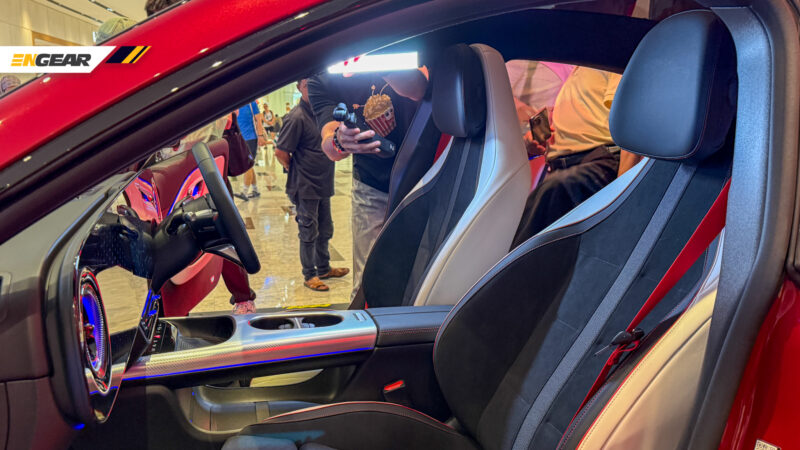
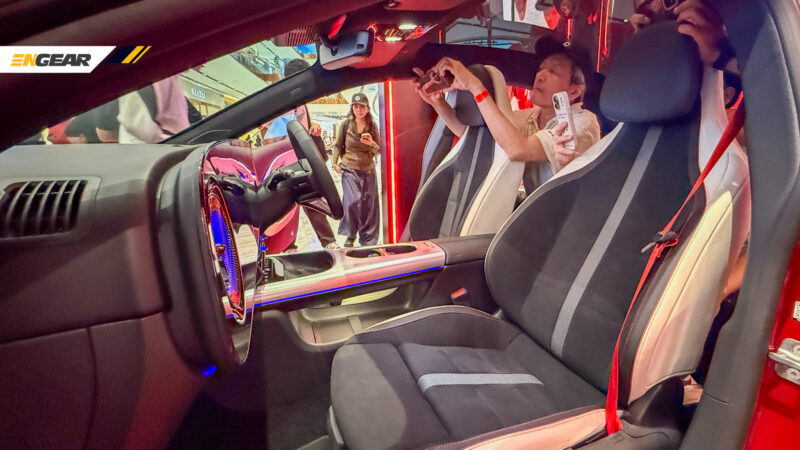
Inside, the CLA is fitted with the wide MBUX Superscreen, consisting of a 10.25-inch digital cluster and two 14-inch displays.
Apple CarPlay and Android Auto are supported.
The MB.OS operating system integrates AI features powered by ChatGPT, Microsoft Bing, and Google Gemini for navigation-related queries.
Other interior features include:
Nappa leather-wrapped sport steering wheel
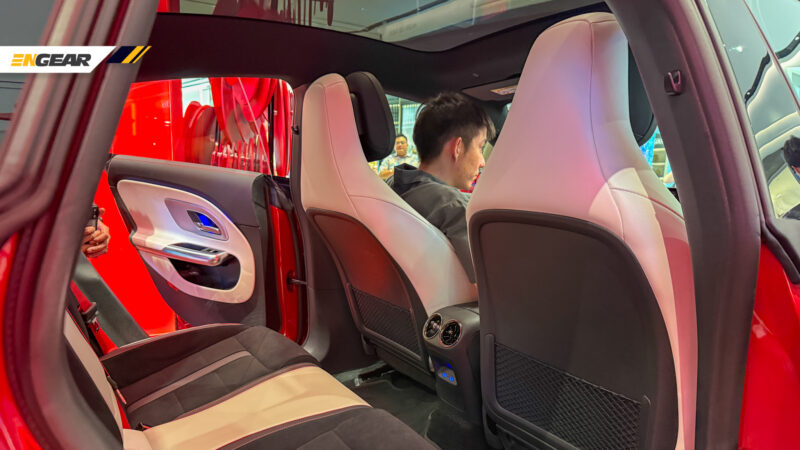
AMG Line sports seats in Artico leather/microfiber Microcut
Ambient lighting system
Anthracite trim
Selfie and video camera
Safety
Safety equipment includes eight airbags (including a centre airbag), tyre pressure monitoring, and the MB.Drive Standard suite, which offers:
Autonomous emergency braking
Distronic adaptive cruise control
Lane keeping assist
Blind spot monitoring
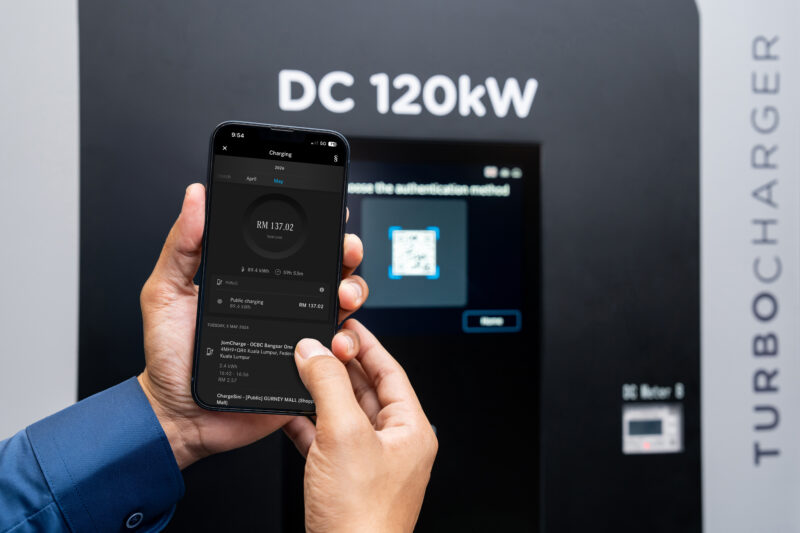
MB.Charge Public
Mercedes-Benz Malaysia also announced the MB.Charge Public charging network, available across Malaysia and Singapore.
It provides access to 10,000 charging points from various charge point operators (CPOs), including:
The much-anticipated hybrid sedan, the Toyota Vios HEV GR Sport has finally hit the Malaysian market.
It was officially launched by UMW Toyota Motor earlier this year, priced at RM109,900 for the hybrid GR Sport version. This is only RM6,000 more than the standard 1.5 HEV model, or RM13,000 above the petrol version of the Vios.
Unlike previous offerings of the Vios GR Sport, this new model comes with an essential component—a hybrid heart.
Hybrid vehicles are often closely associated with fuel savings, so what benefits does the Vios HEV GR Sport offer?
Differences Between Vios HEV and the Standard Version
The standard Vios is equipped with a 1.5L 2NR-VE engine that produces 106 PS at 6,000 rpm and 138 Nm at 4,200 rpm.
In contrast, the hybrid Vios features a fourth-generation hybrid system that includes:
1.5L 2NR-VEX Atkinson cycle engine, 91 PS at 5,500 rpm, 121 Nm at 4,000 rpm
Electric motor: 80 PS/141 Nm
Lithium-ion battery pack, 4.3 Ah
e-CVT transmission
The total power output is approximately 111 PS, which drives the front wheels.
On paper, the power increase isn’t drastic. However, the electric motor provides a more vigorous initial acceleration compared to the petrol model. The benefit? You can accelerate more quickly from highway exits to merge into the main traffic flow.
While engine noise is still present when the pedal is pressed to the floor, the cabin gradually quiets down once your desired speed is achieved.
Enhanced Driving Experience
It’s not just the power boost that makes this sedan feel more exciting. The Vios HEV GR Sport features a more responsive and slightly heavier EPS steering system compared to the standard model. This makes handling feel more stable, especially at higher speeds.
The braking system has also been tuned for earlier engagement, meaning you won’t have to slam on the brakes and hope the car comes to a complete stop.
What’s most appreciated is the GR Sport suspension tuning. Compared to the regular Vios, which is already a pleasure to drive, the sportier suspension setup gets two thumbs up automatically. As with any GR Sport model I’ve tested before, this Vios strikes a perfect balance between sporty driving dynamics and comfort.
Adding to this, the Vios HEV GR Sport is fitted with Continental PremiumContact C tires that provide enhanced grip—like a delicious lunch made even better with sambal tempoyak and fresh ulam to enhance the flavor.
Thanks to the harmonious interplay of these systems, drivers can enjoy a more thrilling driving experience without breaking the bank. Not all enjoyment comes solely from horsepower; sometimes, a simple and harmonious setup can bring a smile.
Words alone can hardly capture the exceptional joy offered by the Vios HEV GR Sport; you need to experience it for yourself.
Hybrid with EV-Like Behavior
A notable advantage of this model is its ability to drive in zero-emission mode. Although it lacks a larger battery pack, Toyota’s fourth-generation hybrid system allows for operation without a drop of petrol under certain conditions.
This function is particularly useful in urban settings or when searching for parking in shopping centers. I especially appreciate the percentage display of zero-emission driving recorded every time the vehicle is turned off. This feature encourages more mindful and economical driving.
Engine vibrations are also minimal, especially during transitions between power and EV modes.
Cabin Features
Inside, the Vios HEV GR Sport comes equipped with:
Leather/fabric seats
10.1-inch Display Audio screen, larger than before
EV Mode button
64-color ambient lighting
Hybrid-specific display for the digital cluster
Based on my experience, this brand-new display offers stable functionality, including support for Apple CarPlay and Android Auto. However, its large (and tall) size may obstruct the driver’s view if they prefer a lower seating position.
After all, this is a sporty car; you wouldn’t want to sit like it’s an SUV, right?
The leather/fabric seats are comfortable for long journeys and hold drivers securely during spirited driving. The button clusters on the steering wheel and center console are user-friendly. However, the 360-degree camera system feels outdated, especially due to its non-HD resolution for 2026.
Practicality
Due to the relocation of the 12V battery to the rear, the cargo space in the Vios HEV GR Sport is limited to 460 liters. This is adequate for daily necessities but may not suffice for longer items, as the rear seats do not fold like in other sedan models.
The good news is that the Vios HEV GR Sport now comes with a full-size spare tire in the rear, a feature highly valued by many drivers in Malaysia.
Safety Features
As standard, the Vios HEV GR Sport includes six airbags and Toyota Safety Sense features:
Pre-Collision System (PCS)
Autonomous Emergency Braking (AEB)
Lane Departure Alert (LDA)
Adaptive Cruise Control (ACC)
Forward Movement Warning (FMW)
High Beam Assist (HBA)
Blind Spot Monitoring System (BSM)
Conclusion
The Toyota Vios HEV GR Sport is not just a Vios with a GR emblem slapped on it. Compared to its competitors, it offers a more convincing driving experience, a hybrid system proven for its efficiency, and a balance of sporty driving and comfort.
It’s perfect for those seeking a daily sedan infused with a bit of extra character to make life more exciting. Life is too short to enjoy boring things (read: cars), making this ‘sportiest sedan’ a worthy consideration.
After 12 years, Nissan is finally ready to replace the existing Skyline sedan with a new generation model.
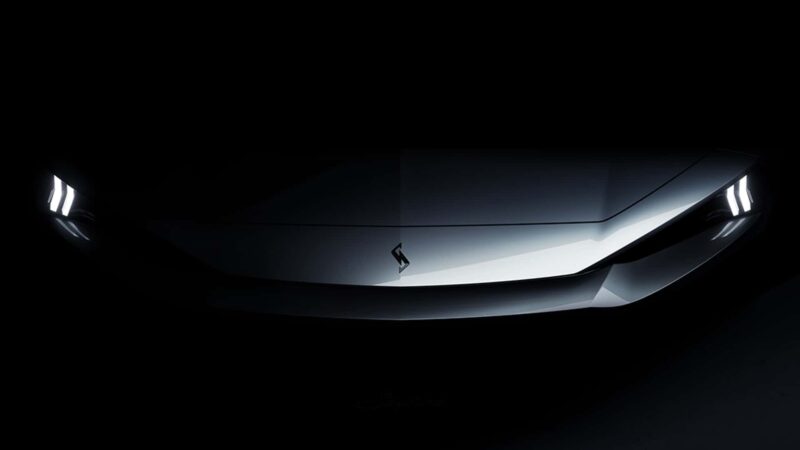
The Japanese manufacturer has also revealed several teaser images showcasing the front and rear design of this sporty sedan.
Inspiration from Previous Models
According to Nissan’s global design director, Alfonso Albaisa, the new Skyline draws inspiration from earlier versions of the model.
The design influence from previous sedans, particularly the Hakosuka, is evident in the angular and aggressive headlight shape.
The front also features an ‘S’ logo.
The rear showcases dual round taillights, accompanied by the ‘Skyline’ lettering on the side fender.
Currently, no further details have been provided regarding the engine specifications for the new Skyline model.
Is a GT-R Version Coming?
Unfortunately, the arrival of the new generation Skyline does not indicate the introduction of a new GT-R model.
This is because the GT-R has been a standalone high-performance nameplate since it separated from the R34 model and has been used on the R35 since 2007.
Three New Models Besides Skyline
Nissan Juke EV
Nissan Rogue e-Power
Nissan XTerra
At the same time, Nissan has revealed three entirely new models: the Nissan Juke EV, Nissan Rogue/X-Trail e-Power, and Nissan XTerra.
The Nissan Juke EV is built on the CMF-EV platform and features a significantly more radical design.
The Nissan Rogue e-Power comes equipped with a powertrain system consisting of a 3-cylinder engine and two electric motors.
Lastly, the Nissan XTerra, a body-on-frame SUV, is set to arrive in 2028, boasting an aggressive front design.
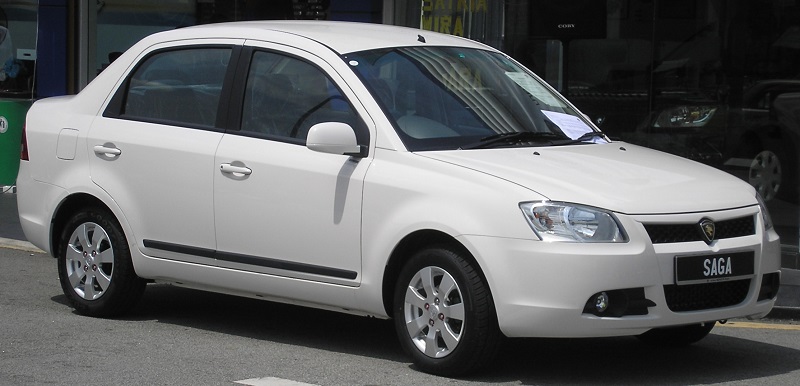
First introduced in 1985, the Proton Saga remains one of the most important models in Malaysia’s automotive landscape.
The Saga is not merely a mode of transport from point A to point B — it’s a necessity for those who want a comfortable, modern, and safe car.
The third facelift (MC3) launched last year, arrived with a strong package that easily embarrasses its rivals.
This was proven when Saga sales surpassed the Perodua Bezza throughout January 2026.
We had the chance to test-drive the Saga, and here are our thoughts on Proton’s new sedan.
A More Premium Saga Design
This entry-level sedan has gone through three design eras:
Mitsubishi’s boxy design (1985)
Proton’s original design (2008)
Geely-influenced design (2025)
There’s no denying that the new Saga offers a more sophisticated image, especially with a front fascia aligned with Proton’s other X models (X70 & X90).
Previously, DRLs came as a separate package, but the new Saga integrates DRLs into the main headlamp unit.
It also features bright LED projector headlamps for night driving.
The Saga’s image is further elevated with full-width LED taillights, matching current automotive design trends.
Unfortunately, the sedan’s side profile still reveals that it sits on the existing platform.
New Saga owners should probably thank the Proton Savvy for that.
A More Advanced and Premium Cabin
Since the original dimensions haven’t changed much, the cabin doesn’t feel significantly more spacious than before.
The dashboard layout has been refreshed.
Our Premium variant test unit comes with a 7-inch digital instrument cluster and a 9-inch infotainment screen in the centre.
Physical climate control buttons are retained, but with a simpler design and smaller knobs and switches.
There’s no denying that the new Saga delivers a more premium-feeling experience for an entry-level sedan.
The climate control knobs don’t feel cheap when turned, and the indicator/wiper stalks feel solid during use.
The air-conditioning system is excellent — a long-standing Proton trademark.
Another point, Saga now supports Apple CarPlay and Android Auto. Wirelessly.
The audio system also delivers pleasant sound quality, complementing the quiet cabin during drives.
Driving Experience
One of the biggest highlights of the new Saga is its new 1.5-litre i-GT engine.
This 1,499 cc engine produces 120 PS @ 6,100 rpm and 150 Nm @ 4,000 rpm — far more powerful than the old Campro’s 94 hp/120 Nm.
Fuel efficient? Absolutely.
A full tank can take the Saga more than 500 km, which is more than sufficient.
Fuel consumption is recorded at around 6.5 litres per 100 km.
Ride and handling have also been improved, making the Saga more exciting to drive, especially on winding roads.
The MacPherson strut and torsion beam suspension tuning feels just right — sporty yet still prioritising comfort.
Rough surfaces and vibrations are well-filtered, giving the Saga a surprisingly premium feel even when the road outside resembles the moon’s surface.
Engine noise no longer roars like the old Campro days.
The naturally aspirated i-GT engine produces only a low-frequency hum that doesn’t distract the driver even under heavy throttle.
Saga Is Not a Perfect Car
Despite the many positives, the Saga isn’t perfect.
A few things need attention to make it even better:
First, the CVT transmission response can be frustrating, especially at low rpm.
At normal speeds it’s fine, but the Saga can test your patience on roads with many traffic lights. Or Shah Alam, the Land of Roundabouts.
It’s hard to achieve smooth driving patterns because of this.
As someone used to manual cars, the writer hopes Proton will one day offer a six-speed transmission.
Second, the brake pedal bite point feels too far forward. Not that the braking system is bad — it still stops the car effectively.
But if you plan to drive the Saga fast, keep your foot ready for anything unexpected.
Third, the tyres. The standard Atlas tyres aren’t terrible, and they’re okay in the wet, but there are better options in the market.
If you’re buying a Saga, set aside some budget for tyre upgrades if you want a more confidence-inspiring drive.
Cabin weaknesses that can be improved
A few cabin improvements would make the Saga even better:
One, the instrument cluster brightness can be lowered further — it’s too bright at night, to the point the car next to you might notice.
Two, although Saga now supports wireless Apple CarPlay and Android Auto, the Altas operating system isn’t very stable.
Sometimes it restarts on its own, which is troublesome when you’re relying on navigation.
Three, the solution to sudden CarPlay/Android Auto disconnections is using a USB cable.
But the USB port is positioned too close to your knee, making driving uncomfortable — and the Saga doesn’t even have a left footrest.
Four, the driving position feels quite high, even at the lowest seat setting.
Your eye level ends up close to the rear-view mirror height.
This makes it difficult when going up or down multi-storey car parks.
Maybe this is a preview of the upcoming Saga Cross. Maybe.
Safety: Better Than Iriz and Persona
After a long wait, Proton has finally equipped an entry-level car with all the necessary safety features.
Six airbags come standard on the Premium variant, along with advanced safety features such as:
Autonomous Emergency Braking (AEB)
Lane Departure Warning (LDW)
Rear Cross Traffic Alert (RCTA)
Rear Collision Warning (RCW)
Door Opening Warning (DOW)
Auto High Beam (AHB)
And finally, the Saga now gets Blind Spot Monitoring (BSM) — a very welcome addition. Even the Iriz and Persona don’t get this.
Saga also gets front and rear parking sensors, which are quite sensitive and annoying in traffic jams.
There’s also a speed limit warning if the system detects the car exceeding the allowed limit.
One feature worth praising is the alert reminding drivers about children (and valuables) in the back seat whenever the engine is turned off.
The sound is loud and clear to ensure no Saga owner suffers from “forgotten child syndrome.”
Lose items and you can replace them. Lose a child and regret will haunt you.
Conclusion
Looking at the package and specifications offered, the Proton Saga is no longer a model you can take lightly.
It has everything needed in an entry-level sedan — power, comfort, space, and technology that makes daily life easier.
Most importantly, it’s priced within reach for most first-time car buyers.
Just like the Iriz in 2014, the Proton Saga has now set a new benchmark for the entry-level sedan segment.
Mitsuoka Motor has announced that production of the classic compact sedan Ryugi which has been offered since 2014, will soon come to an end.
Along with this announcement, Mitsuoka has launched the Ryugi Final Edition model with production limited to just 20 units.
Special badge for 20 owners
Overall, the Ryugi Final Edition retains its classic design, featuring a vertical grille, round headlights, and chrome-plated bumpers.
The emblem on the grille and the rear cargo door is crafted using the traditional Japanese technique “Shippo-yaki,” showcasing the handmade touch that is Mitsuoka’s specialty.
Finally, each unit of the Ryugi Final Edition comes with a special closing edition badge on the rear.
This is the only distinction between the standard Ryugi model and the Final Edition.
Specifications of Mitsuoka Ryugi
The Ryugi is built on the 11th generation Corolla sedan, known as the Corolla Axio in Japan.
It measures 4,510 mm in length, 1,695 mm in width, and 1,460 mm in height.
Buyers can opt for a 1.5L NA engine (code 1NZ-FE) that produces 108 hp at 6,000 rpm and 138 Nm of torque at 4,400 rpm.
There is also a self-charging hybrid 1.5L engine version (code 1NZ-FXE) with a total power output of 99 hp.
Price
In Japan, the Mitsuoka Ryugi is priced as follows:
Proton has officially launched the 2026 Proton S70 for the local market.
Four variants are available, with the following prices:
1.5TD Executive – RM73,800
1.5TD Premium – RM79,800
1.5TD Flagship – RM89,800
1.5TD Flagship X – RM94,800
With a special launch rebate of RM5,000, the Proton S70 2026 can be purchased for as low as RM68,800.
Specifications
Among the major changes made to the S70 is the introduction of a 1.5-liter inline 4-cylinder i-GT turbo engine, replacing the original 3-cylinder engine.
This new engine produces 181 PS and 290 Nm of torque, paired with a 7-speed DCT (Dual Clutch Transmission).
Acceleration from 0 to 100 km/h is now achieved in just 7.5 seconds, with fuel consumption rated at only 5.7 liters per 100 km.
According to Proton, the S70 sedan also features Proton’s Ride & Handling tuning and enhanced Electronic Stability Control (ESC) software.
In terms of exterior design, the S70 comes with revised headlight units, daytime running lights (DRL), and 17-inch alloy wheels.
An aerodynamic kit is also available for a more stylish appearance.
The cabin is equipped with a 12.3-inch infotainment screen that now supports wireless Apple CarPlay and Android Auto.
The S70 features 13 Advanced Driver Assistance System (ADAS) Level 2 attributes, which include functions such as:
Autonomous Emergency Braking (AEB)
Lane Keeping Assistance (LKA)
Rear Cross Traffic Alert (RCTA)
Adaptive Cruise Control (ACC)
Lane Change Assistance (LCA)
Smart High Beam Control (IHBC)
Lastly, features like a 360-degree camera system and a Tire Pressure Monitoring System (TPMS) are also included.
Launch Package
For the first 2,000 customers, a special launch package is available, including:
RM5,000 rebate
Pro-Trade-In support with trade-in assistance of up to RM2,000
Volvo Car Malaysia has just launched the electric sedan, the Volvo ES90 for the local market.
Assembled at the Shah Alam plant, the Volvo ES90 is priced starting from RM339,888.
Here are some key facts about the ES90 that you need to know:
Dimensions
The ES90 measures 5,000 mm in length, 2,120 mm in width, and 1,550 mm in height, with a wheelbase exceeding 3 meters (3,102 mm), contributing to a more spacious cabin.
Standard cargo space is 424 liters, which can expand to 904 liters when the second-row seats are folded down.
The front trunk has a capacity of 27 liters.
All four wheel arches are fitted with 22-inch rims.
The drag coefficient is an impressive low of just 0.25.
Single Motor Extended Range variant
For the Malaysian market, the Volvo ES90 is available in a single variant, the Single Motor Extended Range.
This sedan is powered by a rear-wheel-drive electric motor that produces 333 hp and 480 Nm of torque.
It accelerates from 0 to 100 km/h in 6.6 seconds and has a top speed of 180 km/h.
Battery & Charging
The ES90 is equipped with a 92 kWh NCM battery pack and an 800-volt electrical architecture, allowing a range of up to 651 km (WLTP data).
This electric sedan supports AC charging at 11 kW (a full charge at 100% in 10 hours) and DC fast charging of up to 350 kW.
This means the battery can be charged from 10% to 80% state of charge (SoC) in as little as 22 minutes.
Standard features
The Volvo ES90 comes with active air suspension, headlights designed with Thor’s hammer graphics, and C-shaped LED taillights.
The cabin features include a panoramic glass roof with electrochromatic functionality, a 9-inch digital display, a center screen measuring 14.5 inches, a Bowers & Wilkins sound system with 1,610 watts and Dolby Atmos and Abbey Road Studios sound experiences, as well as a 4-zone climate control system.
The ES90 is also the first Volvo model equipped with the NVIDIA DRIVE AGX Orin computing system, featuring 5G capabilities and support for over-the-air updates.
Safety
In addition to a robust frame, the Volvo ES90 comes with seven cameras, five radars, and 12 ultrasonic sensors, as well as a system that can detect the driver’s level of attention on the road.
Safety features included in the Volvo ES90 consist of nine airbags, a collision avoidance system, automatic emergency braking, rear collision warning, blind spot information system, rear cross-traffic alert, door opening warning, and emergency stop assist.
Additionally, this sedan is equipped with a 360-degree three-dimensional surround camera system to ease maneuvering in tight spaces.
Mercedes-Benz Malaysia has recently announced the opening of bookings for the all-new 2026 Mercedes-Benz CLA electric sedan.
The vehicle is available in a single variant, the CLA 250+ with EQ Technology, with an estimated on-the-road selling price starting at RM295,888, excluding insurance.
Here are some key facts you need to know:
Powertrain
The CLA 250+ features a single electric motor with rear-wheel drive, delivering 272 horsepower and 335 Nm of torque.
Paired with a 2-speed automatic transmission, the CLA 250+ can accelerate from 0 to 100 km/h in just 6.7 seconds and reach a top speed of 210 km/h.
Battery & Charging
The CLA 250+ can travel up to 792 km on a full charge (WLTP data), thanks to its NMC 85 kWh battery pack.
With an 800-volt architecture and a DC charging capability of 320 kW, CLA owners can add up to 325 km of range in just 10 minutes.
Dimensions
As a compact sedan, the CLA measures 4,723 mm in length, 1,855 mm in width, 1,468 mm in height, and has a wheelbase of 2,790 mm.
Compared to the previous generation, this new CLA is 35 mm longer, 25 mm wider, and offers a more spacious cabin.
For the first time, a Mercedes features a front cargo space (frunk) of 101 liters in addition to a rear cargo space of 405 liters.
Exterior
In terms of exterior design, the CLA exhibits a sporty appearance, characterized by features such as short overhangs, a GT-style rear design, and a long wheelbase.
The front is adorned with a grille panel illuminated by 142 three-pointed star LEDs.
Mercedes’ star element is also present in the headlight units, both front and rear.
Interior
The interior of the CLA boasts the wide MBUX Superscreen display, which consists of a 10.25-inch digital cluster screen and two 14-inch screens.
The MB.OS operating system also offers AI features supported by ChatGPT-4, Microsoft Bing, and Google Gemini for navigation-related queries.
More details about this model will be revealed ahead of its upcoming official launch.
Introducing the largest vehicle model produced by smart, the sedan #6 EHD.
In terms of dimensions, the smart #6 EHD measures 4,906 mm in length, 1,922 mm in width, and 1,508 mm in height.
It also boasts a wheelbase of 2,926 mm, making it the longest compared to existing Smart models.
This sedan is powered by the EHD NordThor Hybrid 2.0 plug-in hybrid system, which includes a 1.5-liter turbo engine producing 161 hp, an electric motor, a three-speed DHT transmission, and a lithium iron phosphate battery.
Overall, this system can generate up to 429 hp, with a total driving range of 1,810 km and a fuel consumption rate as low as 3.9 liters per 100 km.
It is also capable of operating in EV mode for up to 285 km.
The front and rear headlights feature a sleek design without any cluttered lines or shapes.
There is a Lidar sensor housing on the roof, accompanied by side cameras positioned at the front.
smart also offers different rim designs, yellow brake calipers, and an adaptive rear wing for the sportier variants.
When we talk about flat or boxer engines, the names of two manufacturers typically come to mind: Porsche and Subaru.
This unique engine configuration offers benefits in terms of better vehicle handling due to its lower center of gravity compared to conventional engines.
You might not suspect that a popular name in China is also venturing into producing boxer engines.
That name is none other than BYD!
This news is quite surprising as BYD already has a family of engines for its plug-in hybrid (PHEV) model lineup.
This brand-new 2.0-liter turbo boxer engine will be paired with four electric motors to power the luxury sedan Yangwang U7.
Overall, it can generate up to 1,287 hp and 1,680 Nm of torque.
Acceleration from 0 to 100 km/h can be achieved in just 2.9 seconds, a truly impressive figure for a sedan weighing 3 tons!
Interestingly, the engine serves primarily as a range extender to charge the battery, which then supplies power to the electric motors.
However, under certain conditions, this engine can deliver 272 hp and 380 Nm of power directly to the rear axle.
With the help of this boxer engine, BYD was able to design the Yangwang U7 with a lower hood profile, giving the sedan a sportier appearance.
Additionally, the NVH (noise, vibration, and harshness) aspects of this sedan are significantly improved due to the reduced vibrations from the boxer engine.
With the boxer range extender, the Yangwang U7 can travel up to 966 km on a full tank and fully charged battery, while the zero-emission range can reach up to 193 km.
In China, the BYD Yangwang U7 is priced between RMB628,000 and RMB708,000 (RM367,000 to RM414,000).
Proton has officially announced the sales prices for the 2026 Proton Saga in the Malaysian market.
The following are the sale prices for each variant offered:
1.5 Standard – RM37,990
1.5 Executive – RM43,990
1.5 Premium – RM48,990
The 2026 Proton Saga is powered by a 1.5-liter inline four-cylinder i-GT engine that produces 120 PS at 6,100 rpm and 150 Nm of torque at 4,000 rpm.
There are two transmission options available: a 4-speed automatic for the Standard and Executive variants, while the Premium variant features a CVT.
In terms of dimensions, the new Saga measures 4,390 mm in length, 1,690 mm in width, and 1,525 mm in height, with a wheelbase of 2,465 mm. The turning radius is a compact 5.2 meters.
The suspension system consists of MacPherson struts in the front, complemented by a torsion beam setup in the rear.
Exterior features include LED projector headlights, LED daytime running lights, 15-inch alloy wheels (14 inches for the Standard variant), electrically adjustable side mirrors, and a full-width LED rear light.
Inside the cabin, the Saga boasts a seven-inch instrument cluster display, a nine-inch infotainment screen, support for Apple CarPlay and Android Auto, four speakers (two for the Standard variant), leatherette seat upholstery (fabric for the lower two variants), and USB charging ports.
Safety features include six airbags, ABS, EBD, Brake Assist, Electronic Stability Control (ESC), Traction Control System (TCS), Hill Hold Assist (HHA), and various Advanced Driver Assistance Systems (ADAS) such as:
Proton has officially announced that bookings for the new Saga sedan model are now open.
The 2026 Proton Saga will be available in three variants: Standard, Executive, and Premium, with estimated selling prices ranging from RM40,000 to RM50,000.
Proton is also offering exclusive rewards for customers who make reservations before the official launch.
The first 20,000 buyers who place their reservations from November 10, 2025, until the official launch date and complete their registration by December 31, 2025, will be eligible for the following offers:
Free Service Package for 1 Year or up to 20,000 km (whichever comes first)
New Touch ‘n Go Saga Limited Edition Card
Details about the 2026 Proton Saga can be found through the following link:
Bermaz Motor has announced the reintroduction of the Mazda3 with a 1.5-liter engine, featuring enhanced specifications and premium features.
This model is available in both sedan and hatchback body styles.
The naturally aspirated 1.5-liter SkyActiv-G engine can produce a power output of up to 118 hp at 6,000 rpm and a torque of 153 Nm at 4,000 rpm, driving the front wheels through a six-speed automatic transmission.
With a fuel tank capacity of 51 liters, the Mazda3 can achieve a fuel consumption figure as low as 5.8 liters per 100 km.
Included in its features are G-Vectoring Control Plus Technology, automatic LED headlights, 18-inch alloy wheels, and a keyless entry system.
The cabin offers a seven-inch TFT mid-display, a 10.25-inch infotainment screen, wireless Apple CarPlay and Android Auto support, dual-zone climate control, a wireless device charging slot, and rear air conditioning vents.
The Mazda3 also boasts leather upholstery on the steering wheel, a 10-way power-adjustable driver’s seat with memory function, a six-way manual adjustable passenger seat, paddle shifters, and a color head-up display.
Safety features include six airbags, ABS, EBD, Brake Assist, Dynamic Stability Control (DSC), Traction Control System (TCS), Hill Launch Assist (HLA), Seat Belt Reminder, ISOFIX anchors, and Auto Hold function.
It is also equipped with i-Activsense ADAS features, which include:
Adaptive Front Lighting System (AFS)
High Beam Control (HBC)
Blind Spot Monitoring (BSM)
Rear Cross Traffic Alert (RCTA)
Lane Departure Warning System (LDWS)
Lane Keeping Assist (LAS)
Driver Attention Alert (DAA)
Smart Brake Support (SBS) for front and rear
Mazda Radar Cruise Control (MRCC)
Traffic Jam & Cruise Support (CTS)
There are several color options available, including Soul Red Crystal, Polymetal Gray, Jet Black, Platinum Quartz, Deep Crystal Blue, Machine Gray, and Snowflake White Pearl.
Imported fully from Japan (CBU), the Mazda3 is now open for orders, with a starting price of RM118,900.
In conjunction with the upcoming Japan Mobility Show 2025, Toyota seizes the opportunity to unveil several eye-catching concept models.
Among them is the Toyota Corolla Concept, which is expected to herald a new chapter for the world’s best-selling nameplate.
The concept model makes its appearance in a campaign titled “To You, Toyota.”
Several details can be observed, including:
A front design resembling a more modern hammerhead shark, complete with full-width LED lights.
No traditional grille structure.
The presence of ventilation ducts on the engine hood.
A simpler rear design featuring full-width LED pixel lights, a ducktail spoiler, and the word “Corolla” in the center.
A charging port cover on the front fender.
The use of conventional side mirror designs and door handles strongly suggests that this sedan has specifications more similar to those of an actual production version.
Did you notice the charging port cover we mentioned earlier?
This provides another hint indicating that the Corolla is likely to be offered as an electric sedan, or possibly as a plug-in hybrid electric vehicle (PHEV), similar to the Prius.
More details will be revealed in the lead-up to the Japan Mobility Show 2025, which will kick off on October 29.
BYD Malaysia has just launched another electric sedan model for the local market, the BYD Seal 6 2025.
With this launch, Malaysia becomes the first international market to receive the Seal 6 after China.
Here are some key facts you need to know:
1. Platform
The BYD Seal 6 is built on the same e-Platform 3.0 used in the Sealion 7 model. It features a single rear-wheel-drive electric motor setup, with a weight distribution ratio of 48:52, contributing to sportier handling. Additionally, the Seal 6 is equipped with a MacPherson strut suspension setup complemented by a multi-link system at the rear.
2. Dimensions
The Seal 6 is categorized as a C-segment sedan, measuring 4,720 mm in length, 1,860 mm in width, and 1,495 mm in height, with a wheelbase of 2,820 mm. Its cargo capacity is 525 liters, consisting of 460 liters in the rear and a front trunk (frunk) of 65 liters. Moreover, there are up to 24 storage compartments available within the cabin of this sedan.
3. Exterior
In terms of design, the Seal 6 presents a more elegant appearance compared to the sportier Seal model. Its features include LED headlamps, semi-hidden door handles, LED taillights, and rims sized from 17 to 18 inches. The aerodynamic body design contributes to a drag coefficient as low as 0.28 Cd.
4. Interior
The cabin of the Seal 6 incorporates a simpler and more minimalist design compared to the existing Seal model. It includes an 8.8-inch digital cluster display, a 12.8-inch central screen, voice command support in four languages (English, Malay, Mandarin, Cantonese), an automatic climate control system, and CN95 and PM2.5 cabin air filters. The center console also features a 15W wireless device charging slot.
5. Variants
For the local market, there are two main variants: Seal 6 Dynamic and Seal 6 Premium.
Seal 6 Dynamic (RM100,000)
127 hp, 220 Nm
0-100 km/h in 10.9 seconds
Top speed of 160 km/h
56.64 kWh battery pack
Driving range of 485 km (NEDC data)
Six-way adjustable driver’s seat
Manual adjustment for the front passenger seat
Six-speaker audio system
Seal 6 Premium (RM115,800)
215 hp, 330 Nm
0-100 km/h in 7.5 seconds
Top speed of 180 km/h
Eight-way adjustable driver’s seat
Four-way adjustable front passenger seat
Front seat ventilation function
Panoramic roof
Eight-speaker audio system
6. Charging
The BYD Seal 6 comes with a 56.64 kWh battery pack, allowing for a driving range of up to 485 km on a full charge (NEDC data). It also supports 7 kW AC charging and DC fast charging up to 100 kW. Both variants also support vehicle-to-load (V2L) functionality of up to 6 kW.
7. Safety
As standard, the Seal 6 is equipped with six airbags, a seatbelt warning system, tire pressure monitoring system (TPMS), Auto Hold function, a 360-degree surround monitoring system, and hill-start assist.
Active safety features include automatic emergency braking (AEB), forward collision warning (FCW), lane departure warning (LDW), and high beam assist (AHB).
8. Launch Promotions
In conjunction with the Seal 6 launch, BYD Malaysia is offering warranty packages as follows:
Six-year or 150,000 km manufacturer’s warranty
Eight-year or 160,000 km drivetrain warranty
Eight-year or 160,000 km high-voltage battery warranty
Additionally, a V2L adapter and Type-2 charging cable will be offered for free.
Customers purchasing the Dynamic variant will receive a free wall charger valued at RM3,288, while those buying the Premium variant will be given the following options:
A free wall charger worth RM3,288 and an exclusive RM3,000 rebate, or
A Sime Platinum 4+ charging package for 12 months valued at RM5,000 and an exclusive RM1,000 rebate.
In addition to the launch of two AMG models, Mercedes-Benz Malaysia has announced the opening of bookings for the luxury sedan C 200 AMG Line.
This new variant is seen as offering a sportier option within the existing C-Class lineup.
Key exterior features of the C 200 AMG Line include:
AMG front apron with large air intake openings
Rear apron resembling a diffuser
Mercedes star pattern on the grille
Exhaust system with dual rear outlets
19-inch AMG alloy wheels
Additionally, Mercedes-Benz has upgraded the braking system with larger rotor dimensions.
In the cabin, there is a flat-bottomed sporty steering wheel with Nappa leather upholstery, AMG sport pedals with brushed stainless steel finishes, and AMG floor mats.
Safety features have been enhanced with a Parking Package that includes a 360-degree camera system offering a 3D bird’s-eye view.
The USB Package Plus provides up to six USB Type-C ports and two 12V sockets, all supporting fast charging for both drivers and passengers.
In terms of power, the C 200 AMG Line retains a 1,496 cc turbo engine that generates 204 hp @ 5,800-6,100 rpm and 300 Nm of torque @ 1,800-4,000 rpm, assisted by a 17 kW/200 Nm electric motor.
Acceleration from 0 to 100 km/h takes just 7.3 seconds before reaching a top speed of 246 km/h.
The starting price for the C 200 AMG Line is RM292,888 on the road without insurance. Deliveries are expected to begin in October 2025.
The introduction of the 2026 IS model puts to rest most speculation that Lexus would launch a new generation of the IS.
This is because the 2026 IS is essentially the third facelift version, following two previous iterations introduced in 2017 and 2020.
The most noticeable change is at the front, where the spindle grille structure has been redesigned, and the Lexus logo has been repositioned to the top.
This redesign gives the front bumper a more aggressive appearance.
Additionally, the IS comes with new 19-inch alloy wheels, a large rear spoiler, and the word “LEXUS” is prominently displayed on the rear.
Inside the cabin, there is a 12.3-inch digital cluster screen, a central 12.3-inch infotainment screen, a more streamlined climate control panel, and bamboo fiber trim on the center console.
Lexus has also eliminated long-standing brand staples like the trackpad and the analog clock.
The Lexus Safety System+ has been improved with ADAS functionalities that allow for hands-free driving on the highway.
Other subtle changes include a more responsive Electric Power Steering (EPS) system and solenoid-type adaptive suspension for a more comfortable ride.
The 2026 Lexus IS is offered only in the IS 300h variant (2.5L hybrid engine with 217 hp) and IS 350 (3.5L V6 engine with 314 hp), while the IS 500 with its V8 engine is unlikely to remain in the lineup following the launch of the Climax Edition model recently.
BMW Malaysia has officially announced the BMW M340i xDrive M Sport Pro sedan as a complement to the existing 3 Series lineup.
The exterior of the M340i can be enhanced with color options such as Alpine White, Black Sapphire, Arctic Race Blue, or Brooklyn Grey, accompanied by 19-inch M alloy wheels and an M Aerodynamics package that includes a rear spoiler and dual exhaust tips.
Inside the cabin, buyers can choose between upholstery colors in Tacora Red or classic Black, sports seats with memory functions, and a curved panel featuring a 12.3-inch instrument cluster display and a 14.9-inch infotainment screen powered by BMW Operating System 8.5.
Additionally, it comes equipped with special features such as M seatbelts, M Aluminium Rhombicle Anthracite trim, an anthracite headliner, and a three-spoke M steering wheel with a 12 o’clock marker.
Other features include ambient lighting, a powered glass sunroof, and a Harman Kardon audio system delivering 464W of power through 16 speakers.
The BMW M340i xDrive is powered by a 3.0-liter inline six-cylinder turbo engine that produces 387 hp and 500 Nm of torque, paired with an eight-speed Steptronic Sport transmission.
With the xDrive all-wheel-drive system, it accelerates from 0 to 100 km/h in just about 4.4 seconds, reaching a top speed of 250 km/h.
Driving performance is enhanced with an M adaptive suspension system, M differential, and variable sport steering system (VSS).
In terms of safety, the M340i is also equipped with advanced driver assistance features including Lane Departure Warning (LDW), Forward Collision Warning (FCW), Active Cruise Control (ACC), and Parking Assistant Plus.
The BMW M340i xDrive M Sport Pro is priced starting from RM388,888, excluding service and repair packages (RM26,400).
While other manufacturers have begun to neglect the sedan segment, there are still some who believe that there is a demand for such models.
One of these is Geely, which has introduced a new sedan model, the Galaxy A7.
This D-segment sedan, which will challenge the Honda Accord and Toyota Camry, is offered exclusively in a plug-in hybrid version that boasts a driving range of up to 2,100 km.
The Galaxy A7 features a PHEV setup that consists of a 1.5-liter engine, an electric motor, and a battery pack, with Geely claiming a fuel consumption rate as low as 2 liters per 100 km.
Several local media reports suggest that Geely will provide the Galaxy A7 with various LFP (lithium-iron phosphate) battery pack options, offering a zero-emission range of up to 120 km.
In terms of dimensions, the Galaxy A7 measures 4,918 mm in length, 1,905 mm in width, and 1,495 mm in height, with a wheelbase of 2,845 mm.
The exterior design of the A7, particularly the front, somewhat resembles that of the facelifted Proton Perdana that was introduced in 2016.
The headlight housing is more streamlined, contrasting with the rear units that feature more complex graphics.
As standard, the Galaxy A7 will be available with wheel sizes ranging from 17 to 19 inches.
The cabin space features a minimalist dashboard layout, highlighted by a large cluster display and infotainment screen, accompanied by physical control buttons on the center console.
This PHEV sedan is set to be officially launched this year, with an estimated selling price of around RMB 100,000 (RM 58,801), significantly cheaper than the Camry, which is priced at RMB 179,800 (RM 105,725).
Will this sedan emerge as a potential replacement for the Proton Perdana in the future?
Malaysia’s Leading Automotive News | ENGEAR ENGLISH