Tag Archives: Japan Mobility Show

2025 JMS: Toyota’s 3 new principles to achieve the vision of Mobility for All and Carbon Neutrality

Toyota’s multi-pathway approach, which has been in place for several years, goes beyond achieving carbon neutrality through modern technologies such as hydrogen fuel cell vehicles (FCEV), hybrids (HEV), plug-in hybrids (PHEV), and battery electric vehicles (BEV).

It also includes more sustainable solutions that can be adapted to local contexts, such as the use of biofuels and compressed natural gas (CNG).

By offering low-emission and zero-emission mobility solutions that are more accessible, Toyota can meet the needs of various user segments in Asia.

At the same time, it can provide lasting value benefits to individuals and society.

The three new principles being implemented by Toyota under this Multi-Pathway Approach are Best in Town, Customer Comes First, and Start by Doing.


Best in Town

This philosophy emphasizes delivering the best products and services that meet the unique mobility needs of each Asian market.

One example provided is the global IMV platform, introduced in 2002, which aims to create a platform that can support various vehicles to cater to the mobility needs of developing markets.

Akio Toyoda stated, “We cannot satisfy customers by promoting the number of vehicles; what matters is being the best in the city.”


Customer Comes First

At the Japan Mobility Show 2025, Toyota introduced its brand lineup—Century, Lexus, Gazoo Racing, Toyota, and Daihatsu—each playing a unique role based on the principle of “Mobility for All.”

This aligns with Toyota’s theme “To You,” introduced this year, emphasizing that no one should be left behind.

Ultimately, the multi-pathway approach to achieving carbon neutrality offers a variety of sustainable solution options for users.


Start by Doing

To achieve its goals, action must be taken immediately.

For this purpose, Toyota has initiated several projects in collaboration with various partners, including the Commercial Japan Partnership Technologies Corporation (CJPT), which drives the logistics industry toward an era of efficiency and carbon reduction fueled by data.

Additionally, the Toyota Mobility Foundation’s (TMF) community projects aim to improve safety, reduce congestion, and enhance accessibility.

Toyota believes that mobility is not just a mode of transportation but rather a means to access opportunities, connections, and a better quality of life.

According to Masahiko Maeda, CEO of Toyota Motor Corporation’s Asia region, “At Toyota, we believe that achieving the Mobility for All and Carbon Neutrality goals requires more than just one solution for vehicles, energy, and data.”

“We believe the future of mobility is ours to create through collaboration, shared purpose, and collective action. As a result, we can build an ecosystem that brings smiles to people across the Asia region.”

2025 JMS: Toyota aims to introduce over 10 xEVs in Asia for the next 3 years

Toyota continues to strengthen its vision of “Mobility for All,” ensuring that no one is left behind through the Multi-Pathway Approach implemented over the past few years.

In the next three years, Toyota plans to introduce more than 10 electrified vehicles (xEV) for the Asian market.

The company also announced its “30 by 30” mission, targeting a sales goal of 30 percent xEVs in the ASEAN market by 2030, which translates to over 1.5 million units sold.

This goal equates to a positive environmental impact, such as planting 25 million trees or reducing CO2 emissions by 8 million tons.

Additionally, Toyota announced plans to begin battery electric vehicle (BEV) production in Thailand and Indonesia by the end of this year.

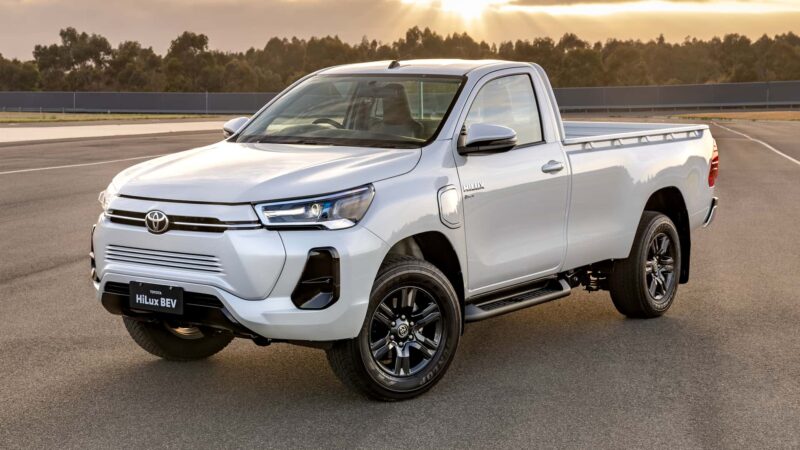
One of the planned BEV models will be built on the IMV (Innovative International Multi-Purpose Vehicle) platform, which serves as the foundation for popular models like the Hilux, Fortuner, Innova, and the Land Cruiser FJ.

Speaking of the Land Cruiser FJ, this compact model will be assembled in Thailand before being exported to the Asian market.

Through the Land Cruiser FJ, Toyota aims to offer new value in the form of Freedom & Joy that customers can enjoy in their own unique ways, while simultaneously maintaining reliability, durability, and off-road performance to meet their lifestyles.

Toyota Land Cruiser FJ: A compact off-roader derived from the Hilux platform

Ahead of the Japan Mobility Show 2025, Toyota has revealed another new model to complement its existing Land Cruiser family, named the Land Cruiser FJ.

With a more compact size, the Land Cruiser FJ is positioned as an entry-level LC without compromising on durability, reliability, and off-road driving performance.

The 2026 Land Cruiser FJ will be showcased at Toyota’s booth during the Japan Mobility Show 2025, which will take place on October 30.

Here are some key facts about the 2026 Land Cruiser FJ:


1. Platform

Unlike the Land Cruiser 300 Series and 250 Series, which are built on the TNGA-F platform, the Land Cruiser FJ uses the IMV platform.

This means that the FJ is a sibling to models such as the Hilux, Fortuner, and the first two generations of the Innova.

Although it uses a somewhat older platform, Toyota has equipped the FJ with additional underfloor braces and a stiffer body to ensure more stable handling.


2. Dimensions

The Land Cruiser FJ measures 4,575 mm in length, 1,855 mm in width, and 1,960 mm in height, with a wheelbase of 2,580 mm—significantly smaller than the Land Cruiser 300 Series and 250 Series.

When placed next to the Corolla Cross, the FJ has a length advantage of 114 mm, though its wheelbase is 58 mm shorter.


3. Exterior

The boxy design of the Land Cruiser FJ draws heavily from the Land Cruiser 250 Series design.

For example, the FJ is available with two different front-end designs, one featuring C-shaped DRLs and the other using round DRLs.

The presence of a full-size spare tire mounted at the rear enhances the rugged image of the FJ.

According to Toyota, this model also features easily replaceable front and rear bumper angles, and it can accommodate various accessories.

Among these is the Land Hopper, an electric-powered personal mobility vehicle with a three-wheeled setup that can fold and be stored in the cargo space.


4. Interior Space

The FJ’s cabin continues to showcase a large, easily accessible array of physical control buttons.

In addition to a centralized infotainment screen, a digital cluster screen is also provided for enhanced driver convenience.

In the center console, there is a physical gear knob complete with a handbrake lever and a rotary dial specifically for off-road driving.


5. Engine

The Land Cruiser FJ is powered by a 2.7-liter inline four-cylinder 2TR-FE engine that produces 163 PS and 246 Nm of torque.

This power is channeled to a part-time 4WD system through a Super ECT 6-speed automatic transmission.

Additionally, Toyota has no plans to market this “baby” Land Cruiser in markets such as the United States and Europe.

Instead, Toyota will focus the Land Cruiser FJ on markets such as Southeast Asia, Africa, Latin America, and the Middle East.

This off-road SUV will be assembled at Toyota’s factory located in Thailand.

Daihatsu Midget X: a small electric LCV concept

Daihatsu is set to showcase several concept models at the Japan Mobility Show 2025, taking place at the end of this month.

One of the models on display will be the Midget X, a small electric vehicle designed for commercial use.

The exterior design of the Midget X serves as a reference and homage to the two previous generations of the Midget.

It features round LED headlights, a curved windshield, and exposed wheel designs.

In line with its nature as a workhorse, the rear of the Midget X can be fitted with various accessories, such as storage boxes, a flatbed, an open cargo area styled like a pickup, or a dedicated workspace.

Based on teaser videos, the Midget X can also be used as a weekend track car!

For now, the Daihatsu Midget X remains a concept vehicle, but it’s not impossible that it could also become a real production model.

This Lexus LS Concept minivan features six wheels!

In addition to the two-door Century idea and the aggressively styled new-generation Corolla, Toyota has presented yet another bold concept: a minivan with six wheels!

This unique and out-of-the-box concept will be officially showcased at this year’s Tokyo Mobility Show.

Named the LS (Luxury Space?), it bears no direct relation to the LS sedan, which has been discontinued in several markets.

Instead, the Lexus LS Concept is a three-axle minivan that appears larger than the existing Lexus LM model.

Based on the single image provided, it is safe to assume that the Lexus LS Concept is an electric minivan featuring a spacious cabin, aided by its boxy shape and high roofline.

The front of this minivan showcases vertical LED lighting units, complemented by LED light strips that deliberately extend to the D-pillar to emphasize the vehicle’s height.

This six-wheeled minivan concept will also be displayed at the Japan Mobility Show 2025 later this month.

Toyota Century Coupe: ultra-luxury GT concept to challenge Rolls-Royce

In addition to the four-door sedan concept model, the Toyota Corolla, Toyota has also unveiled an ultra-luxury two-door coupe (or grand tourer) concept that will bear the Century nameplate.

Yes, you read that correctly.

Recently, Toyota has been attempting to establish the Century as one of its ultra-luxury sub-brands, set to compete with rivals such as Bentley, Jaguar, and Rolls-Royce.

Unlike its existing sedan and SUV offerings, Toyota seems determined to provide a completely new body style under the Century brand.

There are several intriguing details that we can observe from the teaser images provided, such as:

  • A fairly long engine hood
  • A conventional door opening on the right side
  • The presence of double sliding doors on the left side
  • A centrally positioned driver seat
  • No rear windows

This coupe also features layered lighting designs at both the front and rear, resembling the existing Century SUV offerings.

Additionally, there are vents on the engine hood and a partially open grille structure (complete with a phoenix emblem), suggesting that this coupe may be available with an internal combustion engine.

More details are expected to be revealed ahead of the Japan Mobility Show 2025, which will kick off at the end of this month.

Toyota Corolla Concept revealed: is this the next-gen Corolla?

In conjunction with the upcoming Japan Mobility Show 2025, Toyota seizes the opportunity to unveil several eye-catching concept models.

Among them is the Toyota Corolla Concept, which is expected to herald a new chapter for the world’s best-selling nameplate.

The concept model makes its appearance in a campaign titled “To You, Toyota.”

Several details can be observed, including:

  • A front design resembling a more modern hammerhead shark, complete with full-width LED lights.
  • No traditional grille structure.
  • The presence of ventilation ducts on the engine hood.
  • A simpler rear design featuring full-width LED pixel lights, a ducktail spoiler, and the word “Corolla” in the center.
  • A charging port cover on the front fender.

The use of conventional side mirror designs and door handles strongly suggests that this sedan has specifications more similar to those of an actual production version.

Did you notice the charging port cover we mentioned earlier?

This provides another hint indicating that the Corolla is likely to be offered as an electric sedan, or possibly as a plug-in hybrid electric vehicle (PHEV), similar to the Prius.

More details will be revealed in the lead-up to the Japan Mobility Show 2025, which will kick off on October 29.