


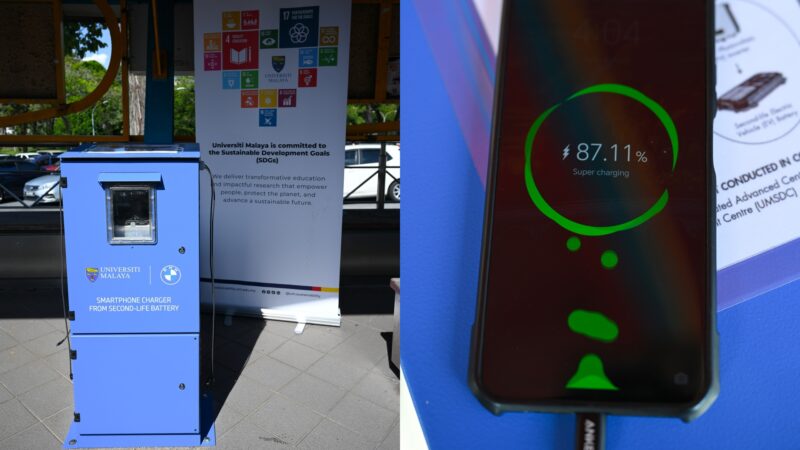
BMW Group Malaysia and Universiti Malaya (UM) have developed a solar‑powered smartphone charging station built using repurposed electric vehicle (EV) batteries.
This marks the first real‑world application completed under the RE:GENERATE x Universiti Malaya research initiative.
The project was designed by Associate Professor Dr. Tan Chia Kwang together with his research team and PhD students at the UM Power Energy Dedicated Advanced Centre (UMPEDAC).
Below are the key facts you should know:
System Components
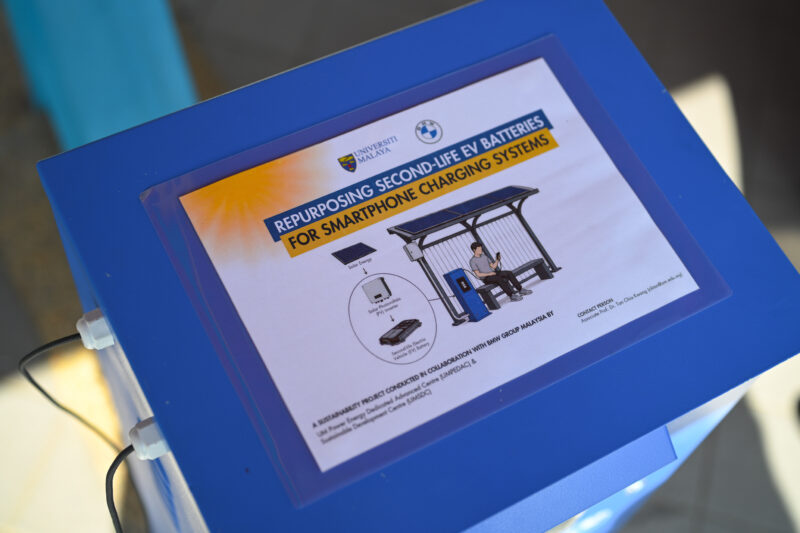
The setup consists of second‑life EV battery packs and reused solar panels, supported by:
- a solar charge controller
- a photovoltaic inverter
- a battery management system (BMS)
- USB fast chargers
Energy Storage
The 1.5 kWh system uses three BMW battery modules, each approximately 10 years old.
Dr. Tan’s team conducted detailed assessment and refurbishment work, successfully restoring 30–40% of the batteries’ original capacity.
Charging Ports
The station features four charging ports: three USB Type‑C ports and one Lightning port.
Total output is 200W, with up to 100W available per port.
Service Life
The system is expected to operate for at least five years, based on:
- current battery condition
- projected usage and discharge cycles
- real‑world usage patterns

The charging station uses low‑capacity EV battery packs, which are suitable for lighter charging needs.
Meanwhile, higher‑capacity EV battery packs are more appropriate for off‑grid rural electrification projects, such as the installation at Pos Sinderut, Kuala Lipis, Pahang.
Once these batteries reach the end of their second life, Dr. Tan’s team plans to repurpose them again for a third‑life smartphone charging station project.
This approach completes a full three‑stage battery lifecycle — from EV use, to rural household applications, and finally to public charging infrastructure.